Key takeaways
- Resolution vs. Refresh Rate: Balance resolution and refresh rate based on your GPU. If your graphics card can push 144+ FPS at 1440p, a QHD high-refresh monitor makes sense. If you’re on a budget GPU, a 1080p 144Hz panel will deliver smoother gameplay without overloading your hardware.
- Panel Type: IPS panels offer the best color accuracy and viewing angles, making them ideal for vibrant, detailed visuals. VA panels deliver deeper blacks and higher contrast for immersive single-player games. TN panels provide the fastest response times but sacrifice color quality — mostly relevant for ultra-competitive esports now.
- Response Time and Sync: Look for 1ms response time (or under 5ms for IPS) and support for AMD FreeSync or NVIDIA G-Sync. These adaptive sync technologies eliminate screen tearing and stuttering by matching the monitor’s refresh rate to your GPU’s frame output.
- Screen Size and Curve: For 1080p, stick to 24-inch displays to maintain pixel density. At 1440p, 27 inches is the sweet spot. Curved monitors (1500R to 1800R) enhance immersion on wider screens and reduce eye strain at the edges, though flat panels are fine for most setups.
- Ergonomics and Connectivity: Ensure the monitor has the ports you need — HDMI, DisplayPort, and possibly VGA for older systems. A height-adjustable stand, VESA mount compatibility, built-in speakers, and eye-comfort features like low blue light filters and flicker-free technology all add long-term value.
Finding the right gaming monitor can be overwhelming. With a dizzying array of panel types, refresh rates, resolutions, and sync technologies on the market, many PC gamers end up either overspending on features they won’t use or settling for a screen that bottleneck their graphics card. The mismatch between what your GPU can push and what your monitor can display is one of the most common — and most frustrating — pitfalls in building or upgrading a gaming rig.
Our top picks


As an Amazon Associate we earn from qualifying purchases at no extra cost to you. Ratings are shown as listed on Amazon.
This guide breaks down everything you need to know to choose the best gaming monitor for your setup and budget. We’ll walk you through the key specs that actually matter, highlight top picks across different price points and feature sets, and answer the questions buyers ask most. Whether you want an affordable entry-level display or a high-refresh curved powerhouse, these recommendations will help you make an informed decision.
🛒 Best Price Today on Amazon
Prime members get fast, free shipping on everything above, plus member-only deals. New members get a 30-day free trial — cancel anytime.
Watch: How To Choose A Gaming Monitor — Video Review
How to Choose a Gaming Monitor
- Resolution vs. Refresh Rate: Balance resolution and refresh rate based on your GPU. If your graphics card can push 144+ FPS at 1440p, a QHD high-refresh monitor makes sense. If you’re on a budget GPU, a 1080p 144Hz panel will deliver smoother gameplay without overloading your hardware.
- Panel Type: IPS panels offer the best color accuracy and viewing angles, making them ideal for vibrant, detailed visuals. VA panels deliver deeper blacks and higher contrast for immersive single-player games. TN panels provide the fastest response times but sacrifice color quality — mostly relevant for ultra-competitive esports now.
- Response Time and Sync: Look for 1ms response time (or under 5ms for IPS) and support for AMD FreeSync or NVIDIA G-Sync. These adaptive sync technologies eliminate screen tearing and stuttering by matching the monitor’s refresh rate to your GPU’s frame output.
- Screen Size and Curve: For 1080p, stick to 24-inch displays to maintain pixel density. At 1440p, 27 inches is the sweet spot. Curved monitors (1500R to 1800R) enhance immersion on wider screens and reduce eye strain at the edges, though flat panels are fine for most setups.
- Ergonomics and Connectivity: Ensure the monitor has the ports you need — HDMI, DisplayPort, and possibly VGA for older systems. A height-adjustable stand, VESA mount compatibility, built-in speakers, and eye-comfort features like low blue light filters and flicker-free technology all add long-term value.
The Best Gaming Monitors Reviewed
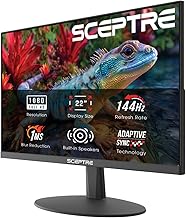
Sceptre 22-Inch 1080p 144Hz Gaming Monitor
This compact 22-inch Sceptre display is an excellent budget entry point for 1080p gaming, offering a 144Hz refresh rate and built-in speakers. It’s a practical pick for smaller desks, secondary PCs, or anyone building a first gaming setup without breaking the bank.
SANSUI 27-Inch Curved 240Hz Gaming Monitor
With a 1500R curve, 240Hz refresh rate, and 1ms response time, this SANSUI monitor targets competitive gamers who want maximum speed and immersion. The 130% sRGB color coverage and HDR support add visual punch, making it a strong all-around value for high-refresh 1080p play.
Samsung 27″ Odyssey G5 QHD 180Hz
The Samsung Odyssey G5 delivers a sharp 1440p resolution paired with a 180Hz refresh rate, striking an ideal balance for mid-range to high-end GPUs. Features like HDR10, a height-adjustable stand, Black Equalizer, and Auto Source Switch+ make it a well-rounded, premium-feeling option.
Acer Nitro 27 QHD IPS 180Hz
This Acer Nitro monitor pairs a QHD IPS panel with a blazing 0.5ms response time and 180Hz refresh rate, making it one of the fastest 1440p IPS displays in its class. With 95% DCI-P3 coverage, FreeSync support, and a VESA-mountable design, it’s built for both competitive and visually rich gaming.
Samsung 27″ Essential S3 Curved 100Hz
The Samsung Essential S3 is a solid choice for casual gamers and office crossover users, offering a 1800R curved FHD panel at 100Hz with a dedicated Game Mode. Advanced Eye Comfort technology makes it comfortable for long sessions, though competitive players may want a higher refresh rate.
Frequently Asked Questions
Is 144Hz enough for competitive gaming?
For most players, 144Hz is more than sufficient and delivers a noticeably smoother experience than 60Hz. Serious esports competitors may benefit from 240Hz, but the diminishing returns are significant unless you have the GPU and reflexes to match.
Should I choose 1080p or 1440p for gaming?
It depends on your GPU. If your graphics card consistently delivers 100+ FPS at 1440p, choose QHD for the sharper image. If you’re prioritizing maximum frame rates on a budget GPU, 1080p at high refresh rates is the better call.
Are curved monitors better for gaming?
Curved monitors can enhance immersion and reduce edge distortion on larger or wider screens, which is especially noticeable on 27-inch and above panels. Flat monitors remain perfectly fine and are often preferred by some competitive players for their predictable geometry.
Do I need FreeSync or G-Sync?
Adaptive sync — whether AMD FreeSync or NVIDIA G-Sync — significantly reduces screen tearing with minimal performance cost. Most modern monitors support FreeSync, which works with both AMD and recent NVIDIA GPUs, making it a must-have feature rather than a luxury.
Final Thoughts
For the best overall balance of resolution, speed, and features, the Samsung Odyssey G5 QHD 180Hz stands out as the top pick. Competitive gamers who prioritize raw speed should consider the SANSUI 27-Inch Curved 240Hz, while budget-conscious builders will find the Sceptre 22-Inch 144Hz monitor a reliable, affordable starting point.