Key takeaways
- Best 32 4K monitors: five 32-inch 3840x2160 monitors from Samsung, Dell, Gigabyte, ASUS and LG, compared on panel, color, USB-C and refresh rate.
A 32-inch 4K monitor sits in a sweet spot that smaller 4K screens cannot reach. At 3840×2160 across 32 inches, text stays crisp, timelines and spreadsheets get real room to breathe, and games gain a large, detailed canvas without the extreme pixel density that makes a 27-inch 4K panel demand heavy scaling. The five monitors in this guide all state a 32-inch screen and a 3840×2160 resolution in their Amazon listings, and each one serves a different kind of desk: a smart monitor that runs streaming apps on its own, a USB-C hub monitor for a laptop-first setup, a 144Hz gaming panel, a factory-calibrated creator screen, and an ergonomic arm monitor for a flexible workspace.
Every pick below links to its Amazon listing. Read the model number on the listing before you order, because several of these makers sell near-identical variants under different model numbers, and the wrong variant can mean a different panel, different ports, or a different stand.
What to look for
Panel type. IPS panels dominate this size for good reason: wide viewing angles and consistent color from corner to corner. A VA panel trades some of that angle stability for deeper blacks and a higher contrast ratio, which suits dark rooms and media viewing. An OLED panel at this size exists, but it sits in a different tier and does not appear in this guide.
Color coverage. If your work involves photo or video editing, look for a listing that names its color coverage and a factory calibration figure. Complete sRGB coverage is the baseline for accurate color on the web, while broad DCI-P3 coverage matters for video work. A Delta E figure under 2 means the panel ships calibrated close to its stated color values.
USB-C with power delivery. A single USB-C cable that carries video, data, and laptop charging turns a monitor into a docking station. Check the wattage: 60W suits a thin ultrabook, while 90W or more covers larger laptops. If your laptop needs more than the monitor delivers, the battery will drain slowly under load even while plugged in.
Inputs and refresh rate. A 60Hz panel is enough for office work, editing, and media. Gaming at 4K benefits from a higher refresh rate, but only if your graphics card and cable can carry it: DisplayPort 1.4 carries 4K at 144Hz on the gaming pick in this guide, while its HDMI 2.1 ports carry 4K at 120Hz. Check the port list against the devices you own before you commit.
Stand and mounting. A 32-inch monitor is heavy, and a weak stand shows it. Height, tilt, swivel, and pivot adjustment let you set the screen at eye level, and a VESA mount lets you move the panel to an arm later. The ergonomic pick in this guide ships on a clamp arm instead of a conventional stand, which frees desk space but needs a desk edge thick enough to grip.
Size honesty. Several monitors marketed as 32-inch panels have a 31.5-inch viewable area. That is the industry norm at this size, and this guide states it plainly wherever it applies, so the panel you receive matches the panel you expected.
Samsung M8 M80D 32-Inch 4K Smart Monitor

The Samsung M8 M80D is the only monitor in this guide that works without a computer attached. Its listing names a 32-inch screen and a 4K UHD 2160p resolution, and it runs Samsung’s smart platform with streaming apps, a Gaming Hub, and built-in speakers, so it doubles as a media screen in a bedroom or small living room. A SlimFit camera ships in the box for video calls, and the USB-C port carries video and charging at 65W, which covers a thin laptop.
The panel is VA with a 3000:1 contrast ratio and a matte finish, which gives deep blacks in a dim room and keeps glare down near a window. HDR10+ support is stated in the listing, and the panel upscales lower-resolution video with the maker’s AI upscaling. The stand is height adjustable and the screen tilts, and the slim frame keeps the footprint modest for a 32-inch display.
Be clear about what this monitor is not: it has no tuner, so it cannot receive broadcast channels on its own, and it is a smart monitor rather than a television. If you want it to show live channels, you need a streaming app or an external source connected over HDMI. The refresh rate figure is not stated in the listing excerpts checked, so this guide quotes none; the M8 is built for media and everyday computing rather than high-refresh gaming. Confirm the exact model number LS32DM801UNXZA on the listing, because Samsung sells several M8 variants with different model years and port layouts.
Dell UltraSharp U3223QE 32-Inch 4K USB-C Hub Monitor
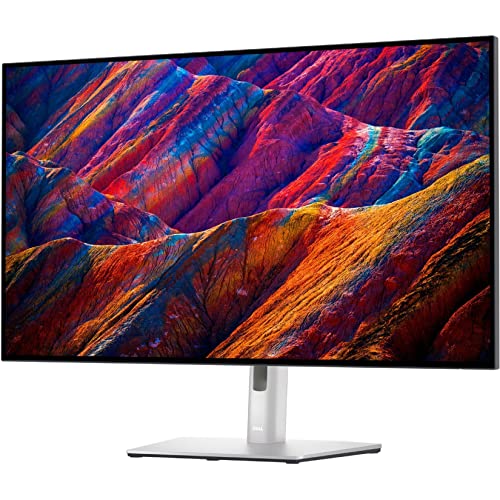
The Dell UltraSharp U3223QE is the hub monitor in this guide, and it is the pick for a laptop-first desk. Its listing names a 32-inch screen and a 3840×2160 resolution, and the panel is IPS with complete sRGB and Rec.709 coverage, DisplayHDR 400, and a USB-C hub that delivers 90W of power, carries video, and adds an RJ45 Ethernet port plus five USB 3.2 Gen 2 ports and a second USB-C port. One cable from your laptop gives you a wired network, peripherals, and charging.
The listing markets the panel as 32 inches while the viewable area measures 31.5 inches, which is the norm at this size and is stated here so there is no surprise. The U3223QE also supports Display Stream Compression, which lets a second 4K monitor daisy-chain from it at full resolution over USB-C, a useful trait for a dual-monitor desk that wants one cable run. HDMI 2.2 and DisplayPort 1.4 cover desktop graphics cards and consoles, and the stand adjusts for height, tilt, swivel, and pivot.
Color work is a strength here: the IPS panel holds its color across wide viewing angles, and the complete sRGB coverage suits web and print workflows. The 60Hz refresh rate is standard for a productivity panel, so this is not the pick for high-refresh gaming. Confirm the model number U3223QE on the listing, because Dell sells a video-conferencing sibling, the U3223QZ, with a built-in camera under a separate listing.
Gigabyte M32U 32-Inch 4K 144Hz Gaming Monitor

The Gigabyte M32U is the gaming pick in this guide. Its listing names a 32-inch screen and a 3840×2160 resolution, and the SS IPS panel runs at 144Hz with a 1ms MPRT response time and Adaptive Sync support. Two HDMI 2.1 ports and a DisplayPort 1.4 input cover a modern graphics card and a console, and a USB-C port with KVM lets one keyboard and mouse serve two connected machines.
The panel covers broad DCI-P3 color and supports HDR, so games and media get vivid color alongside the high refresh rate. The listing states a 31.5-inch IPS display in its description text while marketing the monitor as 32 inches, which is the same viewable-area convention as the other picks in this guide. The stand is height adjustable, and the panel supports picture-in-picture and picture-by-picture modes for watching a second source beside your game.
One limit to know before you order: the HDMI 2.1 ports carry 4K at 120Hz, and the full 144Hz refresh rate needs the DisplayPort 1.4 input, per the maker’s own answers on the listing. If your graphics card has DisplayPort, that is the cable to use. The M32U also ships in an Arm Edition variant under a separate listing, so confirm the model number M32U-SA on the listing for the standard stand version covered here.
ASUS ProArt PA329CV 32-Inch 4K HDR Creator Monitor

The ASUS ProArt PA329CV is the creator pick in this guide. Its listing names a 32-inch screen and a 3840×2160 resolution, and the IPS panel carries complete sRGB and Rec.709 coverage with a Delta E under 2 and Calman Verification, which means it ships factory calibrated for accurate color. A USB-C port delivers 90W of power, and DisplayPort, HDMI, and a USB 3.1 hub cover the rest of a creator desk.
The stand is a C-clamp design with height adjustment, which clamps to the desk edge and keeps the base footprint small. VESA DisplayHDR 400 support is stated, and the panel carries HDR10. The listing states a 3-year manufacturer warranty and a 5ms response time, and the 60Hz refresh rate fits editing, design, and media work rather than high-refresh gaming.
Color accuracy is the reason to choose this monitor over the others here: the factory calibration and the Delta E figure are stated in the listing, not assumed. The PA329CV also has a newer sibling, the PA329CRV, with broader DCI-P3 coverage under a separate listing, so confirm the model number PA329CV on the listing for the panel covered here. If your work lives in DCI-P3 rather than sRGB, the sibling is the one to compare against this pick.
LG UltraFine 32UN880-B 32-Inch 4K Ergo Monitor

The LG 32UN880-B is the ergonomic pick in this guide. Its listing names a 32-inch screen and a 3840×2160 resolution, and the IPS panel carries HDR10, broad DCI-P3 coverage, and a USB-C port with 60W power delivery. The Ergo stand is a C-clamp arm that extends, retracts, swivels, pivots, and adjusts in height, so the panel can sit close for detailed work, swing aside for a meeting, or rotate into portrait for long documents and code.
The panel brightness is stated at 350 nits typical, and the listing names DisplayPort 1.4, two HDMI inputs, and USB-A ports alongside the USB-C input. The same panel appears in LG’s standard-stand model, the 32UN650-W, so the Ergo arm is what you are paying for here: the arm, not a different screen. The listing states a 31.5-inch viewable area while marketing the monitor as 32 inches, the same convention as the other picks in this guide.
One flag to act on before you order: a check on October 21, 2026 found only a used-condition listing for this model on Amazon, with no clean new-condition buy box, while a tracker checked one day before this guide was written shows the listing in stock. The most recent evidence governs, but the conflict is real, so confirm that the listing you open shows a new-condition unit and the exact model number 32UN880-B before you order. If the listing shows only used units, wait for the new-condition listing to return rather than settling for a used panel.
Comparison table
| Monitor | Panel | Resolution | Refresh rate | USB-C power | Best for |
|---|---|---|---|---|---|
| Samsung M8 M80D | VA, matte | 3840×2160 | Not stated in listing excerpts | 65W | Media and smart apps |
| Dell UltraSharp U3223QE | IPS | 3840×2160 | 60Hz | 90W | Laptop hub desk |
| Gigabyte M32U | SS IPS | 3840×2160 | 144Hz via DisplayPort | KVM, video | High-refresh gaming |
| ASUS ProArt PA329CV | IPS, Calman Verified | 3840×2160 | 60Hz | 90W | Color-critical work |
| LG UltraFine 32UN880-B | IPS | 3840×2160 | 60Hz | 60W | Flexible arm setup |
Frequently asked questions
Is a 32-inch 4K monitor sharp enough for text work?
Yes. At 3840×2160 across 32 inches, text renders crisply at typical desktop scaling, and the extra screen area lets you keep two full documents or a timeline and a second window side by side. If you sit very close to the screen, a 27-inch 4K panel gives denser text, but most desks suit the 32-inch size better because the larger text at comfortable scaling is easier to read for long sessions.
Do I need HDMI 2.1 for 4K gaming at a high refresh rate?
It depends on the monitor and the refresh rate you want. On the Gigabyte M32U in this guide, the HDMI 2.1 ports carry 4K at 120Hz, while the full 144Hz refresh rate needs the DisplayPort 1.4 input. A 60Hz monitor needs neither: a standard HDMI or DisplayPort cable carries 4K at 60Hz. Match the cable to the port that carries the refresh rate you want, and check the listing for the port list before you order.
Can a 32-inch 4K monitor replace a television in a small room?
The Samsung M8 in this guide comes closest, because it runs streaming apps, has built-in speakers, and ships with a camera for video calls. It has no tuner, so it cannot receive broadcast channels on its own, and it needs an internet connection for its apps. The other monitors in this guide need a connected source for any video at all. For a small room, the M8 works as a media screen; for a desk, any of the five picks suits the space.
How to choose
Begin with the job the monitor will do most. For a laptop-first desk, the Dell U3223QE earns its place with a 90W USB-C hub, Ethernet, and daisy-chain support for a second 4K screen. For high-refresh gaming, the Gigabyte M32U is the only pick here with a 144Hz panel, and it needs a DisplayPort cable to reach that rate. For color-critical photo and video work, the ASUS PA329CV carries factory calibration with a Delta E under 2 and complete sRGB coverage. For a media screen that works without a computer, the Samsung M8 runs streaming apps on its own, with the caveat that it has no tuner. For a desk that changes shape through the day, the LG 32UN880-B puts the panel on a clamp arm, with the caveat that you must confirm a new-condition listing before you order.
Then check the practical details: the USB-C wattage against your laptop, the port list against your devices, the stand against your desk, and the model number on the listing against the model in this guide. A 32-inch 4K monitor is a long-term desk fixture, so the right pick is the one whose ports, panel, and stand match the way you actually work, not the one with the longest feature list.
Disclosure: As an Amazon Associate, we may earn a commission from qualifying purchases made through links in this article, at no additional cost to you.
FAQ
Is a 32-inch 4K monitor sharp enough for text work?
Do I need HDMI 2.1 for 4K gaming at a high refresh rate?
Can a 32-inch 4K monitor replace a television in a small room?
More from Amazon
Programs that pair well with the guide above. Offers and eligibility are set by Amazon and may change.
Free shipping on eligible items, Prime Video and more. Eligible new members can start with a free trial.
Start a Prime free trialAd-free music streaming. Eligible new subscribers can start with a free trial.
Try Music Unlimited freeA Prime membership for ages 18-24 with a trial period. Eligibility is set by Amazon.
See Prime for Young AdultsAudiobooks and podcasts to listen to on the go. Eligible new members can start with a free trial.
Try Audible freeAs an Amazon Associate we earn from qualifying purchases.