Key takeaways
- Compare the best media room projectors for a dedicated, light-controlled room: true install optics, wide lens shift, quiet fans and film-first contrast.
As an Amazon Associate, we earn from qualifying purchases made through links on this page.
A media room is not a living room with the lights dimmed. It is a dedicated space where the light is controlled, the screen is fixed to the wall, the projector is mounted once and left alone, and the sound comes from a separate receiver and speakers rather than from the projector itself. That single difference changes what a good projector looks like. Brightness still matters, but contrast and black level matter more, because in a dark room a grey-looking black is impossible to hide. Placement hardware matters more too: a ceiling-mounted projector needs real optical zoom and lens shift, not digital keystone correction that discards resolution. And because the projector hangs close to the seating, the fan noise a manufacturer publishes is a genuine buying criterion rather than a footnote.
Every projector here is a fixed-install model chosen for that kind of room — no portables, no battery models, no lifestyle units built around a speaker and a streaming stick. Each pick is a 4K projector with a full lens assembly, and for each one we state plainly how it builds its 4K image, because the four models below use three mechanisms and the difference is part of the decision. One model overlaps with this site’s earlier home cinema coverage; the rest of the set is built for this brief alone.
What to look for in a media room projector
Contrast and black level before brightness. In a light-controlled room, a projector does not need to fight windows or lamps, so the arms race in lumens matters less than what the projector does in dark scenes. Read manufacturer contrast figures with care: most are dynamic or full on/off measurements taken with an iris or light-source dimming fully engaged, and they are not measured the same way across brands. Treat them as a rough orientation inside one brand’s range, never as a ranking across brands. The imaging technology is a more honest guide: reflective panel designs such as SXRD and 3LCD are built around deep blacks, while single-chip DLP trades some of that for sharpness.
How the 4K image is built. Three of the four projectors here reach 4K by pixel shifting: a lower-resolution imaging chip is shifted at high speed so the screen receives a full 3840 x 2160 addressable image. Epson calls its version 4K PRO-UHD and BenQ uses a DLP chip with XPR shifting. The fourth model, from Sony, uses native 4K panels at 4096 x 2160 with no shifting at all. From a normal seat in a media room, a good pixel-shift image is genuinely hard to fault, but native panels hold an edge in fine texture and text, and buyers paying for a permanent install deserve to know which mechanism they are getting.
Lens shift and optical zoom. A media room projector is usually ceiling mounted behind or above the seats, and the screen never moves. Wide optical zoom lets one model cover very different room depths, and lens shift lets the installer align the image without tilting the projector or using keystone correction. Motorised shift, zoom and focus with lens memory is the premium version: the image can be re-framed from the remote, with one stored position for widescreen films and another for everything else. Manual controls do the same job once, at install time.
Brightness matched to screen size. In a dark room, the published figures in this roundup — between 2,000 and 3,200 lumens depending on the model and the standard its maker uses — are enough for 100 to 140 inch screens. Bigger screens spread the same light thinner, so if your room is built around a 150 inch screen, favour the brighter models and a screen with some gain. Note that Epson quotes colour and white brightness in lumens, BenQ quotes ANSI lumens for its pick, and the two numbers are not produced by identical tests.
Published fan noise. The projector in a media room usually sits a short distance from the listeners’ ears, and quiet scenes expose fan noise immediately. If your mount point is directly over the main seats, weight the published figure heavily — the gap between the quietest and loudest model here is wide enough to hear.
Light source and HDR format support. Laser and LED light sources are rated by their makers for around 20,000 hours or more; a lamp model is rated in the low thousands of hours and needs a replacement lamp eventually. For HDR, all four models handle HDR10, two add HDR10 Plus with dynamic metadata, and none supports Dolby Vision, which this class of projector does not carry.
Epson Home Cinema LS11000

The LS11000 is the most complete install package in this roundup. Epson builds it around a laser light source rated at 20,000 hours and a 3LCD engine producing 2,500 lumens of colour and white brightness. The 4K PRO-UHD image is pixel shifted rather than native, and Epson quotes a dynamic contrast figure of up to 2,500,000 to 1 with its light output fully modulated — a darkest-black against brightest-white figure, not a scene you will ever see. What makes the LS11000 a media room projector rather than a bright-room one is the lens: a motorised 2.1x zoom with motorised shift of plus or minus 96.3 percent vertically and plus or minus 47.1 percent horizontally, plus lens memory positions recalled from the remote. A ceiling mount can sit well off the screen’s centre line and the image still lands square.
- ASIN: B09TS2M1ZS — View on Amazon
- Resolution: 4K PRO-UHD pixel shifting, 3840 x 2160 on screen
- Brightness: 2,500 lumens colour and white (Epson figures)
- Light source: laser, rated 20,000 hours
- Lens: motorised 2.1x zoom, motorised shift, lens memory; throw ratio 1.35 to 2.84
- HDR: HDR10, HDR10 Plus, HLG
- Inputs: HDMI 2.1 with 4K at 120 Hz support and eARC
- Fan noise: 30 dB in normal mode, 22 dB in Eco, as published by Epson
Who it is for: a dedicated room that hosts films first and gaming second, where the mount position is awkward and the lens has to do the work. Limitations, from the spec sheet: the image is pixel shifted, not native 4K; there is no built-in streaming or usable speaker, correct for this room type but a player and receiver are mandatory; and at roughly 28 pounds it needs a mount and ceiling fixing chosen for the weight.
Sony VPL-XW5000ES

The XW5000ES is the native 4K option. Sony’s SXRD panels carry the full 4096 x 2160 resolution with no shifting, driven by a laser light source rated at 20,000 hours and quoted at 2,000 lumens. In a dark media room that combination flatters film: true per-pixel detail, deep and even blacks, and Sony’s X1 Ultimate for Projectors processor handling HDR tone mapping frame by frame. Sony also publishes the most home-cinema-friendly noise figure in this group, 24 dB, which matters when the projector hangs above the back row. Its gaming credentials are real but secondary — the HDMI 2.1 inputs accept 4K at 120 Hz, and Sony quotes input lag of 21 milliseconds at 4K 60 Hz and 13 milliseconds at 1080p 120 Hz.
- ASIN: B09XC1K3NH — View on Amazon
- Resolution: native 4K SXRD, 4096 x 2160, no pixel shifting
- Brightness: 2,000 lumens (Sony figure)
- Light source: laser phosphor, rated 20,000 hours
- Lens: manual 1.6x zoom, manual shift of up to 71 percent vertical and plus or minus 25 percent horizontal; throw ratio 1.38 to 2.21
- HDR: HDR10 and HLG; no HDR10 Plus
- Inputs: HDMI 2.1 with 4K at 120 Hz support
- Fan noise: 24 dB, as published by Sony
Who it is for: the film-first buyer who wants native 4K panels and the quietest published fan figure, and whose room is finished enough that the lens is set once by hand. Limitations, from the spec sheet: every lens adjustment is manual — there is no motorised shift, no powered focus and no lens memory, so a scope screen setup that changes framing per format is not its strength; brightness is the lowest here, which suits a controlled room and a moderate screen but argues against very large screens; and HDR support stops at HDR10 and HLG.
BenQ W4100i

The W4100i is the pick for a media room that is not especially deep. Its throw ratio of 1.15 to 1.50 with a 1.3x zoom fills a 120 inch screen from noticeably closer than the two Epson models or the Sony, which suits converted bedrooms and shorter dedicated rooms. The image is DLP based: a single chip with XPR pixel shifting producing 3840 x 2160, lit by a 4LED light source rated at 20,000 hours in normal mode and 30,000 hours in Eco. BenQ quotes 3,200 ANSI lumens and full coverage of the DCI-P3 colour space with factory calibration, and its HDR-PRO processing adds a local contrast enhancer that works zone by zone. Lens shift is manual, with a 60 percent vertical range and plus or minus 15 percent horizontally — less travel than the Epson lens platform, but enough for a sensibly placed ceiling mount.
- ASIN: B0F2VX6WMV — View on Amazon
- Resolution: 4K UHD via DLP XPR pixel shifting, 3840 x 2160 on screen
- Brightness: 3,200 ANSI lumens (BenQ figure)
- Light source: 4LED, rated 20,000 hours, 30,000 hours in Eco
- Lens: manual 1.3x zoom, manual shift of 60 percent vertical range and plus or minus 15 percent horizontal; throw ratio 1.15 to 1.50
- HDR: HDR10 Plus, HDR10, HLG
- Colour: full DCI-P3 coverage as quoted by BenQ, factory calibrated
- Inputs: three HDMI 2.1 ports; Android TV built in
Who it is for: a shorter media room, or a buyer who wants the brightest ANSI figure in this group and calibrated cinema colour in a compact body. Limitations, from the spec sheet: single-chip DLP can show rainbow artefacts to sensitive viewers, something no specification can settle in advance; the dynamic contrast figure BenQ quotes depends on light source dimming and is not comparable with the panel-based figures above; lens controls are manual with the narrowest zoom range here; and its built-in Android TV and small speaker are living-room features that a media room will simply bypass.
Epson Home Cinema 5050UB
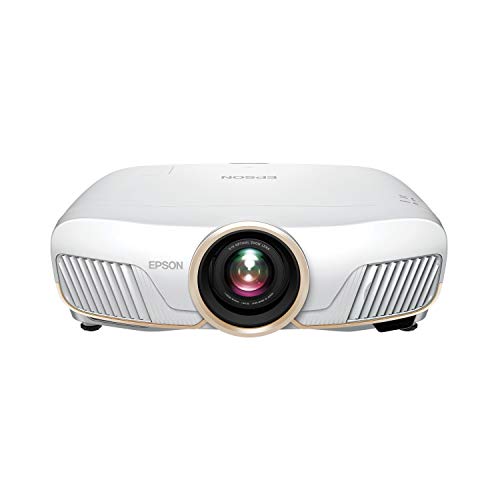
The 5050UB is the long-running benchmark for this exact room type, and it earns its place on lens and contrast rather than novelty. It uses the same motorised lens platform as the LS11000 — 2.1x zoom, motorised shift of plus or minus 96.3 percent vertically and plus or minus 47.1 percent horizontally, and lens memory — behind a 3LCD engine with 4K PRO-UHD pixel shifting and 2,600 lumens of colour and white brightness. Epson’s UltraBlack contrast claim runs to 1,000,000 to 1 dynamic. Epson publishes fan noise of 31 dB in normal mode and 20 dB in Eco, the quietest Eco figure in this roundup, which suits a mount directly over the seats during quiet dialogue.
- ASIN: B07P7Y3D6G — View on Amazon
- Resolution: 4K PRO-UHD pixel shifting, 3840 x 2160 on screen
- Brightness: 2,600 lumens colour and white (Epson figures)
- Light source: lamp, rated up to 5,000 hours in Eco mode
- Lens: motorised 2.1x zoom, motorised shift, lens memory; throw ratio 1.35 to 2.84
- HDR: HDR10 and HLG; no HDR10 Plus
- Inputs: HDMI 2.0, 4K at 60 Hz maximum
- Fan noise: 31 dB in normal mode, 20 dB in Eco, as published by Epson
Who it is for: a buyer building a film-only room who wants the full motorised install lens and deep published contrast, and who accepts a lamp as a consumable. Limitations, from the spec sheet: the lamp is rated in thousands rather than tens of thousands of hours and will need replacing; the platform is HDMI 2.0, so 4K at 120 Hz gaming is off the table; there is no HDR10 Plus; and the design dates from 2019, so check the listing carefully for the current configuration before ordering.
Comparison table
| Model | How it makes 4K | Brightness (maker’s figure) | Lens shift | Zoom | Light source | HDR formats |
|---|---|---|---|---|---|---|
| Epson Home Cinema LS11000 | Pixel shifting (3LCD) | 2,500 lumens | Motorised, widest range here | 2.1x | Laser | HDR10, HDR10 Plus, HLG |
| Sony VPL-XW5000ES | Native 4K SXRD panels | 2,000 lumens | Manual | 1.6x | Laser | HDR10, HLG |
| BenQ W4100i | Pixel shifting (DLP XPR) | 3,200 ANSI lumens | Manual | 1.3x | 4LED | HDR10 Plus, HDR10, HLG |
| Epson Home Cinema 5050UB | Pixel shifting (3LCD) | 2,600 lumens | Motorised, widest range here | 2.1x | Lamp | HDR10, HLG |
FAQ
What makes a projector a media room projector rather than a living-room one?
The room decides it. A media room projector is built for a fixed screen, controlled light and a permanent mount, trading portability and built-in sound for contrast, lens shift, optical zoom and quiet cooling. Living-room models spend their budget on brightness for ambient light and on streaming and speakers; a media room already has a player, a receiver and speakers, so none of that belongs in the projector.
Is native 4K visibly better than pixel shifting in a media room?
At typical seating distances on screens up to about 140 inches, a good pixel-shift image is very close, and contrast and calibration usually matter more to how a film looks. Native panels, like the Sony in this roundup, hold a real edge in fine detail and with text or test patterns. In short, the mechanism is worth knowing, but it should not outrank black level and lens quality in a dark room.
How many lumens does a light-controlled media room actually need?
Far fewer than a living room. With the lights controlled and a screen in the 100 to 140 inch range, the 2,000 to 3,200 lumen class covered here is the working range, and a lower-output model with better blacks will look more cinematic than a brighter one with weaker contrast. Very large screens, or a room that only reaches dim rather than dark, push you toward the brighter end.
Can a media room projector handle games as well as films?
Some can. The LS11000 and the XW5000ES both accept 4K at 120 Hz over HDMI 2.1, and Sony publishes input lag figures for the XW5000ES that suit console play. The 5050UB is limited to 4K at 60 Hz by its HDMI 2.0 inputs. If gaming is a side use rather than the point of the room, the laser and LED models here cover it; if it is the point, this site has separate gaming projector coverage.
Do I need a real screen, or is a painted wall enough?
A wall can work, but a fixed frame screen with a known gain and a flat, uniform surface is part of what makes a media room consistent: the lens settings, focus and calibration you dial in stay valid. A wall’s texture and colour shift the image in ways no projector setting fully corrects, and in a room built for films the screen is the simplest image-quality upgrade in the chain.
Conclusion
For most dedicated rooms, the Epson LS11000 is the balanced answer: a laser light source, the joint-widest motorised lens in this group, lens memory, and HDMI 2.1 headroom for gaming. Film purists who want native panels and the quietest published fan figure should look at the Sony XW5000ES and accept its manual lens. Shorter rooms point to the BenQ W4100i, whose throw ratio and calibrated colour suit a converted space. And the Epson 5050UB remains strong in everything except its lamp: the same install lens and deep contrast, bought knowing a replacement lamp is part of the cost of owning it. Either way, decide the screen size and mount position first — in a media room, the lens you need follows from the room.
More from Amazon
Programs that pair well with the guide above. Offers and eligibility are set by Amazon and may change.
Free shipping on eligible items, Prime Video and more. Eligible new members can start with a free trial.
Start a Prime free trialAd-free music streaming. Eligible new subscribers can start with a free trial.
Try Music Unlimited freeA Prime membership for ages 18-24 with a trial period. Eligibility is set by Amazon.
See Prime for Young AdultsAudiobooks and podcasts to listen to on the go. Eligible new members can start with a free trial.
Try Audible freeAs an Amazon Associate we earn from qualifying purchases.