Our Short List of 3
All 4 Picks at a Glance
| Product | Specs | Action |
|---|---|---|
 Arturia MiniLab 3 | Check price on Amazon | |
 M-Audio Keystation Mini 32 MK3 | Check price on Amazon | |
 Akai Professional MPK Mini Play MK3 | Check price on Amazon | |
 Novation Launchkey Mini MK3 | Check price on Amazon |
Key takeaways
- Compare the best USB MIDI keyboards for music production: 25- and 32-key controllers with pads, knobs, and bundled software, verified on each Amazon listing.
One point of clarity up front: in this guide, “keyboards” means musical keyboards. Every pick below is a MIDI controller keyboard that connects to a computer over USB and sends note and control data to music software. No typing keyboards appear here, no standalone pianos, and no MIDI keyboard without a USB connection. Each controller plugs into a computer with a single USB cable, and that cable carries both the MIDI data and the power, except for one pick that also runs on batteries and carries its own speaker.
A USB MIDI keyboard makes no sound by itself. Four of the five picks here are silent hardware: they send key presses, pad hits, knob turns and pitch bends to software on your computer, and the software makes the sound. The fifth pick, the Akai MPK Mini Play MK3, is the exception: it carries a built-in speaker and built-in sounds, so it can play on its own, and it still works as a USB MIDI controller when you plug it into a computer.
This guide covers USB MIDI keyboards generally, for any music software, not for one program alone. The site already carries a roundup of keyboards for Ableton Live; this guide picks by the USB connection and by what each controller brings to music production in general. Four picks have 25 keys and one has 32. All five use mini or slim keys, so they fit small desks and laptop bags.
What to look for
Keys and key size. Key count decides how much of a melody you can play without shifting octaves. A 25-key controller covers two octaves, so a melody that spans more needs octave shift buttons, and every pick here carries them. Mini keys are smaller than full-size piano keys, so a 25-key controller fits in a backpack, but players with large hands may find mini keys cramped. All five picks name velocity-sensitive keys, which play louder when hit harder. The M-Audio pick adds selectable velocity curves.
Pads. Drum pads are where finger drumming happens. Eight pads cover a basic drum kit, while 16 pads let you lay out a full drum rack with room for extra sounds. The Novation pick carries 16 pads, the most in the guide, and the two Akai picks and the Arturia pick each carry eight. The M-Audio pick carries no pads at all: it is a keyboard for playing notes, not a pad controller.
Knobs, faders and pitch controls. Knobs map to software controls such as filter cutoff, volume and send levels. Three picks here carry eight knobs each. Only the Arturia pick carries faders: four of them, alongside its eight encoders. Three picks use a thumbstick or touch strips, and the M-Audio pick uses dedicated buttons. The Akai and Arturia picks name a display, while the Novation pick names no display.
USB connection and power. Every pick here connects over USB, and four of the five draw all their power from that same USB cable, so no wall adapter is needed. The Akai picks use USB Type B, the Arturia pick uses USB Type C, the M-Audio pick uses USB Mini-B, and the Novation pick uses USB with a cable in the box. The MPK Mini Play MK3 also runs on batteries.
MIDI output for hardware. A 5-pin MIDI output lets a controller talk to hardware synths and modules with no computer involved. Only two picks name one: the Arturia MiniLab 3 and the Novation Launchkey Mini MK3. The other three send MIDI over USB only. The Arturia and Novation picks name a sustain pedal input; the other three listings name none.
Software in the box. A bundled software package gives you sounds to play on the day the controller arrives. Ableton Live Lite appears in the bundles of the Arturia and Novation picks, MPC Beats software appears with both Akai picks and the M-Audio pick, and the Arturia pick adds Analog Lab Intro and UVI Model D. Confirm the bundle on the listing.
Size, weight and warranty. The M-Audio pick is the lightest in this guide at 454 grams, and the Novation pick is next at 0.73 kilograms. The Arturia pick is the heaviest at 3.1 pounds and carries the longest warranty in the guide at five years. The Akai and Novation listings name no warranty length in the material checked.
Akai Professional MPK Mini MK3
Akai Professional MPK Mini MK3
The Akai MPK Mini MK3 is the most widely used 25-key USB MIDI controller in this guide. It carries 25 velocity-sensitive mini keys, eight backlit MPC drum pads, eight assignable 360-degree knobs, a four-way thumbstick for pitch and modulation, an OLED display, and a built-in arpeggiator. The pads support Note Repeat and Full Level. The knobs assign to plugin controls.
Power comes from the USB connection, and the listing names a USB-B to USB-A cable in the box. One catch: the USB-B connector is an older connector type, and a laptop with only USB-C ports needs an adapter or a different cable. The listing names no USB-C port and no 5-pin MIDI output, so this controller talks to hardware only through a computer.
Software is a strong part of this pick. The listing names MPC Beats software, three virtual instruments, and 2 GB of sound content, plus a choice of one of three Komplete 15 Select bundles and 60 days of Splice Creator access. The controller weighs 1.98 pounds, so it fits a laptop bag.
This pick suits a first-time beat maker who wants pads, knobs and keys in one small box. It suits two-handed piano playing less well: 25 mini keys cover two octaves, and wide chords feel tight on mini keys. The listing names no sustain pedal input and no MIDI output, so a buyer who plays piano parts with a pedal or drives hardware synths should look at the Arturia or Novation picks instead. A tracker mirror checked 14 days ago shows the listing in stock on Amazon and fulfilled by Amazon, and a separate Amazon figure tracker shows a current US figure dated November 25, 2026.
Arturia MiniLab 3
Arturia MiniLab 3
The Arturia MiniLab 3 is the pick in this guide with the most practical mixing controls, and its listing names a feature no other pick here carries: four faders. It carries 25 velocity-sensitive slim keys, eight RGB backlit pads in two banks, eight rotary encoders, four faders, two capacitive touch strips for pitch bend and modulation, a mini display with a clickable browsing knob, and a built-in arpeggiator. The faders suit volume and mix levels.
Power and connection are modern: the listing names USB Type C for both data and power, so the controller draws all its power from the USB connection and needs no wall adapter. The back panel adds two things the other compact picks do not carry: a 5-pin MIDI output for controlling hardware synths and modules directly, with no computer involved, and a sustain pedal input for piano parts. Those two jacks make this pick the most hardware-ready controller here.
Software includes Analog Lab Intro, Ableton Live Lite, UVI Model D, a Komplete 15 Select bundle, Loopcloud samples, and a Melodics subscription. The listing names a five-year limited warranty, the longest warranty in this guide, and the controller weighs 3.1 pounds, the heaviest pick here. It needs a little more desk room than the Akai picks.
This pick suits a songwriter who wants faders and a real MIDI output in a 25-key body. It suits a traveller less well than the lighter picks: at 3.1 pounds it is the heaviest controller here, and its footprint is the widest. The slim keys feel closer to full-size keys than mini keys, but 25 keys still cover only two octaves. A direct Amazon crawl 293 days old shows the listing shipped from and sold by Amazon.com, and a mirror checked 14 days ago shows the white version of the same model in stock on Amazon and fulfilled by Amazon.
M-Audio Keystation Mini 32 MK3
M-Audio Keystation Mini 32 MK3
The M-Audio Keystation Mini 32 MK3 is the only pick in this guide with more than 25 keys, and it is also the simplest controller here. It carries 32 velocity-sensitive mini keys with selectable velocity curves, pitch bend and modulation buttons, octave up and down buttons, a volume knob, and a sustain button. The extra seven keys give it more range than any 25-key controller.
Power comes from the USB connection, and the listing names a USB Mini-B to USB-A cable. No drivers are needed: the listing describes a plug-and-play connection to Mac and PC. The listing names no 5-pin MIDI output and no sustain pedal jack, so this controller sends MIDI over USB only, and the sustain control is a button on the panel rather than a pedal input. USB Mini-B is an older connector, and a laptop with only USB-C ports needs an adapter or a different cable.
Software named on the listing includes MPC Beats software and 60 Melodics lessons. Confirm the exact bundle on the listing before you buy, since bundles can change. The controller weighs 454 grams, the lightest pick in this guide, and it measures 16.44 inches wide, 4.2 inches deep, and 0.72 inches high. It carries a one-year warranty.
This pick suits a beginner who wants a light, simple keyboard for entering notes into virtual instruments. It suits a beat maker poorly: with no pads and no assignable knob bank, finger drumming and practical plugin control need a second device or the mouse. The keys are mini keys, so players with large hands may find them tight. A live Amazon figure pull updated minutes ago shows the listing in stock on Amazon.
Akai Professional MPK Mini Play MK3
Akai Professional MPK Mini Play MK3
The Akai MPK Mini Play MK3 is the only pick in this guide that makes sound on its own, and that single difference changes how it can be used. It carries 25 Gen 2 velocity-sensitive mini keys, a built-in speaker with built-in sounds, eight backlit MPC drum pads, four encoder knobs, an OLED display, an arpeggiator with note repeat, and a four-way joystick for pitch and modulation. The listing names batteries as a power path, with a USB mains plug as the other path, and the box includes a USB Type B to A cable.
As a USB MIDI controller, it behaves like its sibling, the MPK Mini MK3, with two differences that matter. It carries four knobs instead of eight, so practical plugin control is thinner, and it carries a built-in speaker and sounds, so it works away from a computer. The speaker is small, so treat it as a sketching and practice tool rather than a mixing tool. The listing names no 5-pin MIDI output and no sustain pedal input, so hardware control runs through a computer, as with the standard MK3.
Software named on the listing includes MPC Beats, Hype, AIR Essential Keyboards, and Electric. Melodics educational software is included with 60 free lessons. The listing names no battery life figure in the material checked, though mirrors describe it as over 14 hours; batteries are not included in the box. A mirror checked 14 days ago shows the listing in stock on Amazon and fulfilled by Amazon.
This pick suits a buyer who wants to practise and sketch melodies away from a computer. It suits a studio buyer less well than the standard MK3: four knobs instead of eight means less practical control, and the speaker adds size and weight for a feature a studio setup does not need. If you always work at a computer, the standard MPK Mini MK3 gives you more knobs for the same key count.
Novation Launchkey Mini MK3
Novation Launchkey Mini MK3
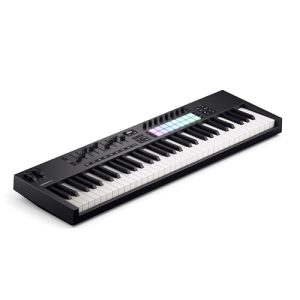
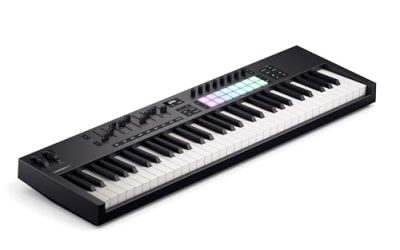
The Novation Launchkey Mini MK3 is the pick in this guide with the most drum pads, and it is built around Ableton Live more closely than any other pick here. It carries 25 velocity-sensitive mini keys, 16 RGB backlit velocity-sensitive pads, eight rotary knobs, pitch and modulation touch strips, transport buttons, a 5-pin MIDI output, and a sustain pedal input. Fixed Chord mode plays a full chord from a single key.
Power comes from the USB connection, and the box includes a USB cable, a safety information sheet, and a user manual. The 5-pin MIDI output lets it control hardware synths with no computer involved, and the sustain pedal input suits piano parts. The listing names no display, so parameter names and values show on the computer screen rather than on the controller, which is a real difference from the Akai and Arturia picks that name a display.
Software named on the listing includes Ableton Live Lite and Spitfire Audio LABS sounds. The controller weighs 0.73 kilograms, the second-lightest pick in the guide after the M-Audio.
This pick suits a Live user who wants the largest pad grid in a 25-key body. It suits a buyer who wants an on-device display less well, since the listing names none. Availability evidence is the thinnest in this guide: no direct Amazon crawl surfaced, and the evidence rests on mirrors, including one checked a day ago showing stock imported from a USA store. Confirm a live buying option on Amazon before you buy this one.
Comparison table
| Keyboard | Keys | Pads | Knobs / faders | USB | MIDI out | Software named |
|---|---|---|---|---|---|---|
| Akai MPK Mini MK3 | 25 mini, velocity-sensitive | 8 backlit MPC | 8 knobs | USB-B, bus-powered | None named | MPC Beats, AIR instruments, Komplete 15 Select |
| Arturia MiniLab 3 | 25 slim, velocity-sensitive | 8 RGB, 2 banks | 8 encoders, 4 faders | USB-C, bus-powered | 5-pin MIDI out | Analog Lab Intro, Ableton Live Lite, UVI Model D |
| M-Audio Keystation Mini 32 MK3 | 32 mini, velocity-sensitive | None | Volume knob only | USB Mini-B, bus-powered | None named | MPC Beats, Melodics 60 lessons |
| Akai MPK Mini Play MK3 | 25 mini, velocity-sensitive | 8 backlit MPC | 4 knobs | USB-B, bus-powered or batteries | None named | MPC Beats, Hype, AIR instruments |
| Novation Launchkey Mini MK3 | 25 mini, velocity-sensitive | 16 RGB | 8 knobs | USB, bus-powered | 5-pin MIDI out | Ableton Live Lite, Spitfire LABS |
Frequently asked questions
Do these keyboards make sound on their own?
Four of the five do not. The Akai MPK Mini MK3, the Arturia MiniLab 3, the M-Audio Keystation Mini 32 MK3, and the Novation Launchkey Mini MK3 send MIDI data to a computer, and the computer and its software make the sound. Only the Akai MPK Mini Play MK3 can play with no computer connected. Every pick needs music software on a computer to reach its full use.
Can I control hardware synths with these controllers?
Only two picks name a 5-pin MIDI output on their listings: the Arturia MiniLab 3 and the Novation Launchkey Mini MK3. The other three send MIDI over USB only, so they control hardware through a computer or an interface. If hardware control matters to you, pick one of the two with the 5-pin output.
How many keys do I need: 25 or 32?
A 25-key controller covers two octaves, which suits bass lines, short melodies, drum patterns, and one-handed playing. A 32-key controller covers two octaves plus seven more notes, which helps with two-handed playing and with pieces that wander across a wider range. In this guide only the M-Audio pick carries 32 keys, and it trades pads and knobs for those extra keys. If pads and knobs matter more than range, pick a 25-key controller with pads. If range matters more than pads, pick the 32-key M-Audio. All five use mini or slim keys, so none feels like a full-size piano.
How to choose
If you sketch beats and drum patterns, pick a controller with pads and knobs: the Akai MPK Mini MK3 or the Novation Launchkey Mini MK3, which carries 16 pads. If you mix and shape synth sounds, pick the Arturia MiniLab 3: four faders, eight encoders, a display, and a 5-pin MIDI output. If you want more keys than pads, pick the M-Audio Keystation Mini 32 MK3: 32 keys and the lightest body here. If you want to play with no computer at all, pick the Akai MPK Mini Play MK3, the only pick with a built-in speaker.
Check three things on the listing before you buy. First, the USB connector type: USB-B, USB-C, and USB Mini-B all appear in this guide. Second, the software bundle: confirm the exact bundle on the listing. Third, the buying option: confirm a new-unit listing and the exact model name, since variants sell under different codes. The Novation pick carries the thinnest availability evidence in this guide, so check it first.
Disclosure: As an Amazon Associate, we may earn a commission from qualifying purchases made through links in this article, at no additional cost to you.
FAQ
Do these keyboards make sound on their own?
Can I control hardware synths with these controllers?
How many keys do I need: 25 or 32?
More from Amazon
Programs that pair well with the guide above. Offers and eligibility are set by Amazon and may change.
Free shipping on eligible items, Prime Video and more. Eligible new members can start with a free trial.
Start a Prime free trialAd-free music streaming. Eligible new subscribers can start with a free trial.
Try Music Unlimited freeA Prime membership for ages 18-24 with a trial period. Eligibility is set by Amazon.
See Prime for Young AdultsAudiobooks and podcasts to listen to on the go. Eligible new members can start with a free trial.
Try Audible freeAs an Amazon Associate we earn from qualifying purchases.