Our Short List of 3

- 61 touch-responsive keys
- 650 instrument voices and 260 auto-accompaniment styles
- 48-note polyphony
- 125 built-in lesson songs with Keys to Success lesson function

- 61 piano-style keys with built-in speakers
- 300 built-in sounds and 300 rhythms
- 40 demo songs with lesson mode
- Layer and split modes for playing two sounds at once

- 61 full-size keys
- 200 tones, 200 rhythms, and 30 demo songs
- Touch display panel for selecting sounds and functions
- Record and playback functions
All 4 Picks at a Glance
| Product | Specs | Action |
|---|---|---|
| 1. Yamaha PSR-E383 61-Key Portable Keyboard |
| Check price on Amazon |
| 3. Alesis Melody 61 MKII Keyboard Piano Bundle |
| Check price on Amazon |
| 4. RockJam RJ761 61-Key Keyboard Piano Super Kit |
| Check price on Amazon |
 5. Donner DEP-20 88-Key Weighted Digital Piano |
| Check price on Amazon |
Key takeaways
- Looking for the best cheapest piano keyboards? Compare 61-key and 88-key beginner picks with touch response, weighted keys, and full starter bundles today.
Learning piano should not require a grand piano budget. The best cheapest piano keyboards give beginners a real instrument to practice on, with full-size keys, touch response, built-in speakers, and enough sounds to keep practice interesting, all at a modest cost that makes starting out feel low risk. Whether you are buying for a child, picking up the hobby as an adult, or looking for a portable second keyboard for songwriting, a well-chosen budget model can carry you through the first year of lessons and beyond.
This guide focuses on piano keyboards, meaning musical instruments with piano-style keys, not computer keyboards. Every pick below is a genuine keyboard instrument sold on Amazon US, with 61 or 88 keys, built-in speakers, and a sound library designed for learning and playing music.
Disclosure: As an Amazon Associate, we earn from qualifying purchases.
How to Choose the Best Cheapest Piano Keyboards
Before you pick a model, it helps to know what separates a good budget piano keyboard from a toy. A few key features decide whether an instrument will support real practice or frustrate you within a month.
Number of Keys: 61 or 88
Most budget piano keyboards have 61 keys, which covers five octaves. That is enough for the majority of beginner and intermediate pieces, pop songs, and practice exercises. An 88-key model matches a full acoustic piano, which matters if you plan to play classical repertoire or want to avoid running out of range on either end. If space and portability matter, 61 keys is the practical choice. If you want the full piano experience and have a dedicated spot at home, 88 keys is worth the extra size.
Touch Response and Weighted Keys
Touch response, also called velocity sensitivity, means the keyboard plays louder when you press a key harder and softer when you press gently. This is the single most important feature for learning proper piano technique, because dynamics are part of how music is expressed. Every pick in this guide has touch response. Avoid any keyboard that lacks it, since it teaches flat, unmusical playing habits that are hard to unlearn later.
Weighted keys go a step further, adding resistance that mimics the hammer action of an acoustic piano and builds finger strength. Fully weighted 88-key models are the closest budget option to a real piano feel. Beginners can start happily on unweighted touch-sensitive keys, so do not treat weighted keys as a requirement on your first instrument.
Sound Library and Polyphony
A piano keyboard’s sound library is the set of instrument voices it can produce, from grand piano and electric piano to strings, organ, and synth sounds. The quality of the core piano voice matters more than the raw count. Polyphony is the number of notes the keyboard can sound at once. A 32-note polyphony is workable, but 48-note polyphony is better, because sustained chords plus a melody plus the sustain pedal can quickly eat through available notes.
Built-In Speakers, Headphone Jack, and Power
Built-in speakers let you play anywhere without extra gear, which is ideal for a first keyboard. A headphone jack is equally important, because it makes silent practice possible late at night or in a shared home. Battery power is a useful bonus for portability. A power adapter is usually included, and it is worth checking before you buy, since some ultra-budget listings sell the adapter separately.
Lessons, Rhythms, and Connectivity
Many beginner keyboards include built-in lesson modes, demo songs, and auto-accompaniment rhythms that play a backing band while you play the melody. These features make practice more engaging, especially for children and self-taught players. Some models also include access to a lesson app, which adds structured guidance for the first months of learning.
USB or MIDI connectivity lets you connect the keyboard to a computer or tablet for recording, notation software, and additional lesson apps. If you think you might want to record your playing or use music production software later, a model with USB MIDI is a smart choice.
Our Top Picks for the Best Cheapest Piano Keyboards
1. Yamaha PSR-E383 61-Key Portable Keyboard
- 61 touch-responsive keys
- 650 instrument voices and 260 auto-accompaniment styles
- 48-note polyphony
- 125 built-in lesson songs with Keys to Success lesson function
The Yamaha PSR-E383 is the successor to the long-running PSR-E373, and it is the strongest all-around pick in this guide for most beginners. The grand piano voice is warm and believable, and the 650 instrument voices give you an enormous palette to explore, from strings and brass to synths and world instruments.
Key specs:
The PSR-E383 shines as a learning instrument. The Keys to Success lesson function breaks songs into steps, and the Touch Tutor feature helps you build control over dynamics. The 260 accompaniment styles let you play along with a virtual band in genres from rock to jazz, which makes practice feel like performing rather than drilling scales.
Pros:
Cons:
Who it is for: The PSR-E383 is for the beginner who wants the best sound and the most room to grow without stepping up to a much higher cost tier. It suits adults starting lessons, teenagers, and anyone who wants a portable keyboard that still sounds like a real instrument.
2. Casio CT-S300 Casiotone 61-Key Portable Keyboard
The Casio CT-S300 is the most portable keyboard in this guide, and one of the easiest to recommend to a first-time buyer. At around seven pounds with a built-in carrying handle, it is light enough to take anywhere, and it runs for up to 19 hours on six AA batteries. That combination makes it a natural choice for students, travelers, and anyone who practices in more than one place.
Key specs:
- 61 full-size touch-responsive keys
- 400 tones and 77 rhythms
- 48-note polyphony
- Pitch bend wheel for expressive playing
- Built-in speakers, headphone jack, and USB MIDI
- LCD display with intuitive controls and My Setup memory button
- Power adapter and music rest included
- Compatible with the Casio Music Space app
The CT-S300 keeps things simple without feeling limited. The 400 tones cover the essentials, the pitch bend wheel adds expression that many budget keyboards skip, and the dance music mode lets you build grooves and experiment with rhythm.
Pros:
- Extremely light and portable, with a carrying handle
- Long battery life for playing away from an outlet
- Pitch bend wheel adds expressive control
- Simple, beginner-friendly controls
- Power adapter included in the box
Cons:
- Speakers are modest in volume compared with larger models
- No sustain pedal included
- Sound library is smaller than the Yamaha PSR-E383
Who it is for: The CT-S300 is for the player who values portability above all else. It is ideal for students, commuters, and casual players who want a real touch-sensitive keyboard that can go anywhere, from a bedroom to a classroom to a park bench.
3. Alesis Melody 61 MKII Keyboard Piano Bundle
- 61 piano-style keys with built-in speakers
- 300 built-in sounds and 300 rhythms
- 40 demo songs with lesson mode
- Layer and split modes for playing two sounds at once
The Alesis Melody 61 MKII is the best complete starter bundle in this guide. Instead of buying a keyboard and then shopping separately for a stand, bench, headphones, and microphone, you get everything in one box and can start playing the day it arrives. For parents buying a first instrument for a child, that convenience is hard to beat.
Key specs:
The Melody 61 MKII is designed around fun and encouragement. The 300 sounds and rhythms invite experimentation, the demo songs give new players something to play along with, and the included microphone lets singers perform along with their playing. The lesson mode and built-in metronome support structured practice, while the record function lets you capture your playing and hear your progress.
Pros:
Cons:
Who it is for: The Melody 61 MKII is for families and absolute beginners who want everything in one purchase. If you are buying a first keyboard for a child or for a household that has no music gear at all, this bundle removes every barrier between opening the box and playing your first song.
4. RockJam RJ761 61-Key Keyboard Piano Super Kit
- 61 full-size keys
- 200 tones, 200 rhythms, and 30 demo songs
- Touch display panel for selecting sounds and functions
- Record and playback functions
The RockJam RJ761 is another strong bundle option, and it stands out for its sustain pedal and touch display panel. The sustain pedal is an important addition, because it lets you hold notes and create the connected, flowing sound that piano music depends on. Many budget keyboards leave it out, so its inclusion here is a genuine advantage.
Key specs:
The touch display gives the RJ761 a modern feel, showing feedback as you select tones and rhythms. The keynote stickers help new players learn note names, and the included lessons through the Simply Piano app add structured guidance. The 200 tones and 200 rhythms provide plenty of variety, and the record and playback function lets you layer parts and hear your own playing back.
Pros:
Cons:
Who it is for: The RJ761 is for the beginner who wants a complete kit with a sustain pedal included. It suits children learning note names, adults working through an app-based lesson plan, and anyone who wants a ready-to-play setup with no extra accessories to buy.
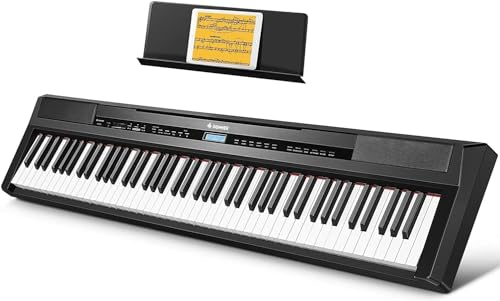
5. Donner DEP-20 88-Key Weighted Digital Piano
- 88 full-size fully weighted hammer-action keys
- 238 tones, including grand piano, electric piano, strings, and organ
- 128-note polyphony
- Built-in speakers, headphone jack, USB MIDI, and sustain pedal input
The Donner DEP-20 is the only 88-key pick in this guide, and it is the right choice if you want a full-size piano experience on a budget. Its fully weighted hammer-action keys mimic the feel of an acoustic piano, building the finger strength and control that serious students need. If you plan to take formal lessons or play classical pieces, this is the model that will grow with you the longest.
Key specs:
The DEP-20’s 128-note polyphony is a major advantage over the 61-key picks, because it means notes will not cut out during sustained passages with the pedal held down. The weighted keys give each note a realistic resistance, and the dual-tone mode lets you layer piano with strings for a richer sound. It is heavier and larger than the portable 61-key models, so it suits a dedicated practice space rather than a backpack.
Pros:
Cons:
Who it is for: The DEP-20 is for the committed beginner or returning player who wants a full piano feel at home. It suits students taking formal lessons, adults returning to piano after years away, and anyone who has space for a permanent practice setup and wants an instrument that will last through years of progress.
Comparison Table
| Keyboard | Keys | Key Action | Tones | Polyphony | Standout Feature |
|---|---|---|---|---|---|
| Yamaha PSR-E383 | 61 | Touch-responsive | 650 | 48-note | Best overall sound and lesson features |
| Casio CT-S300 | 61 | Touch-responsive | 400 | 48-note | Lightest and most portable |
| Alesis Melody 61 MKII | 61 | Piano-style | 300 | Not specified | Complete bundle with microphone |
| RockJam RJ761 | 61 | Full-size | 200 | Not specified | Sustain pedal and touch display included |
| Donner DEP-20 | 88 | Fully weighted hammer action | 238 | 128-note | Full piano range and realistic key feel |
Frequently Asked Questions
Are 61 keys enough for a beginner?
Yes, 61 keys cover five octaves, which is enough for most beginner and intermediate pieces, pop songs, and practice material. Many teachers start students on 61-key keyboards without any problem. You only need 88 keys if you plan to play advanced classical repertoire that uses the extreme ends of the piano, or if you simply want the full range available.
What is the difference between touch-responsive and weighted keys?
Touch-responsive keys change volume based on how hard you press them, which is essential for musical expression. Weighted keys add physical resistance that mimics the hammer mechanism of an acoustic piano. A keyboard can be touch-responsive without being weighted, and that combination is common on portable budget models. Weighted keys build finger strength and feel more like a real piano, but they add weight and cost. For a first instrument, touch response is the must-have feature, while weighted keys are a worthwhile upgrade if you plan to study seriously.
Can I learn piano on a cheap keyboard?
Yes, provided the keyboard has full-size, touch-responsive keys and a decent piano sound. The models in this guide all meet that standard, and many students complete their first year or two of lessons on instruments like these. The main limitations of a budget keyboard are the lighter key feel compared with an acoustic piano and the smaller speaker system. Neither prevents you from learning notes, rhythm, technique, and musicality.
What accessories do I need with my first piano keyboard?
At a minimum, you need a stand to hold the keyboard at the right height, a bench or chair at the right height, and a sustain pedal. Headphones are highly recommended for quiet practice. The Alesis and RockJam bundles include all of these, which is why they are strong choices for first-time buyers. If you buy a keyboard-only model like the Yamaha or Casio, budget for a stand and a sustain pedal, and check whether a power adapter is included before you order.
Conclusion
The best cheapest piano keyboards prove that you do not need to spend a fortune to start learning piano properly. For most beginners, the Yamaha PSR-E383 is the strongest overall choice, with the best piano sound, the largest voice library, and lesson features that support real progress. The Casio CT-S300 is the pick for players who need portability, offering a light, battery-powered keyboard that goes anywhere. The Alesis Melody 61 MKII and RockJam RJ761 bundles are the simplest way to start from nothing, with stands, benches, headphones, and a sustain pedal included. And the Donner DEP-20 is the choice for serious students who want a full 88-key weighted piano feel at home.
Whichever model you choose, the most important feature is touch response, followed by full-size keys and a piano sound you enjoy listening to. Pick the keyboard that fits your space, your goals, and your practice habits, and then focus on the part that matters most: sitting down and playing every day.
FAQ
Are 61 keys enough for a beginner?
What is the difference between touch-responsive and weighted keys?
Can I learn piano on a cheap keyboard?
What accessories do I need with my first piano keyboard?
More from Amazon
Programs that pair well with the guide above. Offers and eligibility are set by Amazon and may change.
Free shipping on eligible items, Prime Video and more. Eligible new members can start with a free trial.
Start a Prime free trialAd-free music streaming. Eligible new subscribers can start with a free trial.
Try Music Unlimited freeA Prime membership for ages 18-24 with a trial period. Eligibility is set by Amazon.
See Prime for Young AdultsAudiobooks and podcasts to listen to on the go. Eligible new members can start with a free trial.
Try Audible freeAs an Amazon Associate we earn from qualifying purchases.