Our Short List of 3
- Amazon ASIN: B0C35ZF3WR — View on Amazon
- Resolution: Full HD 1080p (1920 x 1080)
- Brightness: 4,600 lumens, color and white
- Technology: 3-chip 3LCD, laser light source

- Amazon ASIN: B08WTSV4JY — View on Amazon
- Resolution: True 4K UHD (3840 x 2160)
- Brightness: 4,000 lumens
- Technology: DLP, lamp light source

- Amazon ASIN: B0BDR8THMJ — View on Amazon
- Resolution: 4K PRO-UHD (pixel shift), HDR10 and HLG
- Brightness: 2,800 lumens, color and white
- Technology: 3-chip 3LCD, lamp light source
All 4 Picks at a Glance
| Product | Specs | Action |
|---|---|---|
| 1. Epson Pro EX11000 — Best Overall for a Talk Show Stage |
| Check price on Amazon |
| 2. Optoma UHD38 — Best 4K Brightness for Large Stage Screens |
| Check price on Amazon |
| 3. Epson Home Cinema 2350 — Best Smart Streaming Pick for a Talk Show |
| Check price on Amazon |
 4. BenQ HT2060 — Best Quiet LED Option for Smaller Stages |
| Check price on Amazon |
Key takeaways
- The best projectors for a talk show need brightness that beats stage lights, a quiet fan, and easy laptop and camera hookups. See the top stage-ready picks.
A talk show is a visual medium as much as a spoken one. Behind the host sits a screen carrying guest photos, video clips, social media posts, sponsor logos, and live graphics, and everyone in the room — plus everyone watching the stream or the recording — needs to read that screen clearly. A projector that looks great in a dark living room can wash out completely once stage lights and cameras enter the picture, so the best projectors for a talk show are judged by stage rules, not home theater rules.
Disclosure: As an Amazon Associate, we earn from qualifying purchases.
How to Choose a Projector for a Talk Show
Brightness comes first
Stage lighting is the enemy of a projected image. Key lights, spotlights, and the general wash that keeps the host visible all compete with the projector, and a dim image turns into a grey rectangle the moment the lights come up. For a talk show set, treat 2,500 lumens as a realistic floor and aim higher whenever the stage has strong lighting or a large screen. The brightest pick in this guide is rated at 4,600 lumens, and that kind of output keeps graphics punchy while the host stays well lit. Also check color brightness, not just white brightness: 3LCD designs publish equal figures for both.
Resolution and image quality
A talk show screen carries a lot of text — guest names, lower thirds, audience questions, social media handles — and it has to stay legible from the back row and on camera. Full HD 1080p is enough for most small and mid-size stages, especially for graphics and video rather than fine print. True 4K or pixel-shifted 4K adds crispness for large screens and close camera shots. Contrast behaves differently on stage than in a dark theater: in a lit room, ambient light limits black levels, so brightness and a good screen do more for perceived contrast than a contrast specification alone.
Throw distance and placement flexibility
Throw distance decides where the projector can live. It cannot block audience sightlines, sit in the camera shot, or cast the host’s shadow across the screen. A standard-throw projector behind the audience or mounted high on a ceiling or truss usually works well, provided the room is deep enough. Lens shift and zoom make placement forgiving: optical lens shift moves the image without tilting the projector, so the picture stays rectangular even when the unit sits off-center, and zoom sizes the image without moving the projector.
Fan noise and the microphones
A talk show records dialogue, and projector fans are audible. A loud fan near a boom or table microphone will hum through the entire recording, and no amount of post-production cleanup fully removes it. Favor models with a quiet Eco mode, and note that laser and LED light sources often run cooler and quieter than high-wattage lamps at the same brightness. Placement is half the solution: ceiling mounting puts the projector above the microphones and out of the camera frame.
Connectivity for cameras, laptops, and switchers
A talk show set is a small broadcast rig. At minimum, the projector needs enough HDMI inputs for the main playback laptop and a backup source, such as a second laptop or a media player. Two HDMI ports is a sensible minimum. Wireless casting sounds convenient, but a wired HDMI connection is more reliable for a live show; treat wireless features such as Miracast or built-in smart TV apps as a backup or rehearsal tool. An audio output matters too, so the projector can send show audio cleanly to the house speakers or the mixing desk.
Light source and running costs
Lamp projectors are usually cheaper to buy, but the lamp dims over time and eventually needs replacing, which means downtime and a spare lamp in the cupboard. Laser and LED projectors cost more up front and last far longer — often rated at 20,000 hours — with brightness that stays more consistent across their life. For a show that records weekly, that longevity removes one more thing that can fail on recording day.
The screen matters as much as the projector
Even the brightest projector struggles on a plain white wall under stage lights. A proper projection screen with a modest gain, or an ambient light rejecting screen for difficult rooms, can make a mid-range projector look like a far more expensive one. Keep the screen matte rather than glossy to avoid hot spots that cameras pick up.
Top Picks: The Best Projectors for a Talk Show
1. Epson Pro EX11000 — Best Overall for a Talk Show Stage
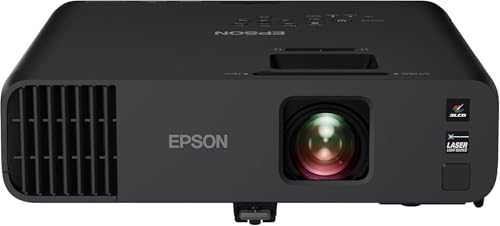
- Amazon ASIN: B0C35ZF3WR — View on Amazon
- Resolution: Full HD 1080p (1920 x 1080)
- Brightness: 4,600 lumens, color and white
- Technology: 3-chip 3LCD, laser light source
The Epson Pro EX11000 is the most stage-ready projector in this roundup, combining serious brightness with the connectivity a live set needs. Its 3-chip 3LCD engine is rated at 4,600 lumens for both color and white brightness, enough to keep graphics and video readable while the key lights are up. The laser light source is rated for up to 20,000 hours, so there is no lamp to dim or replace before a recording, and it reaches full brightness quickly. The image is Full HD 1080p, sharp enough for lower thirds, guest names, and video clips, and the 3LCD design means no rainbow effect and no color brightness shortfall on saturated backdrops.
Connectivity is a strength. Two HDMI ports cover the main playback laptop and a backup source, Miracast wireless casting lets the team throw a guest’s phone or laptop screen up during rehearsal, and a USB port can power a streaming stick. The built-in 16-watt speaker is loud enough for rehearsal or a small room.
Pros:
Cons:
Who it is for: Productions that record regularly under real stage lighting and need a bright, reliable projector that can be ceiling mounted in a studio or carried to a live venue.
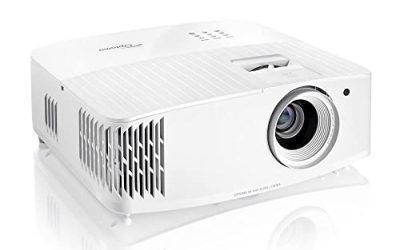
2. Optoma UHD38 — Best 4K Brightness for Large Stage Screens
- Amazon ASIN: B08WTSV4JY — View on Amazon
- Resolution: True 4K UHD (3840 x 2160)
- Brightness: 4,000 lumens
- Technology: DLP, lamp light source
When the screen is large and the cameras get close, resolution starts to matter, and the Optoma UHD38 answers with true 4K and 4,000 lumens of brightness. It projects 8.3 million on-screen pixels, so fine text, detailed graphics, and video clips stay crisp even on a big backdrop. HDR10 and HLG support help video content keep its punch, and the image can scale up to 300 inches for a venue-sized set. It also carries a 1.3x zoom and vertical lens shift, which makes it easier to line up with a fixed screen from a ceiling mount
The trade-off is the lamp. Lamp life is rated up to 15,000 hours in its longest-life mode, which is respectable, but the lamp will dim gradually and eventually need replacing, so keep a spare if the show records on a fixed schedule.
Pros:
Cons:
Who it is for: Studios with a large screen and close camera work, where 4K sharpness and high brightness matter more than a laser light source.
3. Epson Home Cinema 2350 — Best Smart Streaming Pick for a Talk Show
- Amazon ASIN: B0BDR8THMJ — View on Amazon
- Resolution: 4K PRO-UHD (pixel shift), HDR10 and HLG
- Brightness: 2,800 lumens, color and white
- Technology: 3-chip 3LCD, lamp light source
The Epson Home Cinema 2350 is the most convenient projector in this roundup for a production that pulls clips and graphics from streaming apps. Android TV is built in, so YouTube, social video, and other apps run directly on the projector without a laptop tethered to it That self-contained design is handy for a small crew or a show that records in different locations.
The picture is built around a 3-chip 3LCD engine with 2,800 lumens of color and white brightness and 4K PRO-UHD pixel-shifting resolution. That is less raw brightness than the two picks above, so it suits a studio where the lighting can be controlled and the key lights are not blasting directly onto the screen. Placement is flexible thanks to vertical lens shift, manual zoom and focus, and keystone correction The lamp-based design means planning for a replacement eventually, but the smart features and straightforward setup make it a strong choice for a show that values speed over maximum brightness.
Pros:
Cons:
Who it is for: Small crews and mobile productions that want a self-contained projector for clips, social video, and graphics in a studio with controllable lighting.
4. BenQ HT2060 — Best Quiet LED Option for Smaller Stages
- Amazon ASIN: B0BWGXHVRV — View on Amazon
- Resolution: Full HD 1080p (1920 x 1080), 4K input compatible
- Brightness: 2,300 lumens
- Technology: DLP, 4LED light source
The BenQ HT2060 takes a different approach: instead of chasing maximum lumens, it offers a quiet, long-lived LED light source and accurate color in a compact body. Its 4LED engine is rated for 20,000 hours, so a weekly show can run for years without a lamp change, and LED projectors generally run cooler and quieter than lamp models at similar output, which helps keep fan noise out of the microphones on an intimate set.
Brightness is rated at 2,300 lumens, which makes this the pick for smaller stages, controlled lighting, and shorter throw distances rather than a big lit venue. What it gives up in brightness it returns in color: the HT2060 covers a wide color gamut with DCI-P3 and Rec.709 support, and its 500,000:1 contrast rating helps video clips look rich on a modest screen. Resolution is Full HD 1080p with 4K input compatibility, and vertical lens shift, a 1.3x zoom, and 2D keystone correction make placement easy.
Pros:
Cons:
Who it is for: Small studios, podcasts with video, and intimate talk show sets where a quiet room, accurate color, and a long-lived light source matter more than maximum brightness.
Comparison Table
| Projector | Resolution | Brightness | Light Source | Best For |
|---|---|---|---|---|
| Epson Pro EX11000 | Full HD 1080p | 4,600 lumens | Laser, up to 20,000 hours | Bright stages and regular recording |
| Optoma UHD38 | True 4K UHD | 4,000 lumens | Lamp, up to 15,000 hours | Large screens and close camera work |
| Epson Home Cinema 2350 | 4K PRO-UHD | 2,800 lumens | Lamp | Smart streaming and small crews |
| BenQ HT2060 | Full HD 1080p | 2,300 lumens | LED, 20,000 hours | Small, quiet studios |
Frequently Asked Questions
How many lumens do I need for a talk show projector?
It depends on the stage lighting and the screen size. As a rule, 2,500 lumens is a workable floor for a small studio with controlled lighting, while 4,000 lumens or more is the safer choice when key lights and house lights stay up during recording.
Is Full HD enough, or do I need 4K for a talk show?
Full HD is enough for most talk show sets, especially when the screen shows guest names, lower thirds, and video clips rather than fine print. 4K earns its place on large screens, where the audience sits close, or where cameras shoot tight close-ups of the backdrop. If the screen is modest and lighting is the bigger challenge, spend on brightness first and treat 4K as a bonus.
How far should the projector sit from the screen?
That depends on the throw ratio of the model and the size of the screen. As a reference, the Optoma UHD38 in this guide produces a 120-inch image from approximately 13.1 feet. Always check the manufacturer’s throw calculator for the exact model before mounting anything, and leave room for zoom and lens shift adjustments. Ceiling mounting is usually the cleanest option on a set.
Can I connect a camera switcher or a laptop to these projectors?
Yes. All four picks have HDMI inputs, and the Epson Pro EX11000 has two, so a playback laptop and a backup source can stay connected at the same time. A camera switcher with an HDMI program output can feed the projector the same way a laptop does. For a live show, a wired HDMI connection is more reliable than wireless casting, which is best kept as a backup or a rehearsal tool.
How do I keep projector fan noise out of the microphones?
Mount the projector as far from the microphones as the throw distance allows, ideally on the ceiling above and behind the seating area. Use the projector’s Eco or low-brightness mode when the image still holds up, since fans run slower and quieter at lower output. Laser and LED models tend to run cooler and quieter than lamp models, and a sound check with the projector running at show brightness will reveal any hum before recording day.
Do I need a special screen for a talk show set?
A proper projection screen is one of the best upgrades for a stage. A matte white or grey screen with a modest gain gives a more even image than a painted wall, and an ambient light rejecting screen helps considerably in rooms where the lights cannot be dimmed.
Conclusion
The best projectors for a talk show are the ones that survive stage lighting, stay quiet enough for the microphones, and connect cleanly to the laptops and switchers a production relies on. Brightness is the first filter: a dim projector disappears the moment the key lights come up, no matter how sharp its picture is in a dark room.
For most productions, the Epson Pro EX11000 is the strongest all-round choice, with 4,600 lumens, a 20,000-hour laser, and two HDMI inputs in a portable body. The Optoma UHD38 is the pick for large screens where true 4K sharpness matters, the Epson Home Cinema 2350 suits small crews that want streaming built in, and the BenQ HT2060 fits quiet, intimate studios where color and a long LED life matter more than raw output.
FAQ
How many lumens do I need for a talk show projector?
Is Full HD enough, or do I need 4K for a talk show?
How far should the projector sit from the screen?
Can I connect a camera switcher or a laptop to these projectors?
How do I keep projector fan noise out of the microphones?
Do I need a special screen for a talk show set?
More from Amazon
Programs that pair well with the guide above. Offers and eligibility are set by Amazon and may change.
Free shipping on eligible items, Prime Video and more. Eligible new members can start with a free trial.
Start a Prime free trialAd-free music streaming. Eligible new subscribers can start with a free trial.
Try Music Unlimited freeA Prime membership for ages 18-24 with a trial period. Eligibility is set by Amazon.
See Prime for Young AdultsAudiobooks and podcasts to listen to on the go. Eligible new members can start with a free trial.
Try Audible freeAs an Amazon Associate we earn from qualifying purchases.