
Key takeaways
- RTX 3090: DLSS Super Resolution including the transformer-based DLSS 4 model, plus Reflex. It does not support DLSS Frame Generation, which requires RTX 40 or newer, but it can use FSR 3 frame generation in supported games.
- RX 7900 XT: FSR 2 and FSR 3, FSR 3 frame generation and driver-level AMD Fluid Motion Frames. AMD’s ML-based FSR 4 is designed around RDNA 4, so RDNA 3 relies on the older FSR versions in official support.
For pure rasterized gaming, the RX 7900 XT is the better buy, landing roughly 5-20% ahead of the RTX 3090 at 4K depending on the review while drawing less power and fitting in more cases; the RTX 3090 is the better choice for heavy ray tracing, DLSS-centric play and CUDA-based creative or AI work, where its 24 GB of VRAM and NVIDIA software stack still count. Both are previous-generation high-end cards in 2026, so this is mostly a used-market decision.
Our top picks
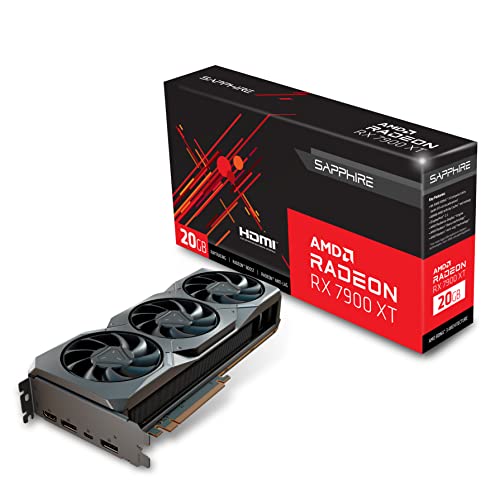 Sapphire 21323-01-20G AMD Radeon RX 7900 XT
- Memory Size: 20 GB
- Memory Interface: 320-bit DDR6
- Form Factor: 3 slot, ATX
| Product | Key specs | |
|---|---|---|
 NVIDIA GeForce RTX 3090 Founders Edition Graphics NVIDIA GeForce RTX 3090 Founders Edition Graphics | Check price | |
 ASUS ROG Strix GeForce RTX 3090 OC ASUS ROG Strix GeForce RTX 3090 OC | Check price | |
| Sapphire 21323-01-20G AMD Radeon RX 7900 XT | Memory Size: 20 GB Memory Interface: 320-bit DDR6 Form Factor: 3 slot, ATX | Check price |
 Sapphire 11323-02-20G Pulse AMD Radeon RX 7900 Sapphire 11323-02-20G Pulse AMD Radeon RX 7900 | Boost Clock: Up to 2450 MHz Game Clock: Up to 2075 MHz Memory Size/Bus: 20GB/320 bit DDR6 | Check price |
As an Amazon Associate we earn from qualifying purchases at no extra cost to you.
Former Flagship vs Upper-Tier Successor
The RTX 3090 launched in September 2020 at $1,499 as the top of NVIDIA’s Ampere lineup, a card aimed as much at creators as gamers thanks to its 24 GB of GDDR6X. The RX 7900 XT launched in November 2022 at $899 as the second-tier card in AMD’s RDNA 3 lineup, below the 7900 XTX. Despite the large difference in launch price, the two cards meet in roughly the same performance class, and on the used market they often sell for similar amounts.
Specification Table
| Specification | RTX 3090 | RX 7900 XT |
|---|---|---|
| Architecture | Ampere | RDNA 3.0 |
| Release date | 1 September 2020 | 3 November 2022 |
| Launch MSRP | $1,499 | $899 |
| Shader units | 10496 CUDA cores | 5376 stream processors |
| Boost clock | 1695 MHz | 2394 MHz |
| Process | 8 nm | 5 nm |
| Board power (TDP) | 350 W | 300 W |
| Memory | 24 GB GDDR6X | 20 GB GDDR6 |
| Memory bus | 384-bit | 320-bit |
| Bandwidth | 936.2 GB/s | 800.0 GB/s |
| Cache | 6 MB L2 | 6 MB L2 + 80 MB L3 |
| PCIe interface | PCIe 4.0 x16 | PCIe 4.0 x16 |
| Power connectors | 1x 12-pin (Founders Edition) | 2x 8-pin (reference) |
| Length (reference) | 336 mm | 276 mm |
| Slot width | 3-slot | 2-slot |
| Display outputs | 1x HDMI, 3x DisplayPort | 1x HDMI 2.1a, 2x DP 2.1, 1x USB-C |
Shader counts are not comparable across these architectures. Ampere’s CUDA core count was doubled by counting dual-issue FP32 units, and RDNA 3 also uses dual-issue designs, so performance has to come from game results rather than spec arithmetic.
Rasterized Performance at 1440p and 4K
TechPowerUp’s RX 7900 XT review concluded that the card matches RTX 3090 Ti performance at a much lower price, while noting weaker scaling at 4K than at lower resolutions. Since the RTX 3090 Ti sits above the RTX 3090, that places the 7900 XT ahead of the RTX 3090 in TechPowerUp’s averages, with forum summaries of its data putting the 4K lead at around 13%. Digital Trends measured about a 20% lead over the RTX 3090 with ray tracing games excluded, while KitGuru and TechSpot found narrower results in some titles, around 4-5% at 4K. A fair range is roughly 5-20% in the 7900 XT’s favor without ray tracing.
Both cards are comfortable 4K performers. As TechPowerUp put it, the 7900 XT can run most titles above 60 FPS at 4K with maximum details. At 1440p, both cards typically deliver well above 100 FPS in mainstream AAA games. These figures move with game settings, CPU, driver version and patches, and at 1440p a fast CPU is needed to separate them.
Ray Tracing and Upscaling: NVIDIA’s Territory
With ray tracing enabled, the picture changes. TechSpot found the 7900 XT roughly matching the RTX 3080 Ti and RTX 3090 in its ray tracing tests at 4K, and KitGuru found it falling below 30 FPS at 1440p in Cyberpunk 2077 with RT Ultra, slightly behind an RTX 3080 10GB. In heavier path-traced or RT-intensive games, the RTX 3090 usually pulls ahead. In lighter ray tracing loads, the two are close.
Upscaling and frame generation support:
- RTX 3090: DLSS Super Resolution including the transformer-based DLSS 4 model, plus Reflex. It does not support DLSS Frame Generation, which requires RTX 40 or newer, but it can use FSR 3 frame generation in supported games.
- RX 7900 XT: FSR 2 and FSR 3, FSR 3 frame generation and driver-level AMD Fluid Motion Frames. AMD’s ML-based FSR 4 is designed around RDNA 4, so RDNA 3 relies on the older FSR versions in official support.
DLSS still produces cleaner upscaled images than FSR 2 and FSR 3 in most games, especially at the Performance preset. That narrows the 7900 XT’s raster lead in practice when both cards upscale to 4K.
VRAM: 24 GB vs 20 GB
Both cards have more memory than any current game needs at 4K. A rough 2026 guide: 12-16 GB covers 4K with high textures in nearly all titles, and 16-20 GB covers ray tracing plus frame generation at 4K. Both clear that comfortably, so VRAM does not separate them for gaming. The RTX 3090’s extra 4 GB matters mainly for local AI models, 3D rendering and video work, where CUDA support and the larger buffer give it an advantage.
Power, Heat, PSU and Case Fit
The RTX 3090 is rated at 350 W against 300 W for the 7900 XT, and the 3090’s GDDR6X memory is known for running hot, particularly on the rear memory modules of the Founders Edition. A worked PSU estimate (GPU board power + about 150 W for a high-end CPU + 150 W headroom):
- RTX 3090: 350 + 150 + 150 = 650 W, so a quality 750-850 W unit is advisable given Ampere’s power spikes.
- RX 7900 XT: 300 + 150 + 150 = 600 W, so a quality 750 W unit.
Size is a bigger practical difference. The RTX 3090 reference card is 336 mm long and three slots thick; partner models are often larger. The RX 7900 XT reference card is 276 mm and two slots, which fits many mid-tower cases that cannot take a 3090. Measure GPU clearance and check that a 3-slot card does not block other expansion slots.
Connectors: the RTX 3090 Founders Edition uses a 12-pin connector with an adapter for two 8-pin cables, while partner 3090 cards commonly use two or three 8-pin connectors. The reference 7900 XT uses two 8-pin connectors.
Transient power behavior is worth a note. Ampere cards, the RTX 3090 in particular, were known for very short power spikes well above rated board power, which tripped overcurrent protection on some older or lower-quality power supplies. A modern ATX 3.0 or ATX 3.1 unit handles those transients better, and either card benefits from a PSU with solid single-rail or well-distributed 12 V capacity.
Used-Market Notes
In 2026, the RTX 3090 typically sells used in the $650-$800 range, with demand propped up by AI hobbyists who value its 24 GB. The RX 7900 XT typically sells used in roughly the $500-$600 range. For used 3090s, check memory temperatures under load, fan health and whether thermal pads have been replaced, since many cards spent time in mining rigs. Used 7900 XTs are younger and less likely to have heavy wear.
A cost-per-frame comparison using those midpoints and an index where the RTX 3090 equals 100 and the 7900 XT around 110 in raster:
- RTX 3090 at about $725: about $7.25 per performance point.
- RX 7900 XT at about $550: $5.00 per performance point.
For gaming alone, the 7900 XT is the clear value winner. New current-generation cards such as the RTX 5070 Ti and Radeon RX 9070 XT also compete in this class with stronger upscaling, so both used options should be priced against them.
Which Card Fits Which Buyer
| Priority | RTX 3090 | RX 7900 XT |
|---|---|---|
| 4K raster gaming value | Good | Better |
| Heavy ray tracing / path tracing | Better | Weaker |
| Upscaling image quality | Better (DLSS) | FSR 2/3 |
| Local AI, CUDA, rendering | Much better | Limited |
| Mid-tower case, 750 W PSU | Tight | Easier fit |
| Lower heat and noise | Hotter | Better |
Frequently Asked Questions
Is the RX 7900 XT faster than the RTX 3090?
In rasterized games, yes. Reviews place it roughly 5-20% ahead at 4K, with TechPowerUp finding it level with the RTX 3090 Ti. With heavy ray tracing, the RTX 3090 usually matches or beats it.
Does the RTX 3090 support DLSS Frame Generation?
No. DLSS Frame Generation requires RTX 40 or newer cards. The RTX 3090 does support DLSS 4 transformer-based upscaling and can use FSR 3 frame generation in supported games.
What PSU do I need for an RTX 3090?
A quality 750-850 W unit is the safe choice, as Ampere cards can produce brief power spikes above their rated 350 W. Make sure the PSU has enough separate 8-pin cables for the card’s connectors or adapter.
Is 20 GB on the RX 7900 XT enough for 4K?
Yes, comfortably. Current games at 4K with high textures and ray tracing typically use well under 20 GB. The RTX 3090’s extra memory matters more for AI and creative workloads than for gaming.
Will an RTX 3090 fit in my case?
The reference card is 336 mm long and three slots thick, and many partner versions are larger. Check the case’s maximum GPU length and slot clearance before buying. The RX 7900 XT reference card is shorter and two slots thick.









