Our Short List of 3

- Best for: A beginner who wants a simple, proven first piano with no learning curve on the controls.
- 88 weighted keys with Graded Hammer Standard action
- 10 voices, including grand piano tones
- Music rest and sustain foot switch in the box
- Built-in speakers and USB connectivity
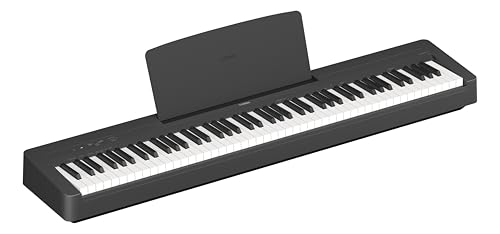
- Best for: A beginner who wants the lightest Yamaha in this guide, with phone audio played through the piano speakers.
- 88 weighted keys with GHC keyboard and matte black keytops
- Four touch settings: hard, medium, soft, fixed
- 64-note polyphony and 10 voices
- Bluetooth audio, one headphone jack, and built-in speakers

- Best for: A beginner in a small room who needs the slimmest 88-key piano that can also run on batteries.
- 88 keys with Smart Scaled Hammer Action
- Five touch sensitivity levels plus off
- 192-note polyphony and 18 tones
- 8 W plus 8 W amplifiers and two headphone jacks
All 4 Picks at a Glance
| Product | Specs | Action |
|---|---|---|
| Yamaha P-45 |
| Check price on Amazon |
| Yamaha P-145BT |
| Check price on Amazon |
| Casio Privia PX-S1100 |
| Check price on Amazon |
 Donner DEP-20 |
| Check price on Amazon |
Key takeaways
- Compare five beginner keyboards with weighted keys, from the Yamaha P-45 to the Roland FP-10, and pick the 88-key piano that fits your practice space.
A beginner who learns on weighted keys builds finger strength and control that transfer straight to an acoustic piano, and that single choice shapes every practice session that follows. Light, springy keys let bad habits slide by unnoticed, while a graded hammer action pushes back the way a real piano does, so soft passages stay soft and loud passages take real effort. The hard part is picking a first instrument that feels honest without demanding a studio budget or a permanent corner of the living room.
This guide compares five 88-key instruments aimed at new players, from a stripped-back Yamaha that keeps the controls out of the way to a Donner that packs in hundreds of sounds for curious households. Every pick below states weighted or hammer-action keys on its Amazon listing, so the comparison turns on action feel, sound, size, and the extras in the box. Read on to match one of them to the way you plan to practise, the room you have, and the lessons ahead.
Quick Picks
As an Amazon Associate we earn from qualifying purchases.
| Product | Best for | Key spec from title |
|---|---|---|
| Yamaha P-45 | A first piano with no distractions | 88 weighted keys, GHS action |
| Yamaha P-145BT | A lighter Yamaha with Bluetooth audio | 88 weighted keys, GHC action |
| Roland FP-10 | The most piano-like key feel | PHA-4 weighted hammer action |
| Casio Privia PX-S1100 | A slim piano for small rooms | Smart Scaled Hammer Action, 88 keys |
| Donner DEP-20 | A feature-packed first piano | 88 full-size weighted keys, 238 tones |
How to Choose
Key action and graded weight
Weighted keys are not all the same, and the action decides how much of your practice transfers to an acoustic piano. A graded hammer action makes the low keys heavier than the high ones, matching the way hammers work inside a real piano, and that resistance trains even finger strength from the first scale. Some actions add escapement, the small click that lets a key reset before it returns fully, which helps with fast repeated notes. Others stay simpler and lighter, which suits younger hands and shorter practice sessions. Before ordering, look for the words weighted, graded, or hammer action on the listing itself, and treat semi-weighted as a different category altogether.
Key count and full-size keys
A full 88-key layout covers every piece a beginner method book will ask for, from the lowest bass notes to the top of the treble, and it means the instrument never runs out of range halfway through a song. Shorter boards save space and money, yet they force players to shift octaves mid-piece, a habit that becomes hard to unlearn later. Full-size keys matter just as much as the count, because narrow keys teach finger spacing that does not carry over to a real piano. All five instruments in this guide have 88 full-size keys, so the choice here is about the action and the body around those keys rather than the range.
Sound, speakers and headphone practice
The piano voice is the sound a beginner hears most, so it deserves more attention than the number of extra tones on the box. A focused grand piano sample with a clean speaker system keeps practice pleasant at living-room volume, while a weak speaker makes even good playing sound thin. Headphone jacks matter for late practice and shared homes, and two jacks let a teacher listen alongside a student without extra gear. Polyphony, the number of notes that can sound at once, also counts once the sustain pedal enters the picture, because held chords and layered tones eat through a low figure quickly. Check the listed polyphony and speaker setup before deciding.
Size, weight and what comes in the box
An 88-key piano is a large object, and where it lives decides how often it gets played. Slim slabs slide under a bed or lean against a wall between sessions, while deeper bodies with furniture stands stay put and look like part of the room. Weight matters too when the piano moves between rooms or travels to lessons, since the models here range from just over 11 kg to well above that once a stand is added. Check what the listing includes: a music rest, a sustain pedal, and a power supply should be in the box, while a stand, a bench, and a three-pedal unit are often separate purchases that change the real cost of starting.
The 5 Best Options
Yamaha P-45
- Best for: A beginner who wants a simple, proven first piano with no learning curve on the controls.
- 88 weighted keys with Graded Hammer Standard action
- 10 voices, including grand piano tones
- Music rest and sustain foot switch in the box
- Built-in speakers and USB connectivity
A beginner who wants a simple, proven first piano with no learning curve on the controls.
Confirm it is still sold before buying, since the listing page could not be opened directly for this check. The stand and bench are separate purchases, and the speaker output is modest for a large room.
The P-45 has long been the usual first digital piano for new players, and its appeal is how little stands between a beginner and playing. Yamaha pairs its Graded Hammer Standard action with ten voices and a single row of plainly marked buttons, so a new player can switch sounds, set the metronome, and start a song without opening a manual. The listing calls it out as suited to the needs of the beginner piano student, and the included music rest and sustain foot switch cover the basics from day one.
Watch out for: Confirm it is still sold before buying, since the listing page could not be opened directly for this check. The stand and bench are separate purchases, and the speaker output is modest for a large room.
Yamaha P-145BT
- Best for: A beginner who wants the lightest Yamaha in this guide, with phone audio played through the piano speakers.
- 88 weighted keys with GHC keyboard and matte black keytops
- Four touch settings: hard, medium, soft, fixed
- 64-note polyphony and 10 voices
- Bluetooth audio, one headphone jack, and built-in speakers
A beginner who wants the lightest Yamaha in this guide, with phone audio played through the piano speakers.
Confirm it is still sold before buying, since the listing page could not be opened directly for this check. The matching three-pedal unit is a separate purchase, and Bluetooth here carries audio rather than MIDI.
The P-145BT is Yamaha’s newer entry point, and it keeps the P-45’s plain approach while slimming the body and adding Bluetooth audio. Its Graded Hammer Compact action uses matte black keytops and four touch settings, so a beginner can make the keys respond harder or softer to match their hand strength. The listing describes it as the perfect choice for beginners who want to have fun playing while enjoying music, and the 24.5-pound body makes it the easiest Yamaha here to carry to a lesson or store away after practice.
Watch out for: Confirm it is still sold before buying, since the listing page could not be opened directly for this check. The matching three-pedal unit is a separate purchase, and Bluetooth here carries audio rather than MIDI.
Roland FP-10
The FP-10 earns its place on the strength of its keyboard alone. Roland’s PHA-4 Standard action is a full hammer action with escapement and ivory-feel white keys, which gives repeated notes and soft passages a response closer to an acoustic piano than any other action at this level. The SuperNATURAL piano tones and 96-voice polyphony keep the sound honest, while Bluetooth MIDI and a USB interface connect the piano to lesson apps on a phone or tablet. Twin Piano mode splits the keyboard so a teacher and a student can play side by side in the same range.
Specs
- 88 keys with PHA-4 weighted hammer-action keyboard and escapement
- Ivory-feel white keys
- 96-voice polyphony with SuperNATURAL piano tones
- Twin Piano mode, Bluetooth MIDI, and USB interface
- Onboard stereo speakers and one headphone jack
- Pedal switch in the box; item weight 12.6 kg without the music rest
Best for: A beginner who puts key feel first and wants the most acoustic-like action in this guide.
Watch out for: Confirm it is still sold before buying, since the listing page could not be opened directly for this check. The speakers are modest next to the step-up FP-30X, and the stand is not included.
Casio Privia PX-S1100
- Best for: A beginner in a small room who needs the slimmest 88-key piano that can also run on batteries.
- 88 keys with Smart Scaled Hammer Action
- Five touch sensitivity levels plus off
- 192-note polyphony and 18 tones
- 8 W plus 8 W amplifiers and two headphone jacks
A beginner in a small room who needs the slimmest 88-key piano that can also run on batteries.
Confirm it is still sold before buying, since the listing page could not be opened directly for this check. The action has no escapement, and the piano needs a table or a stand, which is not in the box.
The PX-S1100 is the slimmest piano in this guide, and its body is barely larger than the keys themselves, which makes it the natural pick when floor space is tight. Casio’s Smart Scaled Hammer Action gives each of the 88 keys its own weighted response, and the listing pairs that action with 192-note polyphony, 18 tones, and two headphone jacks. Six AA batteries can power it away from a wall socket, so practice can move to any room in the house, and Bluetooth audio lets a phone play backing tracks through the built-in speakers.
Watch out for: Confirm it is still sold before buying, since the listing page could not be opened directly for this check. The action has no escapement, and the piano needs a table or a stand, which is not in the box.
Donner DEP-20
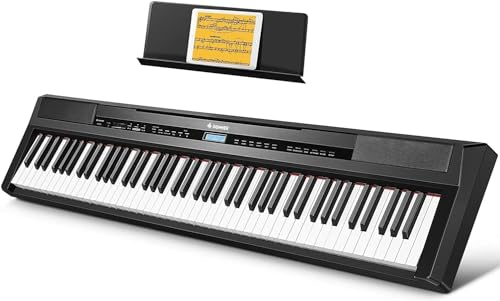
- Best for: A household that wants one feature-packed piano for exploring sounds, rhythms, and recording from the start.
- 88 full-size hammer-action keys with adjustable touch response
- 238 tones, 200 rhythms, and 128-note polyphony
- Backlit LCD showing chord names and notation
- MIDI recording mode and MP3 player
A household that wants one feature-packed piano for exploring sounds, rhythms, and recording from the start.
Confirm it is still sold before buying, since the listing page could not be opened directly for this check. The action has no named escapement mechanism, and the body is deeper and heavier than the slim slabs here.
The DEP-20 takes the opposite approach to the Yamahas in this guide: instead of trimming the feature list, it loads the piano with sounds and practice tools. Its 88 full-size hammer-action keys come with adjustable touch response, and the listing adds 238 tones, 200 rhythms, a backlit LCD that names chords, and a MIDI recorder, so a curious beginner can explore well beyond the piano voice. A sustain pedal and power supply are in the box, and the two 25 W amplifiers are the strongest speakers in this guide, which helps the piano fill a room without extra gear.
Watch out for: Confirm it is still sold before buying, since the listing page could not be opened directly for this check. The action has no named escapement mechanism, and the body is deeper and heavier than the slim slabs here.
Which One Fits Your Situation
You want the simplest first piano
Pick the Yamaha P-45 when the goal is to sit down and play with no menus to learn. Its ten voices and plain buttons keep every session focused on the keys, and the GHS action gives a beginner the graded resistance that builds real finger control. Add a stand and a bench, and the setup stays in one place for daily practice.
You practise in a small room or move the piano often
Pick the Casio Privia PX-S1100 when space is the deciding factor. Its slim body disappears against a wall or under a bed, the 11.2 kg weight makes it easy to carry, and battery power frees practice from the nearest socket. The two headphone jacks also help when a teacher needs to listen in.
You care most about how the keys feel
Pick the Roland FP-10 when touch matters more than extra sounds or speakers. The PHA-4 action with escapement gives the closest feel to an acoustic piano in this guide, and the SuperNATURAL tones keep the sound honest while that touch does its work. Plan on headphones for late practice, since the speakers are modest.
You want one instrument for the whole household
Pick the Donner DEP-20 when several people will share the piano and explore different sounds. Its 238 tones, rhythms, and recording mode give younger players something playful between lessons, while the strong speakers and included pedal make it ready to play from the box. The Yamaha P-145BT is the lighter alternative if Bluetooth audio matters more than the extra tones.
Common Mistakes
- Buying semi-weighted keys by mistake: check that the listing states weighted, graded, or hammer action in its own words before ordering.
- Choosing a 61-key board to save space, then running out of range in the first method book.
- Forgetting the stand and bench: most portable pianos in this guide ship without them, so budget for the full setup.
- Judging a piano by its tone count instead of its piano voice, which is the sound a beginner hears in nearly every session.
- Skipping the headphone check in a shared home, where a single jack can decide whether late practice is possible at all.
Frequently Asked Questions
Do beginners really need weighted keys?
Weighted keys build the finger strength and dynamic control that transfer directly to an acoustic piano, which is why teachers usually ask for them from the start. Unweighted keys feel easier at first, yet they teach a light touch that has to be relearned later. A graded hammer action is the safest starting point for anyone planning lessons.
How many keys should a beginner keyboard have?
Eighty-eight full-size keys cover the complete range of beginner repertoire, so no piece runs off the end of the instrument. Shorter boards work for travel or very young children, but they force octave shifts that interrupt songs. If the piano stays at home, the full layout is worth the extra width.
Is 88 keys too much piano for a child?
The full range is not the problem; the weight of the action and the reach to the pedals matter more for young players. A graded action with adjustable touch settings, like the four levels on the P-145BT, lets a child play comfortably while still building strength. Check the bench height and the pedal position before deciding.
Can a weighted keyboard run on batteries?
Some can, and the Casio PX-S1100 in this guide runs on six AA batteries as well as its adaptor, which suits practice away from a socket. Most portable pianos still need mains power, so check the listing for battery support rather than assuming it. Battery life is usually measured in hours, not days, so keep the adaptor nearby.
FAQ
Do beginners really need weighted keys?
How many keys should a beginner keyboard have?
Is 88 keys too much piano for a child?
Can a weighted keyboard run on batteries?
More from Amazon
Programs that pair well with the guide above. Offers and eligibility are set by Amazon and may change.
Free shipping on eligible items, Prime Video and more. Eligible new members can start with a free trial.
Start a Prime free trialAd-free music streaming. Eligible new subscribers can start with a free trial.
Try Music Unlimited freeA Prime membership for ages 18-24 with a trial period. Eligibility is set by Amazon.
See Prime for Young AdultsAudiobooks and podcasts to listen to on the go. Eligible new members can start with a free trial.
Try Audible freeAs an Amazon Associate we earn from qualifying purchases.