Our Short List of 3

- Best for: A first keyboard for a young child, roughly ages five and under, who needs the smallest keys and the simplest controls.
- 32 mini keys sized for small hands
- 100 high-quality built-in tones
- 50 rhythm patterns
- 10 built-in songs with melody-off lesson mode
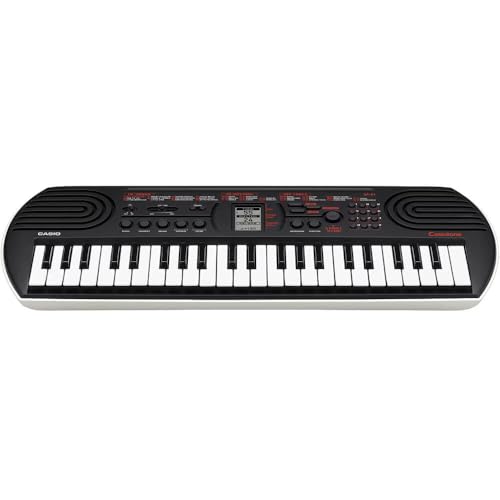
- Best for: A child who is ready for 44 keys and two-handed playing, or an older beginner who wants the most capable mini-key Casio.
- 44 mini keys sized for small hands
- 100 high-quality built-in tones
- 50 rhythm patterns
- 10 play-along songs with melody-off lesson mode

- Best for: A spare or travel keyboard where drum pads and rhythm play matter more than polyphony, or a younger player who mainly plays single-note melodies.
- 44 mini-sized keys
- 5 percussion pads
- 100 sounds
- 50 rhythm patterns
All 3 Picks at a Glance
| Product | Specs | Action |
|---|---|---|
| Casio Casiotone SA-51 32-Key Mini Keyboard |
| Check price on Amazon |
| Casio Casiotone SA-81 44-Key Mini Keyboard |
| Check price on Amazon |
| Casio SA-76 44-Key Mini Personal Keyboard |
| Check price on Amazon |
Key takeaways
- Compare Casio toy keyboards for kids: 32-key and 44-key mini models with 100 tones, 50 rhythms and built-in songs for first-time players at home.
The real decision when buying a Casio toy keyboard is not which model sounds best in a shop demonstration. It is whether the keys fit the child who will play them, and whether the instrument stays fun after the first week. Mini keys sized for small hands, a small number of keys a beginner can see at a glance, and built-in songs that invite practice matter far more than a long feature list. A keyboard that is too big or too complicated ends up in a cupboard, while a small one a child can switch on alone gets played every day.
This guide is for parents, grandparents and guardians choosing a first keyboard for a young child, and for anyone buying a portable second keyboard for travel or lessons. Every model below is a Casio mini-key keyboard with its key count, tones, rhythms and songs taken from its Amazon listing, so you can match the instrument to the player rather than to a brand name alone.
Quick Picks
As an Amazon Associate we earn from qualifying purchases
| Product | Best for | Key spec from title |
|---|---|---|
| Casio Casiotone SA-51 32-Key Mini Keyboard | The youngest first-time player | 32 mini keys, 100 tones |
| Casio Casiotone SA-81 44-Key Mini Keyboard | A child ready for more playing range | 44 mini keys, 100 tones |
| Casio SA-76 44-Key Mini Personal Keyboard | A spare keyboard with drum pads for rhythm play | 44 mini keys, 5 percussion pads |
How to Choose
Key count and key size
Key count decides how much music a child can reach, and key size decides whether small hands can reach it at all. A 32-key board covers about two and a half octaves, which is enough for first songs and simple melodies. A 44-key board adds roughly one more octave, so a child can play a melody with one hand and simple chords or a bass line with the other. All three models in this guide use mini keys, which are narrower and shorter than full-size piano keys. That is the whole point of a toy keyboard: the keys are built for small fingers. An adult with large hands will find them cramped, so buy for the child.
Tones, rhythms and songs
A toy keyboard earns its place by giving a child sounds worth exploring, and the Casio SA range is consistent here: each model in this guide offers 100 built-in tones, 50 rhythm patterns and 10 built-in songs. The tones cover piano, trumpet, drums and many other instruments, with direct buttons for piano, trumpet and drum set tones on the 32-key models. The rhythms span pops, ballad, dance and more, so a child can play along with a beat instead of playing alone in silence. The 10 built-in songs include familiar tunes such as Twinkle Twinkle Little Star and Ode to Joy, and a melody-off lesson mode lets the child play the tune while the keyboard supplies the backing.
Polyphony and speakers
Polyphony is the number of notes a keyboard can sound at once, and it is the clearest technical split between the models in this guide. The current SA-51 and SA-81 play up to 32 notes at once, which keeps chords and held notes sounding cleanly when a child plays with both hands. The older SA-76 plays up to 8 notes at once, which is fine for single-note melodies but can cut notes short during fuller playing. Speaker size follows the same split: the 32-key models use two 0.5 watt speakers, while the 44-key models use two 0.8 watt speakers. Every model here has a headphone jack, so quiet practice is possible regardless of which one you choose.
Power, portability and what is missing
Every model in this guide runs on six AA batteries or an AC adapter, and the adapter is sold separately, so buy one before the keyboard arrives. Batteries are what make these keyboards portable: the 32-key models weigh about 1.0 kg and the 44-key models about 1.4 kg, so a child can carry one to lessons or a grandparent’s house. What they do not have matters just as much. None of them has touch-sensitive keys, weighted keys, a sustain pedal input or a MIDI connection, so they cannot grow into a piano-practice instrument or connect to lesson apps. Buy one as a first step, and expect to move to a larger keyboard if lessons become serious.
The 3 Best Options
Casio Casiotone SA-51 32-Key Mini Keyboard
- Best for: A first keyboard for a young child, roughly ages five and under, who needs the smallest keys and the simplest controls.
- 32 mini keys sized for small hands
- 100 high-quality built-in tones
- 50 rhythm patterns
- 10 built-in songs with melody-off lesson mode
A first keyboard for a young child, roughly ages five and under, who needs the smallest keys and the simplest controls.
The AC adapter and batteries are both sold separately, and the 32 mini keys give less playing range than a 44-key board, so a fast-progressing child may outgrow it.
The SA-51 is the smallest keyboard in this guide and the best starting point for the youngest players. Its 32 mini keys fit hands that cannot yet stretch an octave on full-size keys, and the one-touch tone buttons let a small child switch from piano to trumpet to drums without reading a menu. The built-in songs and the melody-off lesson mode turn practice into a game of playing along, and the whole instrument weighs about 1.0 kg, so it travels in a backpack and runs on batteries wherever it lands. It is a genuine first instrument, with a clear LCD display and a headphone jack for quiet sessions.
Casio Casiotone SA-81 44-Key Mini Keyboard
- Best for: A child who is ready for 44 keys and two-handed playing, or an older beginner who wants the most capable mini-key Casio.
- 44 mini keys sized for small hands
- 100 high-quality built-in tones
- 50 rhythm patterns
- 10 play-along songs with melody-off lesson mode
A child who is ready for 44 keys and two-handed playing, or an older beginner who wants the most capable mini-key Casio.
The keys are still mini size, so adults will find them cramped, and the AC adapter is sold separately, so budget for power on arrival.
The SA-81 is the step up for a child who has outgrown a 32-key board or who is old enough to start with more range. Its 44 mini keys still suit small hands, but the extra octave makes room for two-handed playing, simple chords and a bass line under a melody. It keeps the same friendly formula as the SA-51, with 100 tones, 50 rhythms and 10 play-along songs, and adds a fuller sound through larger speakers and 32-note polyphony that holds chords together. The compact body remains portable at about 1.4 kg, and the headphone jack keeps practice quiet in a shared home.
Casio SA-76 44-Key Mini Personal Keyboard
- Best for: A spare or travel keyboard where drum pads and rhythm play matter more than polyphony, or a younger player who mainly plays single-note melodies.
- 44 mini-sized keys
- 5 percussion pads
- 100 sounds
- 50 rhythm patterns
A spare or travel keyboard where drum pads and rhythm play matter more than polyphony, or a younger player who mainly plays single-note melodies.
Casio has discontinued the SA-76, so new stock is limited. Check the Amazon listing before ordering to confirm the unit is new rather than used, and expect 8-note polyphony to cut notes during chord playing.
The SA-76 is the older 44-key model in the Casio mini range, and its appeal is the five percussion pads that the other models here do not offer. A child can tap out drum patterns between melodies, which makes it a lively second keyboard for fun rather than formal practice. It shares the family formula of 44 mini keys, 100 sounds, 50 rhythm patterns and 10 built-in songs, with an easy-to-read LCD display and a headphone jack. Its limits are real: Casio has discontinued this model, and its 8-note polyphony is far below the 32 notes of the SA-81, so chords can drop out during busier playing.
Which One Fits Your Situation
Buying for the youngest beginner
Choose the Casio SA-51. Its 32 mini keys are the smallest in this guide, and a young child can reach an octave that would be impossible on full-size keys. The direct tone buttons and the 10 built-in songs keep the experience simple, and the light body means the child can carry it and switch it on without help. The limited range is a fair trade at this age, because the goal is confidence and curiosity, not repertoire.
Buying for a child who is progressing
Choose the Casio SA-81. The 44 mini keys give a growing player room for two-handed pieces, and the 32-note polyphony keeps chords sounding properly as playing gets busier. It keeps the same 100 tones and 50 rhythms as the SA-51, so nothing familiar is lost, and the larger speakers suit a living room better than a bedroom-only instrument. It is the model to pick when lessons are likely to continue past the first few months.
Buying a second keyboard for travel or another home
Choose the Casio SA-76, with its discontinued status checked first. Its 44 mini keys match the SA-81 for range, and the five percussion pads make it the most playful of the three for car journeys, holidays or a grandparent’s house. Treat it as a spare rather than a main instrument, confirm the listing sells a new unit, and accept that its 8-note polyphony suits melodies better than chords.
Buying for quiet practice in a shared home
Choose the SA-51 or the SA-81, since both have a headphone jack and small speakers that stay modest at low volume. Pick the SA-51 if the player is very young and the keyboard will move between rooms, and pick the SA-81 if the player is older and practises longer sessions with both hands. Either way, buy headphones and batteries or an adapter at the same time, because neither comes in the box.
Common Mistakes
- Buying a full-size keyboard for a small child and expecting small hands to reach an octave they physically cannot stretch.
- Assuming the AC adapter or batteries are included, then finding the keyboard cannot be switched on when it arrives.
- Expecting touch-sensitive or weighted keys, a sustain pedal or a MIDI connection from a toy keyboard that lists none of these.
- Choosing the SA-76 for chord-heavy playing without noticing its 8-note polyphony, then wondering why notes drop out.
- Ordering the SA-76 from a listing without checking whether the unit is new or used, since Casio has discontinued that model and new stock is limited.
Frequently Asked Questions
Are Casio toy keyboards good for a first instrument?
Yes, as a first step into music. The mini keys fit small hands, the 100 tones and 50 rhythms invite exploration, and the 10 built-in songs with a melody-off mode give a child something to play along with from day one. They are no substitute for a piano once lessons become serious, so treat one as a starting point and upgrade when the teacher advises it.
What is the difference between the Casio SA-51 and SA-81?
The main difference is key count: the SA-51 has 32 mini keys and the SA-81 has 44, which gives the SA-81 about one more octave for two-handed playing. Both share 100 tones, 50 rhythms, 10 songs and 32-note polyphony, and both run on six AA batteries or a separately sold adapter. Pick the SA-51 for the youngest players and the SA-81 for a child ready for more range.
Do Casio SA keyboards need batteries or an adapter?
Both. Each model runs on six AA batteries or an AC adapter, and neither is included in the box, so you need to buy one or the other before the first session. Batteries make the keyboard portable for lessons, travel and outdoor play, while an adapter suits regular practice at home. Check the exact adapter model for the keyboard you buy, because the wrong adapter will not fit.
Can a child use headphones with a Casio toy keyboard?
Yes. All three models in this guide have a headphone jack, so a child can practise quietly while others are in the room. None of them has a MIDI or USB connection, so they cannot connect to lesson apps or recording software on a computer. If app-based lessons matter, a larger Casio model with USB-MIDI is a better choice.
FAQ
Are Casio toy keyboards good for a first instrument?
What is the difference between the Casio SA-51 and SA-81?
Do Casio SA keyboards need batteries or an adapter?
Can a child use headphones with a Casio toy keyboard?
More from Amazon
Programs that pair well with the guide above. Offers and eligibility are set by Amazon and may change.
Free shipping on eligible items, Prime Video and more. Eligible new members can start with a free trial.
Start a Prime free trialAd-free music streaming. Eligible new subscribers can start with a free trial.
Try Music Unlimited freeA Prime membership for ages 18-24 with a trial period. Eligibility is set by Amazon.
See Prime for Young AdultsAudiobooks and podcasts to listen to on the go. Eligible new members can start with a free trial.
Try Audible freeAs an Amazon Associate we earn from qualifying purchases.