Our Short List of 3

- Best for: A household upgrading to Wi-Fi 6E that wants a 6 GHz lane for the main television without paying flagship money.
- Tri-band Wi-Fi 6E router, AXE5400: 574 Mbps on 2.4 GHz, 2,402 Mbps on 5 GHz, 2,402 Mbps on 6 GHz
- 160 MHz channel support on the 6 GHz band
- 2.5 Gbps WAN port, four gigabit LAN ports, one USB 3.0 port
- 1.7 GHz quad-core CPU with 512 MB of RAM

- Best for: A security-minded household that streams on several screens and wants mesh expansion as an option later.
- Tri-band Wi-Fi 6E router, speeds up to 7,800 Mbps
- 6 GHz band for added capacity and steadier connections
- 2.5 Gbps WAN/LAN port with WAN and LAN aggregation
- AiProtection Pro network security and ASUS Safe Browsing

- Best for: A larger home that streams in several rooms and wants stated coverage and device capacity to guide the choice.
- Tri-band Wi-Fi 6E router, AXE7800, wireless speed up to 7.8 Gbps
- New 6 GHz band
- Eight streams across the three bands
- Coverage up to 2,500 sq. ft.
All 4 Picks at a Glance
| Product | Specs | Action |
|---|---|---|
| TP-Link Archer AXE75 |
| Check price on Amazon |
| ASUS RT-AXE7800 |
| Check price on Amazon |
| NETGEAR Nighthawk RAXE300 |
| Check price on Amazon |
 NETGEAR Nighthawk RAX50 |
| Check price on Amazon |
Our Top Picks
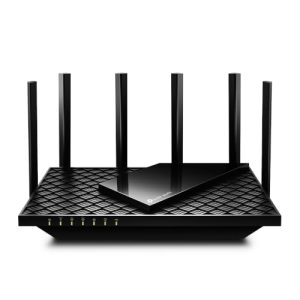
- TP-Link AXE5400 Tri-Band WiFi 6E RouterWiFi 6E, Tri-Band AXE540012.91 x 10.43 x 4.72 inches1.5 poundsCheck on Amazon
A stream that stalls in the final minutes of a film is rarely a problem with the streaming service. More often the router cannot keep up once several televisions, phones and laptops all ask for video at the same time, and the household notices the shortfall as buffering, sudden drops in picture quality and audio that drifts out of sync. The decision that matters is not which router prints the largest speed number on the box, but which one keeps a steady flow of data reaching the screen while the rest of the home stays online.
This roundup is written for households that stream in more than one room, for viewers who watch in 4K and want that resolution to hold, and for anyone whose evenings mix video with video calls, downloads and gaming. Every router below was picked from the name and specifications on its Amazon listing, with the emphasis on wireless standard, band layout, wired ports and traffic controls that decide whether a stream stays smooth.
Quick Picks
As an Amazon Associate we earn from qualifying purchases
| Product | Best for | Key spec from title |
|---|---|---|
| TP-Link Archer AXE75 | First Wi-Fi 6E upgrade for a streaming household | AXE5400 Tri-Band WiFi 6E Router |
| ASUS RT-AXE7800 | A security-minded home that streams on several screens | AXE7800 Tri-band WiFi 6E Router, 6GHz Band, 2.5G Port |
| NETGEAR Nighthawk RAXE300 | Larger homes that need wide coverage for streaming | AXE7800 Tri-Band WiFi 6E Router, New 6GHz Band, 8-Streams |
| NETGEAR Nighthawk RAX50 | A straightforward Wi-Fi 6 step up for 4K viewing | AX5400 WiFi 6 Router, 6-Stream, Up to 5.4 Gbps |
How to Choose
Match the wireless standard to the streams, not the box
Wi-Fi 6 handles several devices at once far better than the older Wi-Fi 5 standard, because it schedules airtime more efficiently instead of letting every device shout over the others. Wi-Fi 6E adds a 6 GHz band on top of that, giving newer televisions, laptops and phones a lane with far less interference from neighbours. A household running two 4K streams plus a video call will feel the difference in stability rather than in raw speed, since a stream needs a modest but unbroken flow. Choose Wi-Fi 6 when the budget is tight, and step up to Wi-Fi 6E when several people stream at the same hour.
Count the bands before counting the speed
A dual-band router splits traffic between 2.4 GHz and 5 GHz, which works well until the 5 GHz band fills with streams, calls and downloads. A tri-band model adds a third radio, either a second 5 GHz band or a 6 GHz band, so the heaviest traffic can move onto its own lane. The combined speed figure on the listing is the sum of every band, not the speed any single device receives, so read the per-band figures instead. For streaming, the practical question is whether the television can sit on a band that nothing else is crowding, and a tri-band layout answers that question more convincingly than a bigger headline number.
Check the wired ports, because the television should not use Wi-Fi
The most reliable stream in any home is the one that never touches the airwaves. A wired Ethernet connection removes interference, walls and neighbouring networks from the equation entirely, so the main television, the streaming box and the games console deserve cables wherever the layout allows. Look for a gigabit WAN port at minimum, and treat a 2.5 Gbps WAN or LAN port as a genuine advantage on a gigabit or faster plan, since it stops the wired side becoming the bottleneck. Four LAN ports cover a television, a console and a desktop with one spare, while a USB port adds shared storage as a bonus.
Treat QoS as the feature that protects the evening
Quality of Service decides which traffic gets priority when the connection is busy, and a stream needs steady, low-delay delivery while a cloud backup or a game download can wait. A router that lets you prioritise streaming devices or applications keeps the picture smooth when someone else starts a large download, whereas a router without that control treats every packet equally and lets the stream lose. Look for QoS settings you can adjust by device or application, rather than a single on-off switch, and confirm the feature exists on the listing before buying. The setting only helps if it is turned on and pointed at the right devices.
The 4 Best Options
TP-Link Archer AXE75
- Best for: A household upgrading to Wi-Fi 6E that wants a 6 GHz lane for the main television without paying flagship money.
- Tri-band Wi-Fi 6E router, AXE5400: 574 Mbps on 2.4 GHz, 2,402 Mbps on 5 GHz, 2,402 Mbps on 6 GHz
- 160 MHz channel support on the 6 GHz band
- 2.5 Gbps WAN port, four gigabit LAN ports, one USB 3.0 port
- 1.7 GHz quad-core CPU with 512 MB of RAM
A household upgrading to Wi-Fi 6E that wants a 6 GHz lane for the main television without paying flagship money.
The 6 GHz band only helps devices that support Wi-Fi 6E, so older televisions and streaming sticks will still use 5 GHz; check the devices first.
The Archer AXE75 is the most balanced way into Wi-Fi 6E for a household that streams every evening. Its tri-band AXE5400 layout puts a clean 6 GHz band alongside the familiar 2.4 GHz and 5 GHz radios, so a 4K television can sit on a lane that neighbours and older devices never touch. A 2.5 Gbps WAN port keeps a gigabit plan running at full speed, and the quad-core processor handles QoS, security scanning and several simultaneous streams without the slowdowns that cheaper dual-band models show under load.
Watch out for: The 6 GHz band only helps devices that support Wi-Fi 6E, so older televisions and streaming sticks will still use 5 GHz; check the devices first.
ASUS RT-AXE7800
- Best for: A security-minded household that streams on several screens and wants mesh expansion as an option later.
- Tri-band Wi-Fi 6E router, speeds up to 7,800 Mbps
- 6 GHz band for added capacity and steadier connections
- 2.5 Gbps WAN/LAN port with WAN and LAN aggregation
- AiProtection Pro network security and ASUS Safe Browsing
A security-minded household that streams on several screens and wants mesh expansion as an option later.
The 5 GHz band carries the highest single-band speed in this design, so place the router centrally; a corner placement wastes the coverage the antennas can deliver.
The RT-AXE7800 suits a home that wants fast streaming and strong network protection in the same box. Its tri-band Wi-Fi 6E design reaches up to 7,800 Mbps across the three bands, with the 6 GHz band carrying the heaviest traffic away from the crowded 5 GHz spectrum. The 2.5 Gbps port and link aggregation give wired devices real headroom, while AiProtection Pro and Safe Browsing run in the background without a separate subscription. AiMesh support means coverage can grow later with a second ASUS router instead of a full replacement.
Watch out for: The 5 GHz band carries the highest single-band speed in this design, so place the router centrally; a corner placement wastes the coverage the antennas can deliver.
NETGEAR Nighthawk RAXE300
- Best for: A larger home that streams in several rooms and wants stated coverage and device capacity to guide the choice.
- Tri-band Wi-Fi 6E router, AXE7800, wireless speed up to 7.8 Gbps
- New 6 GHz band
- Eight streams across the three bands
- Coverage up to 2,500 sq. ft.
A larger home that streams in several rooms and wants stated coverage and device capacity to guide the choice.
A Renewed listing for this model circulates under a separate code, so confirm the listing shows the new RAXE300-100NAS before ordering.
The RAXE300 brings the Nighthawk design to Wi-Fi 6E at a mid-range tier, and its eight-stream layout is built for homes where many devices stay connected all day. The listing states coverage up to 2,500 sq. ft. for up to 40 devices, which fits a larger single-storey home or a two-floor house with the router placed centrally. The 6 GHz band gives newer streaming devices a quiet lane, and the folding wing design hides six high-performance antennas inside a chassis that still fits on a shelf beside the television.
Watch out for: A Renewed listing for this model circulates under a separate code, so confirm the listing shows the new RAXE300-100NAS before ordering.
NETGEAR Nighthawk RAX50
- Best for: A household that wants a proven Wi-Fi 6 router for 4K streaming and has no Wi-Fi 6E devices yet.
- Dual-band Wi-Fi 6 router, AX5400, wireless speed up to 5.4 Gbps
- Six-stream design
- Coverage up to 2,500 sq. ft.
- Four 1G Ethernet ports and one USB 3.0 port
A household that wants a proven Wi-Fi 6 router for 4K streaming and has no Wi-Fi 6E devices yet.
A Renewed version of this router and a separate bundle circulate under other codes, so confirm the listing is the new RAX50-100NAS tied to the ASIN below.
The RAX50 is the straightforward pick for a household that wants Wi-Fi 6 speed for 4K viewing without stepping up to Wi-Fi 6E. Its dual-band AX5400 design delivers up to 5.4 Gbps across a six-stream layout, and the listing states coverage up to 2,500 sq. ft., which covers a medium to large home from a central position. Four gigabit Ethernet ports and a USB 3.0 port cover the wired side, so the main television and console can go wired while phones and laptops use the wireless bands.
Watch out for: A Renewed version of this router and a separate bundle circulate under other codes, so confirm the listing is the new RAX50-100NAS tied to the ASIN below.
Which One Fits Your Situation
Several people stream at the same time every evening
Pick the Archer AXE75 or the RT-AXE7800. Both are tri-band Wi-Fi 6E models, so the heaviest stream can move onto the 6 GHz band while phones and laptops share the other two. The AXE75 is the simpler choice for the cheapest way into Wi-Fi 6E, while the RT-AXE7800 adds stronger security and the option to grow into a mesh later.
The house is large and the far rooms keep dropping streams
Pick the Nighthawk RAXE300. Its listing states coverage up to 2,500 sq. ft. for up to 40 devices, and the eight-stream tri-band layout keeps capacity available in rooms far from the router. Place it centrally and high, wire the main television, and let the wireless bands serve the bedrooms. The RAX50 states the same coverage at a lower tier, so it fits when no device supports Wi-Fi 6E.
Only the living room television matters, and it must never buffer
Pick the RAX50 and wire the television with Ethernet. A wired connection removes the wireless variables entirely, and the AX5400 radio still leaves plenty of capacity for phones and laptops around the house. Turn on the router’s traffic controls and point them at the television, then test a 4K stream during the busiest hour before deciding anything needs changing.
The household wants security controls alongside the streaming
Pick the RT-AXE7800. AiProtection Pro and Safe Browsing run without a separate subscription, parental controls cover the children’s devices, and the Instant Guard VPN protects traffic away from home. The tri-band Wi-Fi 6E radio keeps streams smooth at the same time, so the household does not trade speed for protection.
Common Mistakes
- Buying on the headline speed alone: the combined figure adds every band together, and no single device ever receives it; read the per-band speeds and the port list instead.
- Leaving the main television on Wi-Fi: a wired connection is steadier than any wireless band, so run a cable to the television and the streaming box whenever the layout allows it.
- Hiding the router behind the television or inside a cabinet: walls and furniture absorb signal before it reaches the far rooms, so place the router high, central and in the open.
- Skipping QoS setup: traffic priority only helps when it is turned on and aimed at the streaming devices, so spend a few minutes configuring it after unboxing.
- Ordering the wrong condition or bundle: Renewed units and multi-packs circulate under separate codes for the Nighthawk models here, so match the model number and condition on the listing before checkout.
Frequently Asked Questions
Is Wi-Fi 6E worth it for streaming, or is Wi-Fi 6 enough?
Wi-Fi 6 is enough for most households, since a single 4K stream needs steady delivery rather than extreme speed, and the RAX50 covers that case well. Wi-Fi 6E earns its place when several people stream at once, when neighbours crowd the 5 GHz band, or when newer devices can use the quiet 6 GHz lane. The choice depends on how busy the home network already feels.
How many 4K streams can these routers handle at once?
The honest answer depends on the internet plan as much as the router, because the router cannot deliver bandwidth the plan does not provide. On a gigabit plan, any of these four routers has the wireless capacity for several simultaneous 4K streams, with the tri-band models coping best when the streams run at the same time. Wiring the main television frees wireless airtime for the rest.
Should the streaming device use the 5 GHz or the 6 GHz band?
Use 6 GHz when the television or streaming stick supports Wi-Fi 6E and sits in the same room as the router, since that band is the least crowded. Use 5 GHz for devices further away or behind walls, because the higher 6 GHz signal loses strength faster through obstacles. A tri-band router lets the household split devices across both bands instead of forcing everything onto one.
Do I need a 2.5 Gbps port for streaming?
Not for streaming alone, since even several 4K streams together use a fraction of a gigabit connection. A 2.5 Gbps port matters when the internet plan runs faster than a gigabit, or when a wired desktop or console shares the connection with the streams. The Archer AXE75 and the RT-AXE7800 both include one, so the option is there if the plan is upgraded later.
FAQ
Is Wi-Fi 6E worth it for streaming, or is Wi-Fi 6 enough?
How many 4K streams can these routers handle at once?
Should the streaming device use the 5 GHz or the 6 GHz band?
Do I need a 2.5 Gbps port for streaming?
More from Amazon
Programs that pair well with the guide above. Offers and eligibility are set by Amazon and may change.
Free shipping on eligible items, Prime Video and more. Eligible new members can start with a free trial.
Start a Prime free trialAd-free music streaming. Eligible new subscribers can start with a free trial.
Try Music Unlimited freeA Prime membership for ages 18-24 with a trial period. Eligibility is set by Amazon.
See Prime for Young AdultsAudiobooks and podcasts to listen to on the go. Eligible new members can start with a free trial.
Try Audible freeAs an Amazon Associate we earn from qualifying purchases.