Our Short List of 3

- Sensor: HERO 2 optical, up to 44,000 DPI
- Tracking: up to 888 IPS, up to 88 G acceleration
- Weight: 60 g
- Connection: LIGHTSPEED wireless, up to 8 kHz polling

- Sensor: Focus Pro 30K optical
- Switches: Razer Optical Gen-3, 90-million-click lifecycle
- Weight: 63 g
- Connection: HyperSpeed wireless, wired Speedflex cable

- Sensor: HERO 25K optical
- Switches: LIGHTFORCE hybrid optical-mechanical
- Weight: 86 g with battery, 68 g without
- Connection: LIGHTSPEED wireless and Bluetooth
All 5 Picks at a Glance
| Product | Specs | Action |
|---|---|---|
| 1. Logitech G PRO X Superlight 2 DEX (Black) |
| Check price on Amazon |
| 2. Razer DeathAdder V3 Pro (White) |
| Check price on Amazon |
| 3. Logitech G309 LIGHTSPEED (Black) |
| Check price on Amazon |
 4. Corsair M75 Air (White) |
| Check price on Amazon |
 5. SteelSeries Rival 3 Wireless Gen 2 (Black) |
| Check price on Amazon |
Key takeaways
- Five gaming mice you can buy new right now, each with a live in-stock Amazon listing, compared on sensor, weight, shape, battery life and connection type.
Plenty of roundups still point at mice that quietly left the market months ago. A model gets replaced, the listing lingers, and the only copies left are used units from third-party sellers at odd markups. This guide takes the opposite approach: every mouse below is a current model with a live, in-stock Amazon US listing selling new units right now, so “available” here means exactly that — you can order one today and have a factory-sealed mouse on your desk this week, not a discontinued shell or a marketplace leftover.
That filter shapes the list in a useful way. Current production mice share modern hardware: optical sensors that track far past human limits, wireless links with polling rates at or above 1,000 Hz, optical or hybrid switches that resist double-click faults, and USB-C charging on the rechargeable models. The real differences are shape, weight and battery strategy. Two picks are esports flagships built for competitive shooters. One is an ergonomic Razer classic in its lightest wireless form. One runs for months on a single AA cell, and one runs on AAA cells you can swap in seconds. Read the shape notes first, because a sensor can be flawless on paper and still feel wrong if the shell fights your grip.
Disclosure: As an Amazon Associate, we earn from qualifying purchases made through links on this page, at no extra cost to you.
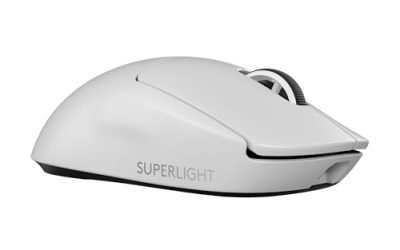
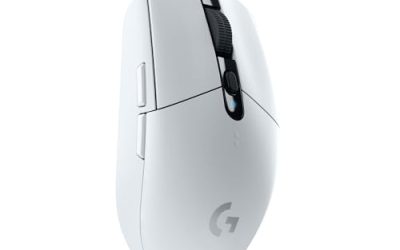
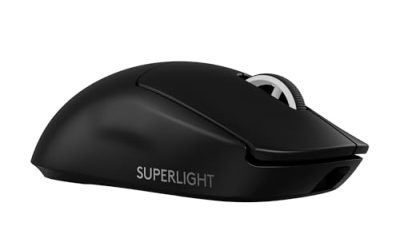
1. Logitech G PRO X Superlight 2 DEX (Black)
- Sensor: HERO 2 optical, up to 44,000 DPI
- Tracking: up to 888 IPS, up to 88 G acceleration
- Weight: 60 g
- Connection: LIGHTSPEED wireless, up to 8 kHz polling
The Superlight 2 DEX takes the proven Superlight formula and reshapes it for right-handed players who found the original symmetrical shell a little plain under the palm. The asymmetrical body adds thumb support and a sculpted right side, so a relaxed palm or palm-claw grip settles in naturally, while the 60-gram weight keeps flicks and quick corrections effortless. It is a flagship built with direct input from esports players, and it feels like one: tight clicks, clean lines, and nothing decorative anywhere on the shell.
The HERO 2 sensor tracks up to 44,000 DPI with sub-micron precision, and the LIGHTSPEED wireless link supports polling up to 8 kHz, eight times the report rate of a standard gaming mouse. Battery life runs up to 95 hours per charge, and charging is over USB-C. Five programmable buttons cover the essentials without crowding the sides. If you play competitive shooters with a right-handed grip and want the most refined ergonomic flagship Logitech currently sells new, this is the one to beat.
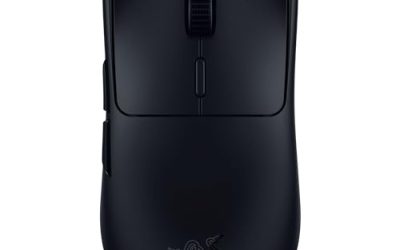
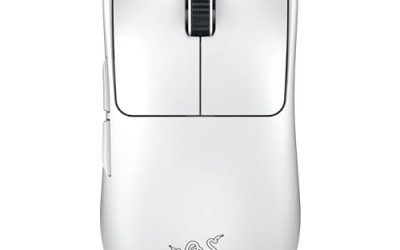
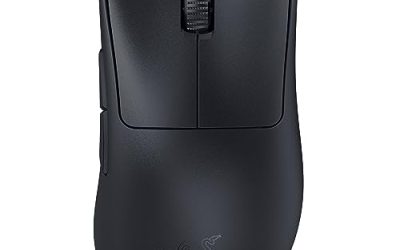
2. Razer DeathAdder V3 Pro (White)
- Sensor: Focus Pro 30K optical
- Switches: Razer Optical Gen-3, 90-million-click lifecycle
- Weight: 63 g
- Connection: HyperSpeed wireless, wired Speedflex cable
The DeathAdder shape has been a default recommendation for ergonomic gaming mice for well over a decade, and the V3 Pro is its lightest, fastest form. At 63 grams in this white version, it undercuts many symmetrical esports mice while keeping the tall, supportive hump that palm-grip players love. The shell is smooth, the side buttons sit exactly where a thumb expects them, and the whole mouse feels built for long sessions in aim-heavy games.
Inside is Razer’s Focus Pro 30K optical sensor with on-the-fly sensitivity adjustment, paired with Gen-3 optical switches that actuate at the speed of light and carry a 90-million-click lifecycle. HyperSpeed wireless keeps latency at wired levels, and the mouse also works over its Speedflex cable while it charges. Battery life reaches up to 90 hours of continuous play. Players who want a proven ergonomic shape with flagship internals — and who prefer a white setup — will find this listing an easy yes.
3. Logitech G309 LIGHTSPEED (Black)
- Sensor: HERO 25K optical
- Switches: LIGHTFORCE hybrid optical-mechanical
- Weight: 86 g with battery, 68 g without
- Connection: LIGHTSPEED wireless and Bluetooth
The G309 answers a different question: what if a gaming mouse never needed a charging cable at all? It runs on a single AA battery and delivers over 300 hours of play over its LIGHTSPEED connection, or more than 600 hours over Bluetooth. There is no dock to remember and no cable to plug in at midnight — when the cell finally fades, you swap in a fresh AA and keep playing. It also supports POWERPLAY wireless charging mats for anyone already inside that ecosystem.
At 86 grams with the battery fitted, the G309 is heavier than the flagships above, but the compact shell suits claw and fingertip grips and smaller hands well. The HERO 25K sensor is a generation behind the newest flagship silicon yet still tracks far beyond what real play demands, and the LIGHTFORCE hybrid optical-mechanical switches give crisp, consistent clicks. Six programmable buttons and dual-device pairing round out a mouse aimed at players who value uptime over spec-sheet extremes.
4. Corsair M75 Air (White)
- Sensor: Corsair MARKSMAN optical, 26,000 DPI
- Tracking: 650 IPS, up to 50 G acceleration
- Weight: 60 g
- Connection: Slipstream wireless, Bluetooth, wired
Corsair built the M75 Air around one idea: remove everything that does not help in a firefight. The symmetrical 60-gram shell has no lighting, no extra trim and no wasted mass, and the shape was tuned through an extended design process to sit neutrally under claw and fingertip grips. The result is a mouse that disappears under the hand, which is exactly what fast, low-sensitivity aim needs.
The MARKSMAN optical sensor tracks at a native 26,000 DPI and 650 IPS, and Corsair’s QUICKSTRIKE buttons close the gap between the button and the switch so clicks register with no pre-travel delay. Connectivity covers Slipstream wireless, Bluetooth and a wired mode, with battery life up to 100 hours depending on the link in use. Full-length PTFE feet keep the glide smooth on cloth and hard pads alike. For players who want a symmetrical ultralight with a clean white finish and no distractions, the M75 Air is the current Corsair pick that is actually on shelves.
5. SteelSeries Rival 3 Wireless Gen 2 (Black)
- Sensor: TrueMove Air optical, up to 18,000 DPI
- Tracking: 400 IPS, up to 40 G acceleration
- Weight: 95 g with one AAA, 106 g with two AAA
- Connection: 2.4 GHz wireless and Bluetooth 5.0
The Rival 3 Wireless Gen 2 is the practical pick of this group: a current SteelSeries model that trades flagship excess for dual wireless links and battery flexibility. It connects over a 2.4 GHz receiver for play and Bluetooth 5.0 for a second machine, and it runs on one or two AAA cells. Fit two cells for maximum runtime — up to 200 hours on the gaming link and up to 450 hours on Bluetooth — or fit one cell to trim the weight from 106 grams down to 95 grams.
The TrueMove Air optical sensor tracks up to 18,000 DPI at 400 IPS, numbers that sit below the flagships here yet remain well clear of anything a human hand can outrun. Mechanical switches carry a 60-million-click lifespan, the feet are pure PTFE for a smooth glide, and click latency is quoted at 1.9 ms. It is a sensible, currently stocked mouse for players who want wireless freedom, swappable cells and a shape that works for claw and relaxed palm grips.
How to Choose a Gaming Mouse That Is Actually in Stock
Start with availability itself. A current model in active production is the safest buy: firmware updates keep arriving, replacement feet and grips stay on sale, and the listing you order from is the manufacturer’s own current stock rather than old inventory. Before ordering any mouse, check that the listing sells the item as new, that the seller ships from within your region, and that the model name matches the current generation — several lines on this page have older versions with similar names that are no longer produced.
Shape comes next. Ergonomic right-handed shells like the DeathAdder V3 Pro and the Superlight 2 DEX support the whole hand and suit palm grips and long sessions. Symmetrical shells like the M75 Air leave the grip choice open and favour claw and fingertip players who steer with their fingers. Hand size matters as much as grip style: large shells can cramp small hands, and compact mice can feel twitchy in big palms.
Weight and battery strategy are linked. Rechargeable flagships reach 60 grams and run for days between charges, but they do need a cable eventually. Cell-powered mice like the G309 and the Rival 3 Wireless Gen 2 weigh more, yet they run for weeks or months and recover instantly with a battery swap. Neither approach is wrong — pick the one that matches how you play and how tidy you keep your desk.
Finally, match the sensor and polling rate to your games. Every mouse here tracks well beyond human limits, so the headline numbers should not drive the decision. High polling rates up to 8 kHz help most on high-refresh monitors in competitive shooters, while Bluetooth links and long battery life matter more for mixed play and everyday use. Choose on shape, weight and uptime, and the performance will follow.
FAQ
How can I tell a gaming mouse listing is current and not old stock?
Check that the model matches the maker’s current lineup, that the listing sells the mouse as new, and that the page shows a live in-stock status with a normal delivery window. Current models also keep receiving firmware updates through the maker’s software, which is a good sign of active production.
Does a higher polling rate make a real difference?
On a high-refresh monitor, a polling rate above 1,000 Hz can make cursor movement feel smoother in fast shooters, because the mouse reports its position more often. The gains shrink quickly beyond that, and most players will notice shape and weight differences long before they notice polling differences.
Are AA and AAA powered gaming mice still competitive?
Yes. Modern low-power sensors stretch a single AA cell past 300 hours, and the wireless links in cell-powered mice use the same gaming-grade technology as rechargeable models. The trade-off is extra weight from the battery, balanced against never needing a charging cable.
Which grip style should I choose if I am unsure?
Start with your hand size and how you naturally hold the mouse. A relaxed palm grip suits ergonomic shells, while claw and fingertip grips suit lighter symmetrical shells. If you play a mix of games and work at the same desk, a mid-sized ergonomic mouse is the safest all-round choice.
More from Amazon
Programs that pair well with the guide above. Offers and eligibility are set by Amazon and may change.
Free shipping on eligible items, Prime Video and more. Eligible new members can start with a free trial.
Start a Prime free trialAd-free music streaming. Eligible new subscribers can start with a free trial.
Try Music Unlimited freeA Prime membership for ages 18-24 with a trial period. Eligibility is set by Amazon.
See Prime for Young AdultsAudiobooks and podcasts to listen to on the go. Eligible new members can start with a free trial.
Try Audible freeAs an Amazon Associate we earn from qualifying purchases.