Key takeaways
- Desk phone headsets compared on DECT range, talk time, EHS and lifter support, mono or stereo fit and desk phone plus PC connections for office use.
A headset bought for a physical desk phone solves a different problem from one bought for laptop calls. The base has to plug into the phone on your desk, the radio link has to hold up across a real office floor, and answering a call from the supply room depends on an EHS cable or a handset lifter rather than on the headset alone. Shoppers who order a USB softphone headset for a desk phone discover the mismatch only when nothing plugs in.

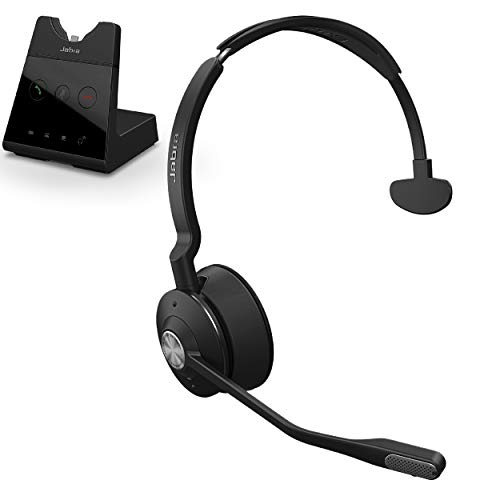
Every verified pick below is a DECT base system from the Jabra Engage family, because that is the desk phone shelf on Amazon US whose listings could be confirmed in full. One stereo model and two mono models cover the main office patterns: a phone plus PC desk, a single-ear all-day caller, and a mixed desk phone and softphone setup.
Quick Picks
As an Amazon Associate we earn from qualifying purchases.
| Product | Best for | Key spec |
|---|---|---|
| Jabra Engage 75 SE Stereo | Busy desks juggling phone, PC and mobile | Connects up to 5 devices at once |
| Jabra Engage 65 SE Mono | All-day callers who keep one ear open | Up to 13 hours of talk time |
| Jabra Engage 65 Mono | Mixed desk phone and softphone desks | Desk phone and PC from one base |
How to Choose
How the Headset Reaches the Phone
Two connection families serve desk phones. A DECT system uses a base station that wires into the phone and the PC, while the headset itself links to that base over a voice-dedicated radio. A corded headset instead runs a cable to a quick-disconnect plug and then an RJ9 cord into the handset or headset port. Wireless bases suit anyone who files, greets visitors or fetches printouts mid-call. Corded models remove charging from the routine entirely, though the cable fixes you within arm’s reach of the desk. All three picks here are DECT base systems, so the base, not the phone, anchors the connection.
Remote Answering: EHS Cable or Handset Lifter
A wireless headset alone cannot lift a handset. Away from the desk, picking up and ending calls needs either an electronic hook switch cable matched to your phone model or a mechanical lifter that physically raises the handset. Phone brands differ in which EHS cable they accept, and some older phones support neither route, leaving the base button and a walk back to the desk as the only option. Before ordering, match your exact phone model against the headset maker’s compatibility guide and budget for the cable or lifter as a separate purchase, because bases rarely bundle either accessory.
Mono or Stereo: One Ear Open or Both Covered
A mono headset leaves one ear uncovered, which suits reception desks and shared offices where colleagues and visitors still need your attention between calls. Stereo coverage helps when the room around you is loud, when calls carry detailed figures worth concentrating on, or when the same headset doubles for PC audio after the phone work ends. Wearing style matters over a full shift as well: headband pressure, ear cushion size and the option to switch ears decide whether a mono model stays comfortable through hour six. Pick the format around your room and your call load, not around habit.
Talk Time, Range and the Second Connection
Published range figures describe open line-of-sight conditions, and office walls, shelving and metal partitions shorten the real working distance considerably. Even so, a longer rated range gives a stronger margin for a desk that sits far from the storage room or the printer. Talk time decides whether the headset survives a full shift without a midday charge, and standby time matters for desks where calls arrive in bursts. The second decision is how many sources the base serves: some systems stop at the desk phone and PC, while others add a softphone and a smartphone to the same headset.
The 3 Best Options
Jabra Engage 75 SE Stereo
This is the flagship desk phone system in the verified pool and the one to choose when a single headset has to cover nearly everything on the desk. Its base links a desk phone and a PC, and the system holds up to five devices at once, adding a softphone and a smartphone or tablet to the usual pair. Dual-ear coverage, enhanced speakers and an advanced noise-cancelling microphone suit a loud office where callers still need to hear you clearly. The integrated busylight warns colleagues off while you are mid-call, and the stereo fit doubles comfortably for focused PC listening between calls.
Specs
- Connection: DECT wireless headset system with base station
- Connects to: desk phone and PC, up to 5 devices simultaneously including softphone and smartphone or tablet
- Wireless range: up to 150 meters / 490 feet
- Microphone: advanced noise-cancelling microphone
- Speakers: enhanced speakers
- Busylight: integrated do-not-disturb indicator
- Certification: meets Skype for Business Open Office requirements
- Dimensions: 5.55 × 1.26 × 6.65 inches
Best for: receptionists and office coordinators whose calls arrive on the desk phone, the PC and a mobile in the same hour.
Watch out for: the five-device figure counts every paired source, so map which of your devices actually needs the headset before assuming a spare slot remains.
ASIN: B0DGB5Q1M1
Jabra Engage 65 SE Mono
The second-edition 65 SE trims the formula down to the two connections most office desks actually use: the desk phone and the PC. A single-ear fit keeps the room audible, which matters for front desks and team offices where a covered ear means missed questions from the next desk. Talk time runs up to 13 hours, enough for a full calling shift, and three wearing styles let you settle on the fit that survives that shift. The noise-cancelling microphone and integrated busylight carry over from the larger system, so callers get the same clarity and colleagues get the same do-not-disturb signal.
Specs
- Connection: DECT wireless headset system with base station
- Connects to: desk phone and PC, up to 2 devices
- Wireless range: up to 150 meters / 490 feet
- Talk time: up to 13 hours; standby up to 52 hours
- Wearing styles: 3
- Microphone: advanced noise-cancelling microphone
- Busylight: integrated do-not-disturb indicator
Best for: all-day callers on a desk phone and PC who need one ear free for the room around them.
Watch out for: availability signals for this listing conflict — a reproduction of the listing was already several weeks old when checked, and fresher offer listings did not carry this code — so confirm a live featured offer for the exact ASIN B0DJN1M8F2 before ordering.
ASIN: B0DJN1M8F2
Jabra Engage 65 Mono
The original Engage 65 remains a sound route into the same desk phone setup, pairing its base with a desk phone and a PC softphone at once. Two devices connect simultaneously, which covers the common pattern of fielding landline calls while a softphone app sits ready on the computer. Battery life is listed at 13 hours with a 1.5-hour charging time, so an overnight charge on the base restores a full shift of calling. The mono earpiece keeps one side open for conversation in the room, and the model has been sold long enough that EHS cables and lifters for it are easy to source.
Specs
- Model number: 9553-553-125
- Connection: DECT wireless headset system with base station
- Recommended uses: desk phone and softphone (PC)
- Compatible devices: desk phone and softphone (PC)
- Wireless range: up to 150 meters / 490 feet
- Connections: up to 2 devices at once
- Battery life: 13 hours
- Charging time: 1.5 hours
Best for: offices standardising on a proven desk phone and PC pairing without paying for extra device slots.
Watch out for: freshness signals for this ASIN conflict — the direct listing crawl behind it was months old, and the freshly priced pages nearby belong to Renewed versions — so confirm a live featured offer for the exact ASIN B07C37JH5T, for a new unit, before ordering.
ASIN: B07C37JH5T
Which One Fits Your Situation
You Run a Front Desk With Calls Arriving Everywhere
Choose the Engage 75 SE Stereo. Reception work rarely respects a single channel: the desk phone rings while a softphone call waits on the PC and a mobile sits in the drawer. Five simultaneous connections mean one headset covers all of it, and the stereo earpieces plus busylight protect your concentration when the lobby gets busy and colleagues hover with questions between calls.
You Spend the Whole Shift on Calls but Work in a Team Room
Choose the Engage 65 SE Mono. A single earpiece leaves the room audible, so a colleague’s quick question never needs a headset removal, while 13 hours of talk time outlasts the longest calling day. Three wearing styles help you find a fit that stays put and stays comfortable, and the busylight still tells the room when a call is live.
Your Desk Splits Time Between a Landline and a Softphone
Choose the Engage 65 Mono. Its base serves the desk phone and the PC together, which matches the hybrid pattern of landline calls in the morning and app-based calls after lunch. The 13-hour battery and short 1.5-hour charge keep the routine simple: dock it overnight and pick it up charged, with both call sources ready from the same earpiece.
You Are Replacing an Older Headset on an Existing Phone System
Any of the three bases will wire into a typical corded desk phone, so choose on device count and ear coverage rather than on compatibility worries. Count the sources you truly use each day, decide whether one ear must stay open, and then check your phone model for the right EHS cable or lifter, because remote answering depends on that accessory whichever system you pick.
Common Mistakes
- Ordering a USB or Bluetooth softphone headset for a physical desk phone, then finding no port on the phone accepts it.
- Treating DECT as Bluetooth and expecting the headset to pair directly with the phone, when the base station is the actual connection point.
- Skipping the EHS cable or handset lifter, then discovering that answering away from the desk still means walking back to lift the handset.
- Landing on a Renewed listing or a dongle-only portable variant instead of the new base system sold under the exact ASIN.
- Choosing stereo for a front desk role where one ear must stay open, or mono for a noisy room where both ears need cover.
Frequently Asked Questions
Will one of these headsets work with my desk phone?
Very likely, because the base rather than the headset handles the phone connection, and DECT bases of this class wire into most corded desk phones. The real check is remote answering: EHS cable support varies by phone brand and model, so confirm your exact phone in the maker’s compatibility guide and plan on the matching cable or a handset lifter.
How is DECT different from Bluetooth?
DECT is a radio standard built specifically for cordless voice, and it runs between the headset and its base station rather than pairing with the phone itself. The base wires into the desk phone and the PC, which is why these systems reach a rated 150 meters and handle phone calls with priority. Bluetooth headsets pair with individual devices and belong to the softphone and mobile world instead.
Can I answer and end calls away from my desk?
Yes, provided the phone side of the setup supports it. An EHS cable matched to your phone model, or a mechanical handset lifter fitted under the receiver, lets the headset button pick up and end calls anywhere within range. Without one of those accessories, the call still rings in the earpiece, but lifting the handset has to happen at the desk itself.
Can one headset cover both my desk phone and my computer?
That dual role is exactly what these bases are built for. Each system here connects the desk phone and a PC at the same time, and switching follows the base controls rather than any re-pairing ritual. The Engage 75 SE widens the count to five devices including a smartphone, while both Engage 65 models hold the line at two, which still covers the standard phone-plus-PC desk.
FAQ
Will one of these headsets work with my desk phone?
How is DECT different from Bluetooth?
Can I answer and end calls away from my desk?
Can one headset cover both my desk phone and my computer?
More from Amazon
Programs that pair well with the guide above. Offers and eligibility are set by Amazon and may change.
Free shipping on eligible items, Prime Video and more. Eligible new members can start with a free trial.
Start a Prime free trialAd-free music streaming. Eligible new subscribers can start with a free trial.
Try Music Unlimited freeA Prime membership for ages 18-24 with a trial period. Eligibility is set by Amazon.
See Prime for Young AdultsAudiobooks and podcasts to listen to on the go. Eligible new members can start with a free trial.
Try Audible freeAs an Amazon Associate we earn from qualifying purchases.