Key takeaways
- Compare complete home speaker systems, from home theater packages and surround kits to soundbar systems, by channels, wiring, room fit and what is in the box.
As an Amazon Associate we earn from qualifying purchases.
A home system speaker setup is a different purchase from a pair of stereo speakers. Instead of two cabinets built mainly for music, a system means every channel a film, a game or a TV broadcast expects: front left and right, a center channel for dialogue, surround speakers behind or beside the seating, a subwoofer for low effects, and some form of amplification and processing to tie it all together. The four options below are complete systems in that sense. Two are soundbar systems that put the processing inside the bar, one is a home-theater-in-a-box package with an AV receiver in the carton, and one is a passive surround speaker package designed to pair with a receiver you choose yourself.
That structure is also what separates this guide from a music-first stereo shortlist. Nothing here is a standalone bookshelf pair. Every pick covers the center channel and the low-frequency channel as part of the purchase, because a system that leaves dialogue or bass to a later upgrade is not really a system yet. If your listening is mostly two-channel music at a desk or on a shelf, a powered stereo pair is the simpler tool. If the goal is one purchase that makes a living room sound like a coherent whole for films, sport, games and streamed music, read on.
How to Choose a Home Speaker System
Decide which system architecture fits the room
There are three broad architectures in this guide, and the right one is mostly a question of wiring tolerance and how much separate equipment you want to own. A soundbar system hides the amplification and decoding in the bar itself, adds a wireless subwoofer, and in the stronger examples adds wireless rear speakers, so the only cables are power leads and one connection to the TV. A home-theater-in-a-box package bundles a conventional AV receiver with matched passive speakers and a subwoofer, which means speaker wire runs around the room but also means the receiver can be replaced or upgraded later without discarding the speakers. A passive speaker package sits between the two: the speakers and subwoofer are matched by the manufacturer, but the receiver is yours to choose, which suits anyone who already owns amplification or wants specific features such as a particular room-correction system.
Read the channel numbers honestly
Channel notation follows a simple pattern. The first number counts the main ear-level channels, the second counts subwoofers, and the third, when present, counts height channels used by Dolby Atmos and DTS:X. A 5.1 system therefore has front left and right, a center, two surrounds and one subwoofer. An 11.1.4 soundbar system reaches its count by combining many drivers inside the bar with separate rear speakers and up-firing drivers that reflect height effects off the ceiling. Both can be legitimate, but they are not interchangeable experiences: discrete speakers placed around the room give physical separation that a single bar approximates, while the bar gives a tidiness and setup speed that discrete speakers cannot match. Ceiling-bounce height effects also depend on a flat, reasonably low ceiling, so a vaulted room weakens the case for paying for up-firing channels.
Check the connection to the TV first
For TV-based systems, the connection that matters most is HDMI with eARC, which carries full-quality audio back from the TV to the soundbar or receiver and lets the TV remote control volume. Optical connections still work for basic surround formats but cannot carry the highest-bandwidth Atmos streams from a TV app. If a games console or a disc player is involved, check whether the system offers HDMI inputs of its own and what video pass-through it supports, because a receiver or bar that cannot pass the video signal your console produces becomes a bottleneck rather than a hub. Bluetooth and Wi-Fi streaming are secondary but genuinely useful, since most of these systems double as the room’s music player once they are installed.
Plan placement before buying
Surround speakers need to sit beside or behind the seating, not on the same shelf as the TV, and a subwoofer needs floor space where it can be moved a little to find a smooth response. Soundbar systems with wireless rears still need power sockets near those rear positions. Passive packages need speaker wire, and the honest cost of the system includes that wire, plus stands or wall mounts if the satellites are not going on furniture. Measuring the room and deciding where each box can physically go eliminates most bad purchases in this category before they happen.
Quick Picks
Our Short List of 3
All 4 Picks at a Glance
| Product | Specs | Action |
|---|---|---|
 Samsung HW-Q990F Soundbar System | Check price on Amazon | |
| Yamaha YHT-4950U 5.1-Channel Home Theater System | Check price on Amazon | |
 VIZIO Elevate P514a-H6 Soundbar System | Check price on Amazon | |
 Klipsch Reference Theater Pack 5.1 Surround Sound System | Check price on Amazon |
The Systems in Detail
Samsung HW-Q990F Soundbar System
The HW-Q990F is Samsung’s flagship Q Series soundbar system for 2025, and it is the most complete bar-based option in this guide. The package combines the main soundbar, a wireless subwoofer and two wireless rear speakers into an 11.1.4-channel layout, with eleven front and surround channels, one subwoofer channel and four up-firing channels for Dolby Atmos height effects. Because the rear speakers are separate cabinets rather than a processing trick, surround material has somewhere physical to come from, which is the main weakness of single-bar systems addressed directly in the box.
Connection and setup are built around the TV. The system supports wireless Dolby Atmos over a compatible connection as well as conventional HDMI, and it includes SpaceFit Sound Pro, which uses microphones in the soundbar to calibrate the output to the room. Q-Symphony allows the soundbar to work alongside the speakers of a compatible Samsung TV instead of muting them, although that feature only applies to Samsung television owners and should not drive the decision for anyone else. Alexa is built in, and AirPlay 2 and Google Cast support cover phone-based music streaming, so the system doubles as the room’s music player without a separate streamer.
The honest limitations are size, dependence on the ceiling, and ecosystem extras that not everyone can use. The bar is wide and belongs under a large television, the height channels rely on ceiling reflection, and features such as Q-Symphony are Samsung-only. Within those limits, this is the pick for a household that wants the fullest surround layout available without running speaker wire or owning a separate receiver. Confirm the current listing configuration before purchase, because Samsung sells several model years of Q Series flagship bars with similar names.
Yamaha YHT-4950U 5.1-Channel Home Theater System
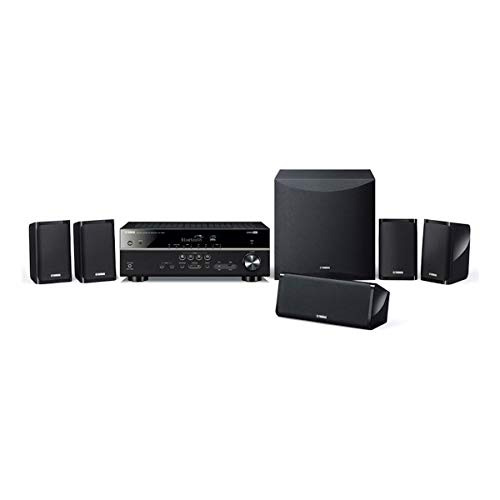
The YHT-4950U takes the opposite approach to the soundbar systems: it is a home-theater-in-a-box package built around a proper AV receiver. The carton contains the receiver, five speakers covering the front, center and surround positions, a powered subwoofer with an eight-inch cone, speaker wire and a subwoofer cable, so nothing else is required to assemble a working 5.1 system. The receiver passes 4K video at sixty frames per second and supports HDR formats including Dolby Vision and Hybrid Log-Gamma, which keeps it compatible with current televisions, disc players and consoles.
Yamaha’s YPAO room optimization is included, using a supplied microphone approach to analyze the room acoustics and adjust the audio accordingly, and the CINEMA DSP processing supports HD audio formats such as Dolby TrueHD and DTS-HD Master Audio from disc sources. A feature worth knowing about is Virtual CINEMA FRONT, which can produce a virtual surround effect with all five speakers placed at the front of the room. That is a compromise rather than a substitute for properly placed surrounds, but it is a realistic option for rooms where running wire to the back is impossible. Bluetooth is built in for wireless music playback from a phone, although there is no Wi-Fi streaming on this package, so network music depends on whatever source is connected to the receiver.
Choose this system if you want the traditional, upgradeable architecture: when the receiver eventually ages, it can be replaced while the speakers and subwoofer stay in service. Choose something else if the idea of running speaker wire around the room is a non-starter, or if Dolby Atmos height channels are a requirement, because this is a 5.1 package with no height layer.
VIZIO Elevate P514a-H6 Soundbar System
The Elevate is VIZIO’s 5.1.4 soundbar system, and its signature idea is mechanical rather than digital. The bar contains eighteen drivers in total, and its height speakers physically rotate: they point forward for conventional content and turn upward when Dolby Atmos or DTS:X material is detected, reflecting height effects off the ceiling only when those effects are actually present. The package includes the soundbar, a wireless subwoofer and two satellite surround speakers, so, like the Samsung system above, it provides real rear cabinets instead of relying entirely on virtualization.
That rotating design makes the Elevate a sensible middle position in this guide. It offers a genuine height layer and discrete surrounds in a system that still connects to the TV with a single cable and needs no receiver, no speaker wire across the room and no separate calibration equipment. Chromecast is built in for music streaming from compatible apps, and the VIZIO app provides control from a phone or tablet. For gaming households, the bar format also keeps the area under the television clear, which matters in rooms where a receiver and five separate speakers would crowd the furniture.
The trade-offs mirror the other bar systems. Height performance depends on ceiling shape and height, the satellite speakers connect by cable to the subwoofer rather than being fully independent, and a component system will always offer more freedom to replace individual pieces. As a complete, self-contained Atmos system for a living room that cannot accommodate a receiver rack, the Elevate covers the brief well. Check the live listing for the exact model code P514a-H6, since VIZIO has sold several Elevate generations and smaller V Series bars with similar styling.
Klipsch Reference Theater Pack 5.1 Surround Sound System
The Reference Theater Pack is the passive option in this guide: four compact satellite speakers, a center channel and a wireless subwoofer, voiced as a matched set and designed to pair with an AV receiver of your choice. There is no receiver in the box, and that is the point. Buyers who already own a receiver, or who want to choose one for specific features, get a complete speaker side of the system in a single purchase with a notably small footprint.
Klipsch builds these satellites around its Reference series technology. The woofers use Injection Molded Graphite cones, which are light and rigid, and the tweeters are aluminum units with Linear Travel Suspension mounted in the company’s Tractrix horns. Horn loading is why Klipsch speakers are known for playing clearly at modest amplifier power, which makes this pack forgiving of entry-level receivers. The subwoofer is down-firing and connects wirelessly through a pre-paired transmitter that plugs into the receiver’s subwoofer output, so the bass cabinet can sit where it works best in the room rather than where a cable forces it to be. Each satellite includes a keyhole mount and a threaded insert, and the center channel has dual mounting points, so wall mounting is a designed option rather than an improvisation.
The conditions attached to this pick are straightforward. Budget for a receiver if you do not already own one, and expect to run speaker wire to the five passive speakers even though the subwoofer is wireless. In return, this is the most placement-flexible system here and the easiest to fit into a small room where full-size speakers would dominate. It is also the natural step up for a household that started with a receiver bundled into an older package and wants better speakers without replacing the electronics.
Soundbar System or Receiver Package?
The decision usually comes down to three questions. First, wiring: if speaker wire cannot cross the room, a soundbar system with wireless rears and a wireless subwoofer is the realistic answer, and both bar systems in this guide are built exactly for that constraint. Second, longevity: a receiver-based package, whether the bundled Yamaha or the Klipsch pack with your own receiver, lets you replace the electronics and the speakers on separate schedules, while a soundbar system is replaced as a unit. Third, channels: if height effects for Atmos content are a priority, the two bar systems here include them, while the 5.1 packages concentrate on doing the ear-level layer properly.
Music deserves a mention, because these systems will inevitably be used for it. A system with a real center channel and subwoofer handles streamed music and concert films comfortably, and both soundbar systems include casting or streaming support for that role. What a surround system does not try to be is a dedicated two-channel hi-fi rig, and listeners whose main hobby is stereo records will still be better served by a focused stereo setup. For mixed living-room use, which is what most households actually have, a complete system is the more useful purchase.
What to Check Before Ordering
Confirm the exact model code on the live listing, because every brand in this guide sells multiple generations and channel layouts under similar names. Check that your television has an HDMI eARC port if you want the simplest high-quality connection, and confirm where the rear speakers will get power if you choose a bar system with wireless rears. For the passive Klipsch package, confirm receiver compatibility and speaker wire separately. Finally, measure the space under the television for a flagship-width bar, and the floor space for the subwoofer, before the boxes arrive rather than after.
Disclosure
Disclosure: This article contains affiliate links. If you buy through those links, a commission may be earned at no additional cost to you. Product information was taken from the listings and manufacturer details available at the time of writing, and specifications should be confirmed on the live listing before purchase.
FAQ
Soundbar System or Receiver Package?
More from Amazon
Programs that pair well with the guide above. Offers and eligibility are set by Amazon and may change.
Free shipping on eligible items, Prime Video and more. Eligible new members can start with a free trial.
Start a Prime free trialAd-free music streaming. Eligible new subscribers can start with a free trial.
Try Music Unlimited freeA Prime membership for ages 18-24 with a trial period. Eligibility is set by Amazon.
See Prime for Young AdultsAudiobooks and podcasts to listen to on the go. Eligible new members can start with a free trial.
Try Audible freeAs an Amazon Associate we earn from qualifying purchases.