Key takeaways
- Compare the two best planetarium projectors for home: a 60,000-star disc planetarium for learning constellations and a rechargeable photographic model.
If you have been browsing star projectors, most of them are not planetariums at all. They are nebula lamps that wash a ceiling in coloured clouds and laser dots, which looks pleasant but teaches you nothing about the night sky. A true home planetarium is an optical disc system: a lens projects a real star field, or real deep-sky photography, from an interchangeable disc. The decision is whether you want an accurate sky you can learn from, or photographic imagery you can relax under.
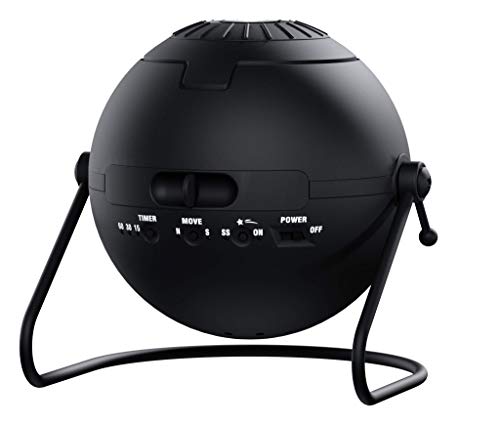

This guide covers the two disc-based machines that hold up as genuine planetariums. Accuracy-first buyers should look at the Sega Toys Homestar Flux, which projects about 60,000 stars from real star-field discs and includes a constellation-line disc. Buyers who want flexibility should consider the POCOCO Galaxy Star Projector, which uses 5K ultra-HD image discs of real deep-sky photography and runs on a rechargeable battery, so it moves between rooms without a trailing cable.
Quick Picks
As an Amazon Associate we earn from qualifying purchases.
| Product | Best for | Key spec |
|---|---|---|
| Sega Toys Homestar Flux (Satin Black) | Learning real constellations at home | About 60,000 stars from real star-field discs |
| POCOCO Galaxy Star Projector | Photographic deep-sky discs in any room | 5K ultra-HD image discs, rechargeable battery |
How to Choose
Star-Field Discs or Photographic Discs
Start with what the disc actually holds, because that decides everything else. A star-field disc carries a mapped sky: thousands of individual stars in their real positions, and the Homestar Flux adds a constellation-line disc that draws the figures over the field. That is the educational route. A photographic disc, like the ones the POCOCO uses, carries deep-sky images shot through telescopes — nebulae and galaxies rendered in fine detail. It is the atmospheric route. Neither is wrong, but they answer different questions, so settle this before comparing brightness or battery life. Decide what the ceiling is for before you compare anything else.
Light Source, Lens and Focus
Sharpness is where cheap lamps and real planetariums part company. A lamp only has to glow, but a planetarium has to resolve thousands of pinpoint stars, so look for a proper lens and manual focus. The Homestar Flux pairs a 5W white LED with adjustable focus and projection angle, which lets you tune the image to your ceiling height. The POCOCO uses a 2-megapixel lens to keep its photographic discs detailed across about 12 square metres. Whichever you choose, a projector without focus adjustment will look soft in some rooms and sharp in none.
The Disc Library You Are Buying Into
A disc projector is an ecosystem purchase, because the two included discs are only the starting point. Check how deep the catalogue behind each machine runs and whether expansion discs are sold separately. The Homestar line has more than 30 optional discs beyond the star field and constellation pair in the box, covering different skies and scenes. POCOCO sells themed expansion disc packs separately from its two included discs, so budget for the packs you actually want rather than assuming they are bundled. A machine with a thin disc catalogue gets repetitive within a few months.
Power, Timers and Room Fit
Finally, match the machine to the room it will live in. A mains-powered projector suits a fixed spot: the Homestar Flux runs from USB or its wall adapter and offers a sleep timer, so it can live on a bedroom shelf permanently. A battery model suits renters and shared spaces — the POCOCO is rechargeable, also works plugged in, rotates its disc, and has a 15, 30 or 60 minute sleep timer. Think about where the projector sits, how far the ceiling is, and whether a cable run would annoy you nightly. A projector that fights its room every night quickly stops being used at all.
The 2 Best Options
Sega Toys Homestar Flux (Satin Black)
The Homestar Flux is the accuracy pick, built for people who want the ceiling to behave like the real sky. Its star-field discs project about 60,000 stars, and the second included disc overlays constellation lines, so you can move from admiring the field to actually learning it. A 5W white LED, adjustable focus and an adjustable projection angle keep the image crisp on different ceiling heights, while the sleep timer suits bedtime use. It is a fixed-position machine that runs from USB or the wall adapter, finished in satin black.
Specs
- Projects about 60,000 stars from real star-field discs
- 5W white LED light source
- Two discs included (star field + constellation lines); 30+ optional discs available
- Adjustable focus and projection angle; sleep timer
- Power: USB + wall adapter
- Finish: Satin black
Best for: Buyers who want to learn real constellations from an accurate star field.
Watch out for: Availability signals conflict for this ASIN — price trackers have never recorded an Amazon-sold price for it, even though a live offer appears in current listing data — so confirm a live featured offer for the exact ASIN before ordering.
ASIN: B07JB9Q3FW
POCOCO Galaxy Star Projector
The POCOCO takes the other route: its discs hold 5K ultra-HD photographs of real deep-sky objects, projected through a 2-megapixel lens across roughly 12 square metres. Be clear about the trade — those photographs are not a star map, so this machine shows you nebulae and galaxies in detail rather than teaching constellation shapes. What you gain is freedom: a rechargeable battery, disc rotation and a three-step sleep timer make it easy to move between a bedroom, a gaming setup and a child’s room. Two discs are included, and themed expansion packs let the imagery change with the season.
Specs
- Disc-based projection using 5K ultra-HD image discs of real deep-sky photography
- 2-megapixel lens
- Rechargeable battery (also runs plugged in)
- Two discs included; themed expansion disc packs sold separately
- Sleep timer (15/30/60 minutes); disc rotation
- Projection area about 12 sq m
Best for: Renters and families who want photographic deep-sky imagery without a fixed installation.
Watch out for: The included discs are photographs of deep-sky objects, not a star map — this projector will not teach constellations, and themed expansion disc packs are sold separately.
ASIN: B0B5RPHBFR
Which One Fits Your Situation
You Want Your Kids to Learn the Constellations
Choose the Homestar Flux. Its star-field disc puts about 60,000 stars in their real positions, and the included constellation-line disc draws the figures over the field, turning a bedroom ceiling into a teaching tool. The adjustable focus keeps the lines readable, and the sleep timer means the lesson can double as a night routine without anyone getting up to switch the machine off afterwards. It doubles as a first astronomy gift that keeps teaching.
You Rent, Move Rooms, or Hate Cables
Choose the POCOCO. Its rechargeable battery removes the cable entirely, and it still runs plugged in when you settle somewhere longer. Disc rotation keeps the photographic image slowly moving, the timer handles falling asleep under it, and the roughly 12 square metre projection suits ordinary bedrooms. It packs away in a drawer, which matters in a rented room where nothing can be mounted or wired permanently. No shelf needs drilling and no socket needs freeing up.
You Are an Astronomy Hobbyist Who Wants the Real Sky
Choose the Homestar Flux again, but for the depth rather than the teaching disc. More than 30 optional discs extend the two in the box, so the sky can change with the seasons and your interests. The 5W LED and adjustable angle suit a dedicated viewing corner, and because the field is a real map, what you learn indoors transfers directly to a telescope session outdoors. It rewards patience in a way a lamp never attempts.
You Want Atmosphere for a Gaming or Media Room
Choose the POCOCO. Deep-sky photographs give a gaming or film room a backdrop with genuine detail instead of generic coloured clouds, and the rotating disc keeps it from feeling static during long sessions. Battery power means it can sit on a shelf or side table wherever the angle works, and the sleep timer shuts it down after the session ends without a trip across the room. It also travels to wherever the group is watching that night.
Common Mistakes
- Buying a nebula lamp and expecting a planetarium: laser dots and coloured cloud washes are ambience lighting, not a projected star field, and no lamp will show you a recognisable constellation.
- Assuming photographic discs teach the sky: the POCOCO’s discs are photographs of deep-sky objects rather than a star map, so they show nebulae beautifully but carry no constellation positions to learn.
- Ignoring focus adjustment: ceiling heights vary from room to room, and a fixed-focus projector that looks sharp in one bedroom can look soft in another, with no way to correct it.
- Forgetting that expansion discs cost extra: both machines include two discs in the box, and every additional sky or themed pack beyond that is a separate purchase, so budget for the library.
- Ordering from the wrong listing: variant and marketplace listings circulate for both models, so check the exact ASIN on the product page and confirm a live featured offer before you pay.
Frequently Asked Questions
What Is the Difference Between a Planetarium Projector and a Galaxy Lamp?
A galaxy lamp projects coloured nebula clouds and often laser dots purely for ambience. A planetarium projector is an optical disc system: a lens projects a real star field or real deep-sky photography from an interchangeable disc. If you want to recognise constellations or see actual nebulae, you need the disc system, not the lamp. The two share shelf space, which is why buyers mix them up.
Can the POCOCO Teach Me Constellations Like the Homestar Flux Can?
No. The POCOCO’s discs hold photographs of deep-sky objects, not a mapped star field, so there are no constellation positions to learn from. The Homestar Flux is the teaching tool: its second included disc overlays constellation lines on the star field. Buy the POCOCO for imagery and portability, and the Homestar for learning the sky. They are different tools that happen to share a ceiling.
How Dark Does the Room Need to Be?
Both machines are built for dark rooms, and the darker the better. A 5W LED star field or a photographic disc will wash out under ceiling lights or daylight through curtains. Blackout curtains, lights off and a plain, light-coloured ceiling give the sharpest result; textured or dark-painted ceilings soften the image noticeably on any disc projector. Judge it after full dark, not at dusk.
Do I Need to Keep Buying Discs?
Not immediately. Both projectors include two discs, which cover the core experience out of the box. Expansion is optional: the Homestar line offers more than 30 additional discs, and POCOCO sells themed packs separately. Treat extra discs as a later upgrade for variety rather than a requirement, and check pack contents before buying duplicates. One well-chosen pack a season is plenty for most households.
FAQ
What Is the Difference Between a Planetarium Projector and a Galaxy Lamp?
Can the POCOCO Teach Me Constellations Like the Homestar Flux Can?
How Dark Does the Room Need to Be?
Do I Need to Keep Buying Discs?
More from Amazon
Programs that pair well with the guide above. Offers and eligibility are set by Amazon and may change.
Free shipping on eligible items, Prime Video and more. Eligible new members can start with a free trial.
Start a Prime free trialAd-free music streaming. Eligible new subscribers can start with a free trial.
Try Music Unlimited freeA Prime membership for ages 18-24 with a trial period. Eligibility is set by Amazon.
See Prime for Young AdultsAudiobooks and podcasts to listen to on the go. Eligible new members can start with a free trial.
Try Audible freeAs an Amazon Associate we earn from qualifying purchases.