Our Top Picks
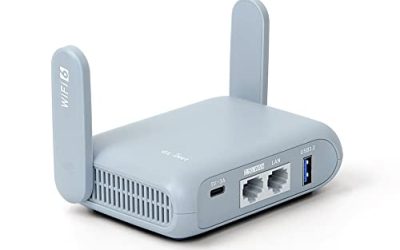
 GL.iNet GL-BE3600 Slate 7 Wi-Fi 7 Travel Router3.5 x 1.3 x 5.1 inches (Mini)3.5 x 1.3 x 5.1 inches0.7 poundsCheck on Amazon
 TP-Link Roam 6 AX3000 Dual-Band Wi-Fi 6 TravelCompact3.6 x 1.18 x 4.13 inches0.33 poundsCheck on Amazon
 TP-Link Roam 6 AX1500 Portable Wi-Fi 6 TravelPocket Size4.09 x 3.54 x 1.1 inches0.34 poundsCheck on Amazon
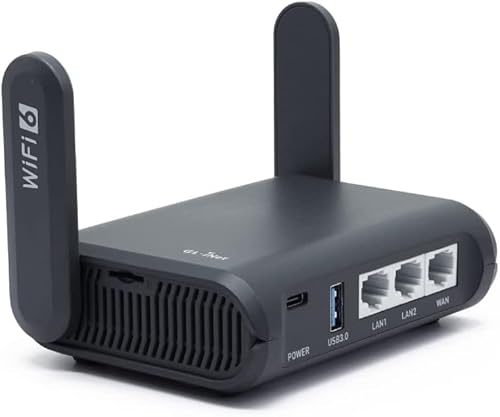
A portable router turns one connection into a private network that every device you packed can share. Plug it into hotel Ethernet, join hotel Wi-Fi through it, or tether it to a phone, and your laptop, tablet, phone, and handheld console all sit behind one network you control. That matters on the road, where public Wi-Fi asks every device to log in separately, where a hotel jack feeds only one wired device, and where a VPN on one laptop leaves the rest of your gear exposed.
The five routers below are all pocket-sized travel routers with portability stated in their listings. They span Wi-Fi 6 and Wi-Fi 7, two brands, and a wide range of ports and VPN support, so the guide covers a light day bag, a full remote-work kit, and a power-user setup with a touchscreen and dual 2.5 GbE ports. Every pick is a router, not a hotspot: none of these has a built-in battery or a cellular modem, so each one needs an upstream connection — hotel Ethernet, hotel Wi-Fi, or a phone tether — and power from USB-C or a wall adapter. That distinction is worth knowing before you pack one, because a portable router secures and shares a connection you already have rather than creating one from thin air.
What to Look for in a Portable Router
Wi-Fi generation and speed
Wi-Fi 7 routers in this guide move data at up to 3600 Mbps across two bands, while Wi-Fi 6 picks top out at 1500 or 3000 Mbps. The faster standard helps most when several devices stream, sync, and back up at once, or when you move large files across your own network. For email, calls, and browsing, Wi-Fi 6 is ample, and the Wi-Fi 6 picks here cost less and run cooler in a bag. Match the standard to the workload, not to the newest label.
Ethernet ports
Count the ports and check their speed. A 2.5 GbE WAN port lets a fast hotel or office wired connection through at full speed, while gigabit ports cap wired throughput at 1000 Mbps. Two or three ports let you wire a laptop and still feed a second device, or run the router as a wired bridge. If your travel kit is wireless-only, one WAN port is enough, and the extra LAN ports add little.
USB port and storage
A USB port does two jobs on the road. It shares files from a flash drive across your private network, and it tethers a phone for internet when no wired or wireless source is handy. Some picks add a microSD slot for the same file-sharing job. If you travel with a phone as your backup connection, a USB port with tethering support belongs high on your list.
VPN support
Every router in this guide runs a VPN client, which tunnels all traffic from every connected device through one encrypted connection. OpenVPN and WireGuard are the two protocols to look for, with WireGuard the faster of the two on small hardware. GL.iNet models add OpenWrt and AdGuard Home, which suit travelers who want deeper control. TP-Link models keep the VPN setup simpler, with an app-led flow and fewer menus to learn.
Captive portal handling
Hotel and airport Wi-Fi usually shows a login page before it lets you online. A travel router signs in once, then shares that connection with all your devices, so you do not log in from each phone, laptop, and console in turn. Every pick here states captive portal support in its listing. Confirm the exact flow on the listing for the model you choose, since the steps differ between brands.
Power and size
All five picks run from USB-C, and several run from a power bank, which means one less wall adapter in your bag. Check the power spec before you rely on a bank: some models want a 9V or 12V power-delivery bank, while others run from a plain 5V source. Weight runs from about 145 grams to under 300 grams, and every pick fits a jacket pocket or a laptop sleeve.
The 5 Best Portable Routers
GL.iNet Slate 7 (GL-BE3600)
The Slate 7 is the Wi-Fi 7 flagship of this guide, and the only pick with a touchscreen. Its dual-band Wi-Fi 7 radios move data at up to 3600 Mbps — 688 Mbps on 2.4 GHz and 2882 Mbps on 5 GHz — and its two 2.5 GbE ports, one WAN and one LAN, keep wired throughput ahead of gigabit. A USB 3.0 port handles file sharing and phone tethering, and the listing states OpenWrt 23.05 firmware with OpenVPN and WireGuard built in.
The touchscreen is the feature that sets it apart in daily use. It shows connection status at a glance and lets you toggle the VPN without opening an app, which is handy when you land, join hotel Wi-Fi, and want the tunnel up before anything else connects. The screen also shows the network name and connected devices, so you can confirm at a glance that your private network is live.
The Slate 7 is the largest pick in this guide, and the Wi-Fi 7 radios draw more power than the Wi-Fi 6 models below, so it suits travelers who carry a power bank or a wall adapter rather than travelers counting every gram. It also costs more than the Wi-Fi 6 picks, which is the fair trade for the newest standard, the dual 2.5 GbE ports, and the touchscreen. If your trips involve heavy file syncs, several devices at once, or a work VPN that must stay up all day, the Slate 7 is the strongest fit.
One note on availability: an older copy of the listing carried mixed signals about stock, while recent tracking shows it listed on Amazon with a live buying option, including a tracker noting it on Amazon three days ago. Confirm the listing shows a live buying option before you order, as with every pick in this guide.
GL.iNet Beryl AX (GL-MT3000)

The Beryl AX is the proven default of the travel-router category, and the pick most travelers should pack first. Its Wi-Fi 6 radios move data at up to 3000 Mbps — 574 Mbps on 2.4 GHz and 2402 Mbps on 5 GHz — and a 2.5G WAN port keeps a fast wired connection moving at full speed. A USB 3.0 port covers file sharing and phone tethering, and the listing states support for more than 30 VPN providers, with OpenVPN and WireGuard among them.
At 196 grams and 120 x 83 x 34 mm, with folding antennas, the Beryl AX is genuinely pocket-sized. It runs from USB-C, works as a router, repeater, access point, and client, and handles captive portals so one hotel login covers every device you carry. The listing states support for up to 70 connected devices, which is far more than any travel kit needs and leaves headroom for a full remote-work setup plus a console and a tablet.
The Beryl AX sits in the middle of this guide on speed and ports, and that is its strength: it does everything a travel router needs to do, with the newest-but-one Wi-Fi standard, a multi-gig WAN port, and deep VPN support, without the size or the cost of the Wi-Fi 7 flagship. If you want one router that covers hotels, conferences, rentals, and coworking spaces with no fuss, this is the one to pack.
TP-Link TL-WR3002X
The TL-WR3002X is TP-Link’s answer to the Beryl AX, and it matches that pick spec for spec in most areas that matter. Its dual-band Wi-Fi 6 radios move data at up to 3000 Mbps, and its 2.5 Gbps WAN port pairs with a 1 Gbps LAN port for wired devices. A USB 3.0 port and a microSD slot share files across your private network, and the listing states OpenVPN and WireGuard support with seven working modes: router, hotspot, USB tethering, USB modem tethering, access point, range extender, and client.
The TL-WR3002X runs from USB-C and a power bank, which makes it a strong fit for travelers who want to work from a cafe table or a train seat without hunting for a wall socket. The listing states support for up to 80 connected devices, and captive portal authentication means one hotel login covers the whole kit. TP-Link’s Tether app leads the setup, which suits travelers who would rather tap through an app than learn a new admin panel.
Where it differs from the GL.iNet picks is software depth. It does not run OpenWrt, and it does not include AdGuard Home, so travelers who want deep customization will find less to tune. What it gives in return is a simpler setup flow, a familiar app, and hardware that matches the Beryl AX on speed and ports. If you want Wi-Fi 6, a 2.5 Gbps WAN port, and VPN support without learning a new firmware, the TL-WR3002X is the right match.
TP-Link TL-WR1502X
The TL-WR1502X is the lightest Wi-Fi 6 pick in this guide and the best fit for travelers who pack light. Its dual-band Wi-Fi 6 radios move data at up to 1500 Mbps — 300 Mbps on 2.4 GHz and 1201 Mbps on 5 GHz — and its gigabit WAN and LAN ports cover wired hotel connections and one wired device. A USB 2.0 port shares files and tethers a phone, and the listing states OpenVPN and WireGuard support with the same seven working modes as its bigger sibling.
At 5.44 ounces and 4.09 x 3.54 x 1.1 inches, the TL-WR1502X disappears into a laptop sleeve or a jacket pocket. It runs from USB-C with a 9V or 12V power-delivery bank or the included adapter, and the Tether app leads setup and control. Captive portal authentication covers the whole kit with one hotel login, and the listing states support for up to 60 connected devices.
The trade for the small size is speed: 1500 Mbps is ample for calls, streaming, and browsing, but it trails the 3000 Mbps picks when several devices sync large files at once. The gigabit ports also cap wired throughput below the 2.5 GbE picks. Those limits matter little on hotel Wi-Fi, where the upstream connection is usually the bottleneck, and the small size and light weight matter a lot in a bag. If your trips are short, your bag is tight, and your workload is calls and documents rather than large syncs, the TL-WR1502X is the pick to pack.
One note on availability: two older copies of the listing showed no buying option, while a later copy showed a live buy box sold by Amazon.com, and a tracker two days ago shows it in stock on Amazon. The recent evidence governs, but confirm the listing shows a live buying option before you order.
GL.iNet Slate AX (GL-AXT1800)
The Slate AX is the port-rich pick of this guide, and the best fit for travelers who wire more than one device. Its dual-band Wi-Fi 6 radios move data at up to 1800 Mbps — 600 Mbps on 2.4 GHz and 1200 Mbps on 5 GHz — and its three gigabit ports, one WAN and two LAN, let you wire a laptop and a second device at the same time. A USB 3.0 port and a microSD slot cover file sharing and phone tethering, and the listing states OpenWrt with AdGuard Home, plus VPN client and server support.
The listing states support for up to 120 connected devices, the highest device count in this guide, and the Slate AX works as a router, repeater, access point, client, and bridge. That flexibility suits travelers who set up a small network in a rental or a coworking space and want every device behind one tunnel. The VPN client and server support also lets you reach back to a home network while you travel, which is a feature the other picks in this guide do not state as plainly.
The Slate AX is the oldest design in this guide, and its 1800 Mbps top speed trails the 3000 Mbps picks. Its gigabit ports also cap wired throughput below the 2.5 GbE models. What it gives in return is the most wired flexibility, the deepest software, and the highest device count. If your travel kit includes two wired devices, or you want OpenWrt and AdGuard Home in a pocket router, the Slate AX is the pick for you.
Confirm the listing shows a live buying option before you order: the most recent direct copy of the listing is old, and the freshest evidence is a tracker noting it in stock on Amazon one day ago plus mirror listings from the past few days. It is the weakest evidence in this guide, so check it first.
Portable Routers Compared
| Router | Wi-Fi | Top speed | Ethernet | USB and storage | VPN |
|---|---|---|---|---|---|
| GL.iNet Slate 7 (GL-BE3600) | Wi-Fi 7 | 3600 Mbps | 2 x 2.5 GbE | USB 3.0 | OpenVPN, WireGuard |
| GL.iNet Beryl AX (GL-MT3000) | Wi-Fi 6 | 3000 Mbps | 2.5G WAN, 1G LAN | USB 3.0 | OpenVPN, WireGuard, 30+ providers |
| TP-Link TL-WR3002X | Wi-Fi 6 | 3000 Mbps | 2.5G WAN, 1G LAN | USB 3.0, microSD | OpenVPN, WireGuard |
| TP-Link TL-WR1502X | Wi-Fi 6 | 1500 Mbps | 1G WAN, 1G LAN | USB 2.0 | OpenVPN, WireGuard |
| GL.iNet Slate AX (GL-AXT1800) | Wi-Fi 6 | 1800 Mbps | 3 x 1G | USB 3.0, microSD | OpenVPN, WireGuard, server |
Frequently Asked Questions
Do I need a portable router if my phone can share its connection?
A phone hotspot covers one device well and a few devices in a pinch, but it drains the phone battery, and every device still joins a network the phone manages. A portable router gives every device one private network, runs a VPN tunnel for all of them at once, and lets you use hotel Ethernet or hotel Wi-Fi as the upstream connection instead of mobile data. If you travel with a laptop, a tablet, and a console, the router earns its place in the bag.
Can a portable router work without an upstream connection?
No. A portable router shares a connection; it does not create one. It needs hotel Ethernet, hotel Wi-Fi, or a phone tether to feed it. None of the picks in this guide has a cellular modem or a built-in battery, so plan for a USB-C power source — a wall adapter or a power bank — and an upstream connection at each stop.
Is Wi-Fi 7 worth it in a travel router?
Wi-Fi 7 helps when several devices move large files at once, or when you sync and back up over your own network while traveling. For calls, streaming, and browsing, Wi-Fi 6 is ample, and the Wi-Fi 6 picks here are smaller and lighter. Choose Wi-Fi 7 if your workload is heavy and your bag has room; choose Wi-Fi 6 if your trips are light and your bag is tight.
How to Choose
Begin with the workload. If your trips involve heavy syncs, several devices, and a work VPN that stays up all day, take the Slate 7 for its Wi-Fi 7 radios, dual 2.5 GbE ports, and touchscreen. If you want one proven router that covers hotels, conferences, and rentals with no fuss, take the Beryl AX. If you prefer a simpler app-led setup with the same Wi-Fi 6 speed and a 2.5 Gbps WAN port, take the TL-WR3002X. If your bag is tight and your workload is calls and documents, take the TL-WR1502X for its small size and light weight. If you wire two devices or want OpenWrt and AdGuard Home, take the Slate AX for its three gigabit ports and deep software. Whatever you choose, confirm the listing shows a live buying option and the exact model number before you order, since model names in this category are close and variants share similar boxes.
Disclosure: As an Amazon Associate, we may earn a commission from qualifying purchases made through links in this article, at no additional cost to you.
FAQ
Do I need a portable router if my phone can share its connection?
Can a portable router work without an upstream connection?
Is Wi-Fi 7 worth it in a travel router?
More from Amazon
Programs that pair well with the guide above. Offers and eligibility are set by Amazon and may change.
Free shipping on eligible items, Prime Video and more. Eligible new members can start with a free trial.
Start a Prime free trialAd-free music streaming. Eligible new subscribers can start with a free trial.
Try Music Unlimited freeA Prime membership for ages 18-24 with a trial period. Eligibility is set by Amazon.
See Prime for Young AdultsAudiobooks and podcasts to listen to on the go. Eligible new members can start with a free trial.
Try Audible freeAs an Amazon Associate we earn from qualifying purchases.