Key takeaways
- Your Primary Output Goal (Streaming vs. Local Archiving): If you are streaming live to platforms like Twitch or YouTube, your software settings must prioritize aggressive, real-time compression (such as H.264 or AV1 at a target bitrate of 6,000 to 8,000 Kbps) to prevent network buffering. If you are archiving gameplay or high-definition camera footage for local editing, your software settings should prioritize lossless or high-bitrate recording (such as NV12 or I420 formats at 50,000+ Kbps), which requires massive storage space but preserves pristine image quality.
- Hardware vs. Software Encoding: You must decide which processor handles the heavy lifting. Software encoding (x264) relies heavily on your computer’s CPU, which can cause frame drops if you are gaming on the same PC. Hardware encoding utilizes your graphics card’s dedicated chips (NVIDIA NVENC or AMD AMF), which minimizes system overhead and keeps your capture running smoothly without impacting your system’s performance.
- Passthrough Requirements vs. Capture Limits: Do you need to play your games at 4K resolution with a 120Hz or 144Hz refresh rate, while only capturing and recording at 1080p 60FPS? Your software configuration must be carefully aligned with your monitor’s hardware capabilities to ensure that scaling down the capture resolution does not introduce latency or ruin your viewing experience.
When setting up a high-performance home office or a dedicated streaming studio, most buyers spend hours comparing the hardware specifications of PC capture cards. They look at pass-through resolutions, frame rates, and port speeds. However, the most common mistake made by both novices and seasoned content creators is ignoring the software settings that actually drive the hardware.
Buying a premium capture card and leaving its software on the default settings is like putting regular fuel into a high-performance sports car—you will end up with washed-out colors, massive screen tearing, audio desynchronization, and unexpected CPU spikes. Many users also mistake a hardware limitation for a software bug, or vice versa, spending hours troubleshooting drivers when a simple configuration tweak in their streaming software (like OBS Studio or proprietary companion apps) would solve the issue instantly. To build a seamless, professional workstation, you must understand how physical design, hardware capabilities, and software configurations interact.
Our top picks



As an Amazon Associate we earn from qualifying purchases at no extra cost to you. Ratings are shown as listed on Amazon.
Decide These 3 Things First
Before diving into the fine-grained menus of your capture software, you must define the foundational parameters of your setup. These three decisions will dictate every setting you toggle later:
- Your Primary Output Goal (Streaming vs. Local Archiving): If you are streaming live to platforms like Twitch or YouTube, your software settings must prioritize aggressive, real-time compression (such as H.264 or AV1 at a target bitrate of 6,000 to 8,000 Kbps) to prevent network buffering. If you are archiving gameplay or high-definition camera footage for local editing, your software settings should prioritize lossless or high-bitrate recording (such as NV12 or I420 formats at 50,000+ Kbps), which requires massive storage space but preserves pristine image quality.
- Hardware vs. Software Encoding: You must decide which processor handles the heavy lifting. Software encoding (x264) relies heavily on your computer’s CPU, which can cause frame drops if you are gaming on the same PC. Hardware encoding utilizes your graphics card’s dedicated chips (NVIDIA NVENC or AMD AMF), which minimizes system overhead and keeps your capture running smoothly without impacting your system’s performance.
- Passthrough Requirements vs. Capture Limits: Do you need to play your games at 4K resolution with a 120Hz or 144Hz refresh rate, while only capturing and recording at 1080p 60FPS? Your software configuration must be carefully aligned with your monitor’s hardware capabilities to ensure that scaling down the capture resolution does not introduce latency or ruin your viewing experience.
Form Factor and Desk Footprint (Size)
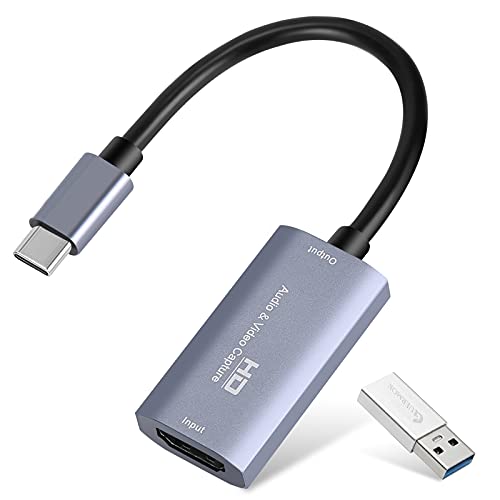
The physical size of your capture card dictates how it integrates into your desk layout. External capture cards are highly portable and typically feature a compact footprint of roughly 4.0 x 2.5 x 0.8 inches, weighing between 3 and 8 ounces. These devices sit directly on your desktop, meaning you must account for the physical space required by rigid HDMI and USB-C cables extending from both sides of the unit.
Internal PCIe capture cards, on the other hand, require zero desk space because they install directly into an open PCIe slot on your PC’s motherboard. They measure approximately 4.7 x 4.8 x 0.8 inches and weigh about 5 to 7 ounces. While internal cards keep your desk free of cable clutter, they require a desktop PC tower with an available motherboard slot, meaning they are completely incompatible with laptops or mini-PCs.
Chassis Material and Thermal Dissipation
Capture cards process massive amounts of high-bandwidth video data, which generates significant thermal energy. Internal operating temperatures can easily reach 110°F to 130°F (43°C to 54°C) during extended recording sessions.
Premium cards feature heavy-duty aluminum alloy housings with integrated cooling fins or ventilation grilles. Aluminum acts as a passive heatsink, drawing warmth away from the internal processing chips to prevent thermal throttling, which causes dropped frames in your software. Budget-tier cards often use cheap plastic enclosures. While lightweight, plastic is a poor thermal conductor; these cards can overheat during long sessions, resulting in software freezes, artifacting, and a significantly shorter product lifespan.
Port Construction and Cable Durability
The physical ports on your capture card are the literal gateways for your video signal. High-quality capture cards feature gold-plated HDMI 2.0 or HDMI 2.1 ports and reinforced USB-C 3.2 Gen 1 (or Gen 2) connections. These ports must be securely soldered to the internal circuit board with physical strain-relief housings to withstand the constant tension of heavy, shielded cables.
Look for devices that utilize USB-C ports with tight tolerances; a loose port can cause momentary disconnections, which will crash your capture software or cause a complete loss of the video signal mid-broadcast. HDMI 2.1 ports are essential if you want to pass through 4K resolutions at 120Hz with Variable Refresh Rate (VRR) enabled, while HDMI 2.0 ports will cap your passthrough at 4K 60Hz or 1480p 120Hz.
Software Performance and System Overhead
When evaluating capture card software, latency is the ultimate metric. High-end cards utilizing USB 3.0 or PCIe connections offer ultra-low latency of under 50 milliseconds, allowing you to play games directly inside your software preview window. Budget cards utilizing older USB 2.0 standards can introduce a massive input lag of 150 to 350 milliseconds, making real-time play through the software preview impossible.
Additionally, look for cards that are UVC (USB Video Class) compliant. UVC cards use native operating system drivers, meaning they work instantly when plugged in. Non-UVC cards require proprietary driver installations, which can introduce software conflicts, bloatware, and high CPU overhead that can drag down your system’s overall performance.
Price Tiers and Software Feature Sets
As we look at streaming and recording setups in 2026, the market is clearly divided into three distinct price tiers, each offering different levels of hardware capability and software customization:
- Budget Tier ($15 to $40): These are basic, compact USB dongles. They typically support 4K 30Hz input but are physically limited to capturing at 1080p 30FPS or 60FPS with MJPEG compression. Their software controls are barebones, often lacking advanced color space adjustments or custom audio routing.
- Mid-Range Tier ($80 to $130): This tier features robust external units with dedicated aluminum housings. They offer true 4K 60Hz HDR passthrough and 1080p 120FPS or 2K 60FPS capture. Software packages include custom utility tools to adjust EDID settings, toggle HDCP, and fine-tune audio gain levels.
- Premium Tier ($140 to $250+): These are top-tier external and internal PCIe cards. They support HDMI 2.1, enabling up to 4K 144Hz or 1080p 240Hz passthrough with VRR and HDR10. The companion software provides deep integration with OBS, multi-app routing, built-in audio mixers, and advanced color formats like RGB or NV12 without compression artifacts.
Warranty and Long-Term Software Support
A capture card is only as good as its software updates. Operating system updates can easily break proprietary drivers. Premium manufacturers offer a solid 2-year warranty and provide consistent, long-term software and firmware updates to ensure compatibility with new operating system releases.
Budget-tier cards often come with a limited 90-day or 1-year warranty and zero post-launch software support. If a major OS update breaks the card’s compatibility, you are left with a useless piece of hardware. Always check the manufacturer’s website to see how recently they have updated their drivers or configuration software before making a purchase.
Out-of-Box Setup and Cable Assembly
An often-overlooked factor is the physical assembly and power requirements of your setup. Most modern external capture cards are USB bus-powered, meaning they draw their operating power directly from your computer’s USB port. However, high-performance cards require a high-wattage USB 3.0 or 3.2 port (delivering at least 4.5W to 7.5W of power) to function stably.
If your PC’s USB port cannot supply enough power, the card may disconnect randomly or fail to initialize in your software. Ensure the retail package includes high-quality, shielded cables—such as a certified SuperSpeed USB-C cable and an HDMI 2.0/2.1 cable. Using a cheap, unshielded cable can introduce electromagnetic interference, causing audio hums or visual static in your final capture.
Spec Checklist
Use this quick-reference table to compare key specifications across budget, mid-range, and premium capture card tiers to find the right fit for your workspace:
| Specification | Budget Tier ($15 – $40) | Mid-Range Tier ($80 – $130) | Premium Tier ($140 – $250+) |
|---|---|---|---|
| Max Passthrough | 1080p @ 60Hz / 4K @ 30Hz | 4K @ 60Hz / 2K @ 120Hz | 4K @ 144Hz / 1080p @ 240Hz (HDMI 2.1) |
| Max Capture Resolution | 1080p @ 30FPS / 60FPS (Compressed) | 1080p @ 120FPS / 2K @ 60FPS | 4K @ 60FPS / 1080p @ 240FPS |
| Latency (Hardware) | High (150ms to 350ms) | Low (50ms to 80ms) | Ultra-Low (Under 50ms) |
| Color Space Formats | MJPEG / YUY2 (Limited) | YUY2 / NV12 (Full/Limited) | NV12 / RGB / P010 (HDR10 support) |
| VRR & HDR Passthrough | No | HDR10 (No VRR) | Yes (VRR, G-Sync, HDR10) |
| Chassis Material | Plastic / Thin Aluminum | Anodized Aluminum | Heavy-Duty Aluminum with Heatsink |
Red Flags
When shopping for a capture card, keep an eye out for these critical warning signs that indicate poor hardware quality or deceptive marketing:
- Deceptive “4K” Labels: Many cheap cards are marketed as “4K Capture Cards,” but reading the fine print reveals they only accept a 4K input signal and downscale the actual capture output to a choppy 1080p 30FPS or even 720p.
- No Mention of USB Version: If a listing simply says “USB” without specifying USB 3.0, USB 3.2, or SuperSpeed, it is highly likely a USB 2.0 device. This means your video feed will suffer from heavy compression artifacts and massive input lag.
- Required Driver CDs or Sketchy Downloads: Modern, high-quality capture cards should be class-compliant (UVC). If a device requires you to download proprietary drivers from an unverified website or install software from a CD, avoid it. It is a security risk and a sign of outdated hardware.
- Lack of Heatsinks or Venting on High-End Specs: If a card claims to capture 4K 60FPS but features a completely sealed plastic housing with no ventilation grilles or aluminum heatsinks, it will overheat and thermal-throttle within 30 to 45 minutes of continuous use.
FAQ
Why does my captured video look washed out or too dark?
This is almost always caused by a color range mismatch between your video source (console/PC) and your capture software settings. In your software (like OBS), check the “Color Range” setting. If your console is set to “Limited/Standard,” your software must also be set to “Limited.” If both are set to “Full,” the colors will look correct. If they are mismatched, your blacks will look gray (washed out) or your dark areas will lose all detail (crushed blacks).
Does using a capture card reduce my gaming PC’s performance?
If you are using a single-PC setup, a capture card does not magically offload the encoding work from your system. Your PC’s CPU or GPU must still compress and record the video stream. The performance hit is determined by your software settings (such as choosing NVENC hardware encoding over x264 software encoding). In a dual-PC setup, however, the capture card completely offloads the encoding task to the second PC, resulting in zero performance loss on your gaming machine.
What is the difference between NV12, YUY2, and RGB color formats in the settings?
These formats dictate how color data is compressed. RGB is uncompressed and offers the highest visual quality, but it requires massive USB bandwidth and CPU power. YUY2 is a balanced format that offers good color reproduction with moderate compression. NV12 is highly optimized and widely compatible, offering excellent performance and low resource usage, making it the industry standard for 1080p 60FPS streaming and recording.
Do I need a separate power supply for an external capture card?
Most standard external capture cards are bus-powered, meaning they run entirely on power delivered through the USB cable from your computer. However, premium HDMI 2.1 cards or cards with built-in audio mixers may require an external 5V or 12V power adapter (usually included) to ensure stable operation and prevent audio popping or signal dropouts caused by unstable USB power delivery from your motherboard.