Key takeaways
- Find the brightest, sharpest PowerPoint projectors for meeting rooms and classrooms, with clear slides in lit rooms, laptop connections, and easy setup.
A projector that works well for films can still fail badly in a meeting room, because PowerPoint slides need a different kind of image. Text must stay sharp at the back of the room, charts must keep their colours distinct, and the picture must hold up while the lights stay on so people can take notes and follow along. Choosing for slides, rather than for cinema, changes which details matter most when you compare models.
The three models below cover the situations most presenters meet in real rooms. A bright 1080p ViewSonic suits a fixed meeting room with dense slides, a WXGA ViewSonic suits a smaller room where straightforward setup matters more than fine detail, and a slim wireless Epson suits a presenter who moves between rooms and needs to start quickly.
Quick Picks
As an Amazon Associate we earn from qualifying purchases
| Product | Best for | Key spec from title |
|---|---|---|
| ViewSonic PA503HD | Dense slides in a fixed meeting room | 4000 Lumens 1080p Full HD DLP Projector |
| ViewSonic PA503W | Smaller rooms and straightforward daily use | 4000 Lumens WXGA High Brightness Projector |
| Epson PowerLite 1781W | Travelling presenters and shared rooms | 3,200 lumens color brightness wireless 3LCD Portable Projector |
How to Choose
Brightness for a lit room
Brightness decides whether slides stay readable when the lights stay on, and PowerPoint decks suffer more than films when the image washes out. A projector rated at 3,200 lumens can serve a small, controlled room, while a 4,000-lumen model gives a clearer margin in a typical meeting room with overhead lighting and daylight from windows. Look at the figure in the Amazon listing for the exact model, and match it to the room rather than buying the brightest unit by default. Consider screen size as well, because the same light spread across a wider image looks weaker at every seat.
Resolution for text and charts
Resolution matters for PowerPoint because slides are built from small text, table cells, thin lines, and chart labels. WXGA resolution, at 1280 by 800, handles ordinary bullet slides and large headings well, and it remains a sensible choice for a small room where the audience sits close to the screen. Full HD resolution, at 1920 by 1080, keeps finer detail legible at a greater distance, which helps when a deck contains spreadsheets or detailed diagrams. Check the native resolution in the listing, because a projector that accepts a higher-resolution signal does not always display that many pixels.
Connections that match your laptop
A presentation projector should connect to the laptops people actually bring into the room, without a hunt for an adapter before the meeting starts. HDMI covers most modern laptops, while VGA still helps with older machines and some fixed installations. Dual HDMI inputs make it easier to switch between a room computer and a visitor laptop, and a USB port can power a wireless dongle on some models. Wireless projection helps a travelling presenter, yet a wired connection remains the more predictable choice for a long meeting. Before buying, list the ports on the laptops in regular use, then check them against the ports named in the Amazon listing.
Placement, keystone, and everyday setup
Placement shapes the whole experience, because a projector that needs a long throw distance may not fit a short meeting room at all. Check the throw range, the image size the model can produce, and whether optical zoom gives any flexibility when the table or ceiling mount sits slightly off centre. Keystone correction straightens an image projected from an angle, and automatic correction saves time when the projector moves between rooms. A portable model should also be light enough to carry with a laptop bag, while a fixed-room model can trade portability for a sturdier mount and a larger image.
The 3 Best Options
ViewSonic PA503HD

The ViewSonic PA503HD is the strongest choice in this group for a fixed meeting room where slides carry a lot of detail. Its Full HD image keeps small table text, axis labels, and diagram lines legible from the back rows, and its bright output helps the picture hold up when the room lights stay on for note taking. Dual HDMI inputs make it simple to switch between a room computer and a guest laptop, while optical zoom and automatic vertical keystone correction reduce the fiddling needed after the projector has been placed.
Specs
- 4000 lumens; 1080p Full HD resolution, 1920 by 1080; 22,000 to 1 contrast ratio; dual HDMI ports and USB-A port; 1.1x optical zoom; auto vertical keystone; images up to 300 inches; 120Hz refresh rate
Best for: Fixed meeting rooms and classrooms with dense PowerPoint slides, charts, and tables.
Watch out for: It is a larger desktop model than a travel projector, so it suits a room where it can stay in place rather than a bag carried between sites.
ViewSonic PA503W
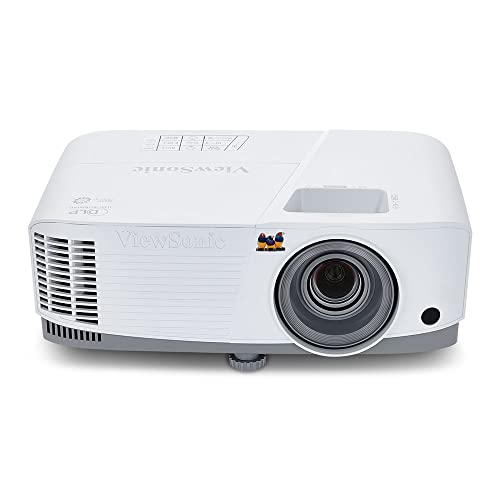
The ViewSonic PA503W is a practical pick for a smaller meeting room, a training room, or a classroom where the deck uses large headings, short bullet points, and simple charts. Its WXGA image is clear enough for that kind of material, and its bright output keeps slides readable without turning the lights off. HDMI and vertical keystone correction cover the basics of a quick setup, and the familiar desktop shape makes it easy for different staff members to use without a long introduction.
Specs
- 4000 lumens; WXGA resolution, 1280 by 800; HDMI input; vertical keystone correction; 4.84 pounds; dimensions 11.57 by 8.58 by 4.33 inches
Best for: Smaller rooms, training sessions, and everyday PowerPoint decks with large text and simple visuals.
Watch out for: WXGA resolution shows less fine detail than Full HD, so dense spreadsheets and small chart labels can look softer at the back of a larger room.
Epson PowerLite 1781W

The Epson PowerLite 1781W is built for a presenter who carries the projector from room to room and needs the meeting to start without a long setup. It is slim and light for a full projector, at 4 pounds, and its wireless projection lets a presenter display slides from a laptop, tablet, or smartphone without staying tied to a cable. Separate colour brightness and white brightness figures of 3,200 lumens each help slides stay vivid in a lit room, while automatic horizontal and vertical keystone correction plus Screen Fit adjust the image when the projector sits off centre.
Specs
- 3,200 lumens color brightness and 3,200 lumens white brightness; WXGA resolution, 1280 by 800; wireless projection; HDMI input; auto horizontal and vertical keystone correction; Screen Fit; 4 pounds; dimensions 11.5 by 8.4 by 2.1 inches
Best for: Travelling presenters, trainers, and shared rooms where the projector moves and setup time is short.
Watch out for: Its brightness is lower than the two ViewSonic models here, so a very large or very bright room may need the lights dimmed or a smaller image.
Which One Fits Your Situation
A fixed meeting room with dense slides
Choose the ViewSonic PA503HD when one room hosts most presentations and the decks contain tables, financial figures, or detailed diagrams. The Full HD image keeps fine labels readable from the back, the bright output copes with overhead lighting, and dual HDMI inputs let a room computer and a visitor laptop share the same setup. Once placed on a shelf, it can stay ready for the next meeting without daily alignment.
A small room with simple decks
Choose the ViewSonic PA503W when the room is small, the audience sits close to the screen, and the slides use large headings and short points. Its WXGA image is enough for that material, its bright output keeps the picture clear with the lights on, and its straightforward controls suit a room used by many different people. It is a sensible match for training rooms and team huddles rather than a large hall.
A presenter who travels between rooms
Choose the Epson PowerLite 1781W when the projector travels in a bag and every venue is slightly different. Its slim shape and light weight make carrying it realistic, wireless projection frees the presenter from a fixed seat, and automatic keystone correction plus Screen Fit handle off-centre placement. It suits trainers, sales staff, and teachers who present in borrowed rooms.
A classroom shared by several teachers
Choose the ViewSonic PA503HD for a classroom that needs sharp text for diagrams and worksheets, or the Epson PowerLite 1781W when teachers move between classrooms and share one unit. A fixed classroom benefits from the sharper image and brighter output of the ViewSonic, while a shared trolley favours the lighter Epson. Decide first whether the projector stays in one room or travels, because that choice narrows the field quickly.
Common Mistakes
- Buying a home cinema projector for slides, then finding that film-friendly contrast and colour handling do not keep small text sharp in a lit room.
- Choosing brightness from a headline figure alone, without checking whether the listing states colour brightness and white brightness separately.
- Ignoring throw distance, then discovering that the projector cannot fill the screen from the only table or mount available in the room.
- Assuming every laptop will connect, without checking HDMI, VGA, and wireless options against the machines people actually bring.
- Placing the projector at an angle and leaving the image skewed, instead of using keystone correction and checking the corners before the audience arrives.
Frequently Asked Questions
Do I need Full HD resolution for PowerPoint?
Full HD helps when slides contain small text or dense charts, because each character stays sharper at a distance. WXGA remains fine for large headings and short bullet points in a small room. If the audience sits far from the screen, choose the sharper native resolution rather than relying on a projector that merely accepts a higher-resolution signal.
How bright should a presentation projector be?
A projector around 3,200 lumens can work in a small room with controlled lighting, while 4,000 lumens gives a clearer image in a typical meeting room with the lights on. Larger rooms and wide screens call for more light. Check the brightness figure in the Amazon listing for the exact model, and remember that colour brightness and white brightness can differ.
Can I present wirelessly from a laptop or phone?
Some projectors support wireless display from a laptop, tablet, or smartphone, and the Epson PowerLite 1781W in this guide is one example, with support for Chromecast, Roku, and MHL-enabled devices. Wireless projection suits a presenter who moves around, yet a wired HDMI connection remains the more predictable option for long meetings. Confirm the exact wireless method in the listing first.
Should I dim the lights for PowerPoint slides?
Dimming helps a weaker projector, but a good presentation projector should keep slides readable with the lights on so the audience can take notes. If the image washes out badly, the projector is either too dim for the room or the image is too large for its output. Try a smaller image first, then adjust blinds and seating before changing the projector.
FAQ
Do I need Full HD resolution for PowerPoint?
How bright should a presentation projector be?
Can I present wirelessly from a laptop or phone?
Should I dim the lights for PowerPoint slides?
More from Amazon
Programs that pair well with the guide above. Offers and eligibility are set by Amazon and may change.
Free shipping on eligible items, Prime Video and more. Eligible new members can start with a free trial.
Start a Prime free trialAd-free music streaming. Eligible new subscribers can start with a free trial.
Try Music Unlimited freeA Prime membership for ages 18-24 with a trial period. Eligibility is set by Amazon.
See Prime for Young AdultsAudiobooks and podcasts to listen to on the go. Eligible new members can start with a free trial.
Try Audible freeAs an Amazon Associate we earn from qualifying purchases.