Key takeaways
- Discover the best selling projectors for home theater, gaming, and movie nights, with bright 1080p and 4K picks, portable options, and easy setup.
The best selling projectors earn their popularity by doing the same thing well: turning an ordinary wall into a screen far larger than any television that fits in the same room. Shoppers keep coming back to the same handful of models because they combine a sharp picture, enough brightness for real living rooms, and setup that does not demand a dedicated theater room or a professional installer. Whether the goal is a weekend movie night, a gaming setup with a huge display, or a portable unit that moves from the living room to the backyard, the models that sell in the largest numbers tend to cover one of those jobs better than the rest of the field.
This guide looks at five of the most popular projectors buyers choose again and again. Each one is a different kind of machine: a bright 3LCD home theater unit, a color-accurate DLP favorite for movies and games, a true 4K gaming projector, a compact portable with automatic setup, and a battery-powered outdoor model. All five are listed on Amazon US, and each one is linked below so the exact model can be checked before buying. The focus here is on what each projector does well, where it falls short, and who it suits, so the choice comes down to the room and the way it will be used rather than guesswork.
How to Choose
1. Resolution
Resolution decides how sharp the picture looks up close. Native 1080p is the standard for most home theater and gaming use and looks crisp on screens up to about 120 inches. True 4K models add finer detail for large screens and for viewers who sit close, but they cost more and need a 4K source to show the difference. A projector that only accepts a 1080p signal and scales it down to a lower-resolution panel will look softer, so check the native resolution rather than the maximum supported input.
2. Brightness
Brightness is measured in lumens, and the number that matters is the one for the viewing conditions in the room. A dark or dim room works well with 1,000 to 2,200 lumens. A living room with lamps on or daylight coming through curtains needs 3,000 lumens or more to keep the image from looking washed out. Portable projectors with built-in batteries usually trade brightness for size, so they shine in dark rooms and lose impact in bright ones. Compare ANSI lumens with ANSI lumens where possible, since different makers measure differently.
3. Contrast and Color Accuracy
Contrast shapes how deep blacks look and how much depth a dark scene keeps. A higher contrast ratio helps movies with night scenes and shadow detail. Color accuracy matters just as much: a projector that covers a wide share of the Rec.709 color space reproduces films the way the director intended, with natural skin tones and balanced color. For gaming and sports, vivid color matters more than absolute accuracy, while a dedicated movie room benefits from calibrated color.
4. Throw Distance and Screen Size
Throw distance is the space between the projector and the wall. A standard-throw model needs roughly 8 to 12 feet for a 100-inch image, while a short-throw model can do the same from half that distance. Measure the room before buying, and check the zoom range and lens shift, which give flexibility when the projector cannot sit exactly centered. A model with keystone correction can square up an image projected at an angle, though optical adjustments always preserve more sharpness than digital ones.
5. Input Lag for Gaming
Gamers should look at input lag, the delay between a controller action and the picture changing. A lag of around 16 milliseconds or less feels responsive for most games, and dedicated game modes on some projectors cut that further. A high refresh rate, such as 240Hz on some 4K models, helps fast motion look smooth. Projectors built mainly for movies often carry higher lag, so check the specification when the projector will double as a gaming display.
6. Built-In Smart Features and Sound
Many modern projectors include a smart platform with streaming apps, Wi-Fi, and Bluetooth, which means movies can begin without a separate streaming stick or laptop. Built-in speakers are convenient for casual viewing, but they rarely match a soundbar or a set of external speakers, so treat them as a backup rather than the main audio system. Battery-powered models add freedom for outdoor use, though the battery usually lasts only a few hours of video.
7. Lamp Life and Running Costs
Lamp-based projectors need a replacement lamp after a few thousand hours, and that lamp can be a meaningful expense over the life of the unit. LED and laser light sources last far longer, often tens of thousands of hours, and keep their brightness more steadily. Check the rated lamp life in normal and eco modes, and remember that eco mode usually extends lamp life while reducing brightness a little.
Top Picks
Epson Home Cinema 1080

View the Epson Home Cinema 1080 on Amazon
The Epson Home Cinema 1080 is one of the most widely bought home theater projectors because it covers the basics at a high level: a native 1080p picture from a 3-chip 3LCD engine, 3,400 lumens of color and white brightness, and a 16,000:1 contrast ratio. That brightness is the headline feature, since it keeps the picture watchable in a living room with the lights on, a situation where dimmer projectors fade into a grey wash. The 3LCD design produces color and white brightness at the same level, so bright scenes keep their color instead of looking bleached.
Setup is straightforward, with dual HDMI inputs for a console and a streaming device at the same time, a built-in speaker for casual viewing, and automatic picture skew correction that squares the image when the projector sits off-center. The picture stays sharp across the frame, and the color out of the box suits movies, sports, and television without heavy adjustment.
This projector suits a living room or a multipurpose media room where the lights are not always off. It is a strong fit for families who want a big screen for movies and sports without building a dedicated dark theater. The main caveat is that it is a full-size home theater unit rather than a portable one, so it belongs on a shelf or a ceiling mount rather than in a bag. It also has no built-in smart platform, so a streaming stick or a connected device is needed for apps.
BenQ HT2050A
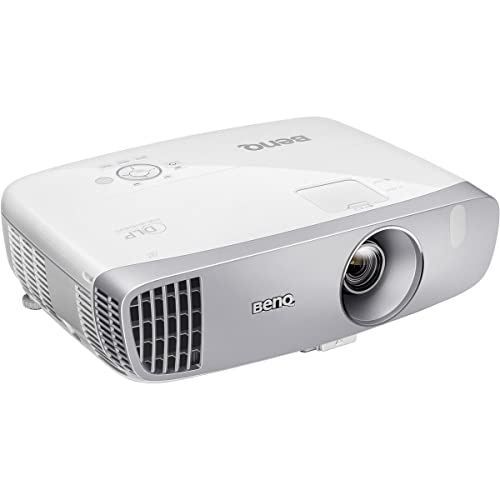
View the BenQ HT2050A on Amazon
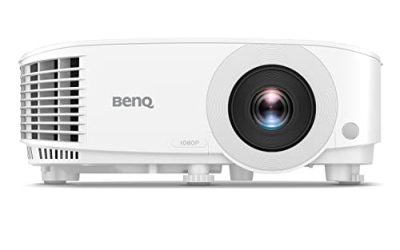
The BenQ HT2050A has been a favorite among home theater enthusiasts for years, and its reputation rests on color. Its DLP engine delivers native 1080p resolution with 2,200 lumens and 96 percent Rec.709 color coverage, which means films look accurate and natural with little calibration. The 15,000:1 contrast ratio gives dark scenes depth, and a low input lag of around 16 milliseconds makes it one of the better choices for gaming at this level.
Practical details help it fit real rooms: a 1.3x zoom lens, vertical lens shift, and 2D keystone correction make placement forgiving, and it can throw a 100-inch image from about 8 feet, stretching up to 300 inches in a large space. Two HDMI ports cover a console and a streaming device, and a 10-watt speaker handles casual viewing. The lamp is rated for up to 7,000 hours in its longest-lasting mode, which keeps running costs reasonable for a lamp-based design.
This projector suits viewers who care about color accuracy and who watch mostly in a dim or dark room, including gamers who want low lag on a huge screen. The caveat is brightness: at 2,200 lumens it needs controlled lighting, so a bright living room with daylight will wash the picture out. It is also an older design without a smart platform, so streaming comes from an external device.
ViewSonic PX701-4K
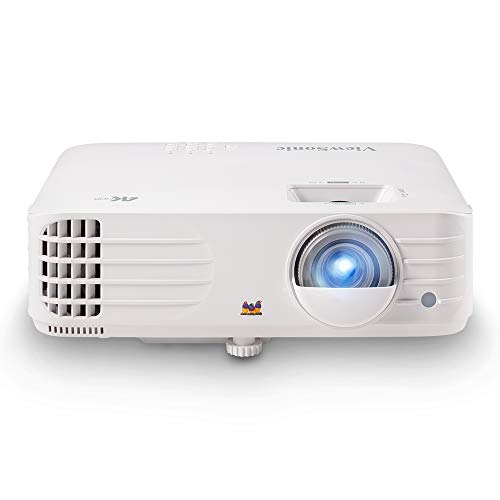
View the ViewSonic PX701-4K on Amazon
The ViewSonic PX701-4K is the pick for buyers who want true 4K resolution without moving into the highest tier of home theater spending. Its DLP engine produces a native 3840 x 2160 image with 3,200 lumens, HDR support, and a 240Hz refresh rate, a combination aimed squarely at large-screen gaming and sports. The high refresh rate and low input lag keep fast motion smooth, and the brightness holds up in rooms that are not fully dark.
The lens offers a 1.1x optical zoom with horizontal and vertical keystone, plus automatic vertical keystone, so the image can be squared up without much fuss. Dual HDMI inputs accept a console and a media player at once, and a built-in 10-watt speaker covers casual use. The 4K detail is most visible on screens above 100 inches and for viewers who sit relatively close, where the extra pixels are easy to see.
This projector suits gamers and sports fans who want a large, sharp, fast picture, and movie lovers with a big screen who want the extra detail of 4K. The caveat is that the full benefit needs a 4K source and a large screen; on a small image or with a standard high-definition source, the difference from a good 1080p model is harder to see. It is also a full-size unit that needs a fixed spot in the room.
XGIMI MoGo 2 Pro

View the XGIMI MoGo 2 Pro on Amazon
The XGIMI MoGo 2 Pro is the portable pick in this group, and its appeal is how little effort setup takes. It is a compact 1080p projector with 400 ISO lumens, automatic focus, automatic keystone correction, intelligent obstacle avoidance, and intelligent screen alignment, so it finds a clear wall and squares the image by itself. The built-in Android TV platform carries streaming apps directly, and two 8-watt speakers provide sound without extra gear.
Its small cylindrical body moves easily from room to room, and it can project an image up to 100 inches, which makes it a natural fit for a bedroom, a small apartment, or a trip to a friend’s place. The 4K input support means it accepts a high-resolution source and scales it to its native 1080p panel. Wi-Fi and Bluetooth cover wireless streaming and audio accessories.
This projector suits anyone who values portability and automatic setup over maximum brightness, including renters, travelers, and viewers who move the projector between rooms. The caveat is brightness: 400 ISO lumens is modest, so it performs best in a dark or dim room and struggles in daylight. It is a convenience-first machine, not a replacement for a bright living-room home theater projector.
NEBULA Mars 3

View the NEBULA Mars 3 on Amazon
The NEBULA Mars 3 is built for taking the big screen outside. It is a portable 1080p projector with 1,000 ANSI lumens, a built-in battery rated for up to 5 hours of video playtime, and an Android TV platform with streaming apps. Its AI-powered image adjustment handles focus and keystone automatically, and it can project an image up to 200 inches, which suits a backyard wall or an outdoor screen.
The battery is the defining feature: it frees the projector from a power outlet, so movie nights can happen on a patio, at a campsite, or in a room without a nearby socket. The sealed design resists dust, and the carrying handle makes it easy to move. At 1,000 ANSI lumens it is noticeably brighter than pocket-sized portable models, which helps it hold up in the early evening before full darkness.
This projector suits outdoor movie nights, camping trips, and households that want one projector for both indoor and outdoor use. The caveat is that it is still a portable unit, so a fixed home theater projector will beat it for brightness and for fine detail in a dark room. Battery life also depends on brightness settings and content, so long movies may need the power adapter nearby.
Comparison Table
| Projector | Resolution | Brightness | Key Strength | Smart Platform | Best For |
|---|---|---|---|---|---|
| Epson Home Cinema 1080 | Native 1080p | 3,400 lumens | Bright 3LCD picture | No | Bright living rooms |
| BenQ HT2050A | Native 1080p | 2,200 lumens | Accurate color, low lag | No | Movies and gaming in dim rooms |
| ViewSonic PX701-4K | True 4K UHD | 3,200 lumens | 4K detail, 240Hz | No | Large-screen gaming and sports |
| XGIMI MoGo 2 Pro | Native 1080p | 400 ISO lumens | Automatic setup, portable | Android TV | Bedrooms and travel |
| NEBULA Mars 3 | Native 1080p | 1,000 ANSI lumens | Built-in battery | Android TV | Outdoor movie nights |
Which One Is Right for You?
For a bright living room where the lights stay on, the Epson Home Cinema 1080 is the natural choice, since its 3,400 lumens keep the picture vivid where dimmer models fade. For a dedicated movie room or a gaming setup in a dim space, the BenQ HT2050A gives the most accurate color and low lag, while the ViewSonic PX701-4K is the step up for anyone who wants true 4K detail and a high refresh rate on a large screen.
For portability, the decision comes down to where the projector will be used. The XGIMI MoGo 2 Pro is the easiest to move and the quickest to set up, which suits bedrooms, apartments, and travel. The NEBULA Mars 3 is the better outdoor choice because its battery removes the need for a power outlet and its 1,000 ANSI lumens hold up better as daylight fades. Measure the room, note the lighting, and match the projector to the job it will do most often, since no single model leads in every category.
Frequently Asked Questions
What size screen can these projectors produce?
Most of these models can fill a screen of 100 inches or more. The BenQ HT2050A can reach up to 300 inches in a large room, the NEBULA Mars 3 up to 200 inches, and the XGIMI MoGo 2 Pro up to 100 inches. The right size depends on the throw distance in the room, so measure the space between the projector and the wall before deciding.
Do I need a dark room for a projector?
A dark room gives the best picture from any projector, but brightness decides how much ambient light is acceptable. The Epson Home Cinema 1080 and the ViewSonic PX701-4K, at 3,400 and 3,200 lumens, handle a lit living room far better than the portable models. The XGIMI MoGo 2 Pro and the NEBULA Mars 3 perform best after dark or in a dim room.
Can I use a projector for gaming?
Yes, and several of these models are built with gaming in mind. The ViewSonic PX701-4K pairs a 240Hz refresh rate with low input lag, and the BenQ HT2050A offers lag of around 16 milliseconds. Connect the console through HDMI, switch the projector to its game mode where available, and keep the room dim for the clearest picture.
Do these projectors need external speakers?
Not always, but external audio usually sounds better. Each model here includes a built-in speaker that works for casual viewing, and the XGIMI MoGo 2 Pro carries two 8-watt speakers. For a theater feel, connect a soundbar or a speaker system through HDMI ARC, Bluetooth, or the audio output, depending on the model.
Disclosure: As an Amazon Associate, we may earn from qualifying purchases.
FAQ
Which One Is Right for You?
What size screen can these projectors produce?
Do I need a dark room for a projector?
Can I use a projector for gaming?
Do these projectors need external speakers?
More from Amazon
Programs that pair well with the guide above. Offers and eligibility are set by Amazon and may change.
Free shipping on eligible items, Prime Video and more. Eligible new members can start with a free trial.
Start a Prime free trialAd-free music streaming. Eligible new subscribers can start with a free trial.
Try Music Unlimited freeA Prime membership for ages 18-24 with a trial period. Eligibility is set by Amazon.
See Prime for Young AdultsAudiobooks and podcasts to listen to on the go. Eligible new members can start with a free trial.
Try Audible freeAs an Amazon Associate we earn from qualifying purchases.