Our Short List of 3

- Best for: Home producers and gamers who want a wide sweet spot and a proven, balanced sound.

- Best for: Mixers and editors who want a flat reference that exposes problems instead of hiding them.

- Best for: Small or untreated rooms, and anyone who wants onboard EQ and voicing modes without extra hardware.
All 4 Picks at a Glance
| Product | Specs | Action |
|---|---|---|
| 1. JBL 305P MkII — Best Overall |
| Check price on Amazon |
| 2. Yamaha HS5 — Best for Flat, Honest Mixing |
| Check price on Amazon |
| 3. KRK Rokit 5 G5 — Best Room Tuning and Versatility |
| Check price on Amazon |
 4. ADAM Audio T5V — Best Ribbon Tweeter Detail |
| Check price on Amazon |
Key takeaways
- Find the best 5 inch active monitors for your home studio. Compare 5-inch powered speakers for mixing, gaming, and music production in 2026 for small rooms.
Introduction
Finding the best 5 inch active monitors is one of the smartest upgrades you can make to a home studio, a gaming desk, or a small editing setup. A 5-inch active monitor pairs a built-in amplifier with a compact cabinet, so you get honest, detailed sound without a separate amp or a speaker that swallows your desk. These nearfield speakers are designed to sit a few feet from your ears and reveal what a mix, a game soundtrack, or a video edit actually sounds like, instead of flattering it.
The 5-inch size hits a sweet spot. Smaller 3-inch and 4-inch monitors often struggle with low-end weight, while 8-inch models can overwhelm a bedroom or a small office and excite room modes that muddy the bass. A 5-inch woofer reaches low enough for most music production, podcast editing, and gaming, yet the cabinet stays small enough for a desktop. In this guide, we explain what to look for, then compare four proven 5-inch active monitors that are widely used by home producers, streamers, and gamers.
How to Choose 5 Inch Active Monitors
Woofer, Tweeter, and Frequency Response
Every monitor in this guide uses a 5-inch woofer and a separate tweeter, usually 1 inch, in a two-way design. The woofer handles bass and midrange, while the tweeter handles treble. Check the frequency response figures published by the manufacturer: a range that starts around 45 to 55 Hz at the low end is typical for this size, and extension to 20 kHz or beyond at the top is standard. A ribbon tweeter, such as the one on the ADAM T5V, extends higher than a conventional dome, which can add air to cymbals and vocals, though it is not automatically better for every listener.
Built-In Amplification
Active monitors have amplifiers built into the cabinet, with one amp channel per driver in a bi-amped design. Total power in this class usually falls between 55 and 82 watts per speaker. More power does not always mean better sound, but it does mean cleaner output at higher volumes and less strain when a track has sudden dynamic peaks. A bi-amped design also lets each amplifier focus on its own frequency band, which tends to keep distortion lower than a single shared amp.
Room Tuning Controls
No room is acoustically perfect, and a desk pushed against a wall boosts bass. That is why room tuning controls matter. Look for high-frequency trim and low-frequency trim switches, or a room-control switch that cuts low mids when the speaker sits close to a wall. The KRK Rokit 5 G5 goes further, with DSP-driven room tuning and selectable voicing modes that adjust the response from a small onboard display. Even simple two-position switches help a monitor sound right in a real room instead of only in a laboratory.
Inputs and Connectivity
Most 5-inch active monitors offer balanced XLR and quarter-inch TRS inputs, which reject interference over longer cable runs from an audio interface. Some models add unbalanced RCA inputs, which are handy for connecting a computer, a turntable preamp, or a gaming console adapter directly. Balanced inputs are the better choice when you run cables from an interface or mixer, while RCA is useful for a simple desktop setup. Make sure the monitor you choose matches the outputs on your interface, mixer, or sound card.
Placement and the Sweet Spot
Nearfield monitors are designed to be heard from about three to five feet away, with the tweeters aimed at ear level and the two speakers and your head forming a rough triangle. Small details make a big difference: isolation pads or stands reduce vibrations travelling into the desk, and keeping the rear bass port a few inches from the wall prevents boomy low end. If your desk is tight, a front-ported design or a model with a room-control switch will be more forgiving than a rear-ported speaker jammed against a wall.
Single Speaker or Matched Pair
Studio monitors are commonly sold individually, so read the listing carefully before ordering. A single-speaker listing means you need two units for stereo. Some listings sell a matched pair, which is convenient and guarantees the two speakers came from the same production run. Either way, budget for a pair, plus cables and isolation pads, when you plan your setup.
Top Picks: Best 5 Inch Active Monitors
1. JBL 305P MkII — Best Overall
- Best for: Home producers and gamers who want a wide sweet spot and a proven, balanced sound.
Home producers and gamers who want a wide sweet spot and a proven, balanced sound.
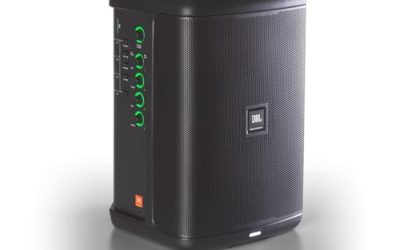
The JBL 305P MkII is a 5-inch two-way powered studio monitor built around JBL’s patented Image Control Waveguide, which widens the sweet spot so the stereo image stays stable even when you shift in your chair. Dual 41-watt Class-D amplifiers, one for the 5-inch woofer and one for the 1-inch tweeter, deliver 82 watts of bi-amped power per cabinet. Frequency response is rated at 49 Hz to 20 kHz, with a wider 43 Hz to 24 kHz range at minus 10 dB, and peak output reaches 108 dB.
The Slip Stream low-frequency port is double-flared to reduce turbulence and extend bass without chuffing, and the rear panel offers balanced XLR and quarter-inch TRS inputs, an input-sensitivity switch, and high-frequency and low-frequency trim controls. JBL also subjects the design to a 100-hour full-power test before it ships, which speaks to long-term reliability. For mixing, gaming, and general desktop listening, the 305P MkII is a strong all-rounder, and it is sold individually, so order two for a stereo pair.
2. Yamaha HS5 — Best for Flat, Honest Mixing
- Best for: Mixers and editors who want a flat reference that exposes problems instead of hiding them.
Mixers and editors who want a flat reference that exposes problems instead of hiding them.
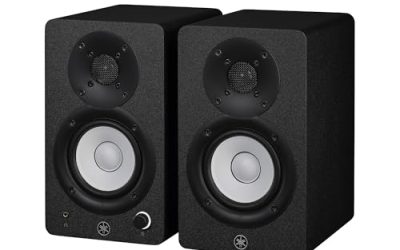
The Yamaha HS5 is famous for its flat, unforgiving response, which is exactly what many mixers want: if a mix sounds good on the HS5, it tends to translate well to other speakers, headphones, and car stereos. The distinctive white 5-inch woofer and 1-inch dome tweeter are driven by a bi-amped design with 45 watts for the low frequencies and 25 watts for the highs, for 70 watts total. Frequency response runs from 54 Hz to 30 kHz.
Rear-panel Room Control and High Trim switches let you tame low-mid buildup when the speaker sits near a wall and adjust treble to taste. Inputs are balanced XLR and quarter-inch TRS, and the cabinet uses a rear bass port. The HS5 has less low-end weight than some rivals, which is a deliberate tuning choice rather than a flaw, and many owners pair it with a subwoofer later if they mix bass-heavy genres. For critical listening in a small room, its honesty is hard to beat.
3. KRK Rokit 5 G5 — Best Room Tuning and Versatility
- Best for: Small or untreated rooms, and anyone who wants onboard EQ and voicing modes without extra hardware.
Small or untreated rooms, and anyone who wants onboard EQ and voicing modes without extra hardware.
The KRK Rokit 5 G5 is the current generation of KRK’s long-running Rokit line, replacing the discontinued G4. It pairs a 5-inch woven Kevlar woofer with a 1-inch silk dome tweeter, driven by bi-amplified Class D power rated at 55 watts total with 130 watts of dynamic headroom. Frequency response is rated at 54 Hz to 30 kHz, and maximum output reaches 104 dB.
Where the G5 stands out is control. DSP-driven room tuning offers 25 graphic EQ combinations, and three voicing modes let the same speaker act as a flat mixing reference or a more energetic listening speaker, all adjusted from a small LCD display and a rear control knob. The front of the cabinet also shows volume and settings at a glance. Inputs are balanced XLR, and the speaker goes into auto standby after 30 minutes of silence to save power. For a small room that needs correction, or for a user who wants one pair to cover both mixing and casual listening, the G5 is the most flexible pick here.
4. ADAM Audio T5V — Best Ribbon Tweeter Detail
- Best for: Listeners who want ribbon-tweeter detail and a wide, precise stereo image.
Listeners who want ribbon-tweeter detail and a wide, precise stereo image.
The ADAM Audio T5V brings ADAM’s signature U-ART ribbon tweeter down to an affordable 5-inch monitor. The 1.9-inch accelerated ribbon tweeter, mounted in an HPS waveguide, extends the top end to 25 kHz and is known for detailed, low-distortion treble. A 5-inch polypropylene woofer handles the low end, and the pair is bi-amped with 50 watts for the woofer and 20 watts for the tweeter, for 70 watts total. Frequency response is rated at 45 Hz to 25 kHz, and maximum output reaches 106 dB.
The rear panel includes balanced XLR and unbalanced RCA inputs, a level control, and high-shelf and low-shelf EQ switches for room adjustment. A rear-firing bass-reflex port extends the low end, so leave some space behind the cabinet. The T5V is a favourite among producers who prize treble detail and imaging, and it also works well as a premium desktop speaker for gaming and media.
Comparison Table
| Monitor | Woofer / Tweeter | Amplifier | Frequency Response | Max SPL | Inputs | Room Tuning |
|---|---|---|---|---|---|---|
| JBL 305P MkII | 5 in / 1 in dome | 82 W bi-amped | 49 Hz–20 kHz | 108 dB | XLR, TRS | HF/LF trim |
| Yamaha HS5 | 5 in / 1 in dome | 70 W bi-amped | 54 Hz–30 kHz | Not published as peak SPL | XLR, TRS | Room Control, High Trim |
| KRK Rokit 5 G5 | 5 in Kevlar / 1 in silk dome | 55 W, 130 W dynamic | 54 Hz–30 kHz | 104 dB | XLR | DSP EQ, 3 voicing modes |
| ADAM Audio T5V | 5 in / 1.9 in ribbon | 70 W bi-amped | 45 Hz–25 kHz | 106 dB | XLR, RCA | HF/LF shelf EQ |
Which 5 Inch Active Monitor Should You Buy?
If you want one safe recommendation, the JBL 305P MkII covers the most ground: a wide sweet spot, balanced sound, and proven reliability. Choose the Yamaha HS5 if your priority is a flat, honest reference for mixing and you are willing to trade some bass weight for accuracy. Pick the KRK Rokit 5 G5 if your room is small or untreated and you want DSP room tuning and voicing modes built into the speaker. Go for the ADAM Audio T5V if treble detail and imaging matter most to you and you like the sound of a ribbon tweeter.
Whichever model you choose, remember that placement matters as much as the speaker itself. Put the tweeters at ear level, form a triangle with your listening position, keep the rear ports clear of the wall where possible, and use isolation pads to decouple the cabinets from your desk. A modest 5-inch monitor set up well will outperform a larger speaker placed carelessly.
Frequently Asked Questions
Are 5 inch active monitors enough for a home studio?
For most home studios, yes. A 5-inch active monitor reaches low enough for the majority of music genres, podcast work, and video editing, and it fits a desktop without dominating the room. If you regularly mix bass-heavy genres such as hip-hop, trap, or electronic dance music, you may later add a matched subwoofer, but many producers work happily on 5-inch monitors alone and check the low end on headphones.
What does active mean in a studio monitor?
Active means the amplifier is built into the speaker cabinet, with a dedicated amp channel for each driver. You connect a line-level signal from an audio interface, mixer, or sound card, and the monitor handles amplification itself. This removes the need for a separate amplifier and lets the manufacturer tune the amp, crossover, and drivers as a single system.
Do I need an audio interface for active monitors?
An audio interface is strongly recommended for music production, because it gives you balanced outputs, a volume control, and low-latency monitoring. For casual desktop listening, you can connect many monitors directly to a computer through an adapter cable, though an interface or a small mixer usually sounds cleaner and gives you better level control.
Should I buy a single monitor or a pair?
Buy a pair for stereo listening. Most 5-inch active monitors are sold individually, so check the listing: a single-unit listing means you need two. Matched-pair listings are convenient, but two identical single units give you the same stereo setup as long as they are the same model.
How far should I sit from 5 inch active monitors?
Nearfield monitors are designed for a listening distance of roughly three to five feet. Sit with the tweeters at ear level and the speakers angled toward you, so that you and the two speakers form a triangle with equal sides. Sitting much further away lets room reflections dominate the sound, which defeats the purpose of a nearfield design.
Conclusion
The best 5 inch active monitors give you honest, detailed sound in a cabinet that fits a real desk in a real room. The JBL 305P MkII is the best all-rounder, the Yamaha HS5 is the flattest reference for critical mixing, the KRK Rokit 5 G5 offers the most flexible room tuning, and the ADAM Audio T5V delivers standout treble detail from its ribbon tweeter. Any of the four is a solid foundation for a home studio, a gaming setup, or an editing desk. Choose the one that matches your room and your workflow, set it up carefully, and your mixes and media will sound clearer for it.
Disclosure: As an Amazon Associate, we earn from qualifying purchases.
FAQ
Which 5 Inch Active Monitor Should You Buy?
Are 5 inch active monitors enough for a home studio?
What does active mean in a studio monitor?
Do I need an audio interface for active monitors?
Should I buy a single monitor or a pair?
How far should I sit from 5 inch active monitors?
More from Amazon
Programs that pair well with the guide above. Offers and eligibility are set by Amazon and may change.
Free shipping on eligible items, Prime Video and more. Eligible new members can start with a free trial.
Start a Prime free trialAd-free music streaming. Eligible new subscribers can start with a free trial.
Try Music Unlimited freeA Prime membership for ages 18-24 with a trial period. Eligibility is set by Amazon.
See Prime for Young AdultsAudiobooks and podcasts to listen to on the go. Eligible new members can start with a free trial.
Try Audible freeAs an Amazon Associate we earn from qualifying purchases.