Key takeaways
- Find the best affordable speakers for desks, bedrooms, and small rooms, with powered and passive picks that sound bigger than their size suggests at home.
Good sound does not need a large budget or a large cabinet. The speakers in this guide cost little, sit neatly on a desk or a shelf, and still deliver clear dialogue, warm music, and enough bass to make films and games enjoyable. They are built for bedrooms, small offices, and dorm rooms, where a full home theatre would be overkill and a soundbar might not fit.
This guide compares four affordable speakers that cover the main ways people listen at a desk, from classic powered bookshelf speakers to a compact 2.1 system with a subwoofer and two tiny USB-powered sets that disappear beside a monitor. The sections that follow explain how to match one of them to your room, your devices, and the way you listen.
As an Amazon Associate we earn from qualifying purchases
Quick Picks
Our Short List of 3

- Best for: Warm, full bookshelf sound for music and films on a desk.
- 4-inch bass driver and 0.5-inch silk dome tweeter in each speaker
- 42 watts total RMS power output
- Dual RCA inputs for two audio sources
- Front-panel volume, bass, and treble controls
- Best for: A clean, minimal desk setup with better sound than laptop speakers.
- 2-inch full-range drivers angled at 45 degrees
- 8 watts total RMS power output
- USB-C powered, no wall adapter needed
- 3.5mm audio input for computers and phones
- Best for: Small-room films and games with more bass than the Pebble V2.
- 2.1 system with two pebble satellites and a subwoofer
- 8 watts RMS from the satellites plus subwoofer power
- Down-firing subwoofer for fuller low end
- USB powered with 3.5mm audio input
All 3 Picks at a Glance
| Product | Specs | Action |
|---|---|---|
| Edifier R1280T |
| Check price on Amazon |
| Creative Pebble V2 |
| Check price on Amazon |
| Creative Pebble Plus |
| Check price on Amazon |
How to Choose
Decide between 2.0 and 2.1 sound
The first choice is between a 2.0 pair of speakers and a 2.1 system with a subwoofer, and it depends on what you listen to most. A 2.0 pair keeps the setup simple, with two speakers that handle everything from dialogue to music, and it suits small desks where a subwoofer would crowd the floor. A 2.1 system adds a dedicated subwoofer that carries the low frequencies, which makes films and games feel bigger and gives music a fuller foundation. The subwoofer needs floor space and a power outlet, so measure your desk area before you choose.
Check the inputs and the power source
Affordable speakers connect in different ways, so check the inputs before you buy. Most use a standard 3.5mm jack that plugs into a computer, a phone, or a television, while some add a second RCA input for another device. USB-powered speakers draw power from your computer, which keeps cables tidy but limits how loud they can play, while mains-powered speakers plug into a wall outlet and play louder with more headroom. If you plan to switch between a computer and a phone, look for dual inputs or a headphone jack on the front for quick private listening.
Think about size and placement
Desk speakers live close to your ears, so size and placement shape the sound more than the specification sheet suggests. Small speakers need to sit at ear level and point toward you, while larger bookshelf models need a little space from the wall so the rear port can breathe. A pair placed too close together collapses the stereo image, and a pair placed too far apart leaves a hole in the middle. Aim for a triangle with your head at the point, keep them away from the desk corners, and give a subwoofer a spot on the floor near the wall.
Listen for what matters to you
Affordable speakers all make compromises, so judge them by the qualities you will notice most. Dialogue clarity matters for films and video calls, warm midrange matters for music and podcasts, and bass matters for games and action scenes. A speaker that sounds bright and detailed may tire your ears during a long session, while a warmer speaker may feel dull for acoustic music. Read the listing for driver sizes and power figures, which hint at how full the sound will be, and remember that a small driver can still sound good when the cabinet and tuning are right.
The 4 Best Options
Edifier R1280T
- Best for: Warm, full bookshelf sound for music and films on a desk.
- 4-inch bass driver and 0.5-inch silk dome tweeter in each speaker
- 42 watts total RMS power output
- Dual RCA inputs for two audio sources
- Front-panel volume, bass, and treble controls
Warm, full bookshelf sound for music and films on a desk.
There is no Bluetooth or digital input, so connections are analogue only.
The Edifier R1280T is the classic affordable bookshelf speaker, and it has stayed popular because it does the basics so well. Its 4-inch bass drivers and 0.5-inch tweeters deliver a warm, full sound that suits music, films, and everyday listening, while the wooden cabinets give the pair a look that fits a desk or a shelf. Front-panel knobs for volume, bass, and treble let you tune the sound without reaching behind the speakers, and dual RCA inputs let you connect a computer and a second device at the same time. For pure analogue listening at a desk, it remains the benchmark in its class.
Watch out for: There is no Bluetooth or digital input, so connections are analogue only.
Logitech Z313
The Logitech Z313 is the pick for anyone who wants real bass without a large budget, because its 2.1 design pairs two small satellites with a dedicated subwoofer that handles the low end. The satellites sit neatly beside a monitor, the control pod puts volume and power within reach, and a headphone jack on the pod makes private listening simple. The subwoofer adds weight to explosions, game soundtracks, and bass-heavy music that a small 2.0 pair cannot match. The satellites are modest on their own, so the system works best as a whole, with the subwoofer filling in the bottom end.
Specs
- 2.1 speaker system with two satellites and a subwoofer
- 25 watts total RMS power output
- 3.5mm input for computers, phones, and televisions
- Wired control pod with volume and power controls
- Headphone jack on the control pod
- Compact satellites that fit beside a monitor
Best for: Films and games with real bass in a small room.
Watch out for: The satellites sound thin on their own, so the subwoofer needs to stay connected and placed well.
Creative Pebble V2
- Best for: A clean, minimal desk setup with better sound than laptop speakers.
- 2-inch full-range drivers angled at 45 degrees
- 8 watts total RMS power output
- USB-C powered, no wall adapter needed
- 3.5mm audio input for computers and phones
A clean, minimal desk setup with better sound than laptop speakers.
Bass is limited by the tiny cabinets, so do not expect deep low end.
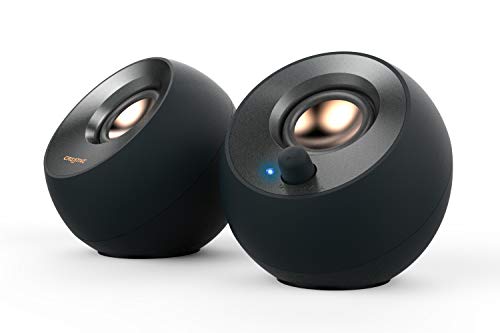
The Creative Pebble V2 is the smallest and tidiest speaker in this guide, a pair of smooth pebble-shaped speakers that draw power from a USB-C port and connect through a standard 3.5mm jack. Their drivers angle upward at 45 degrees, which lifts the sound toward your ears instead of firing it across the desk, and the result is a clear, focused image for music, calls, and video. They will not fill a large room or shake a desk with bass, but on a small desk beside a laptop they sound far better than built-in laptop speakers.
Watch out for: Bass is limited by the tiny cabinets, so do not expect deep low end.
Creative Pebble Plus
- Best for: Small-room films and games with more bass than the Pebble V2.
- 2.1 system with two pebble satellites and a subwoofer
- 8 watts RMS from the satellites plus subwoofer power
- Down-firing subwoofer for fuller low end
- USB powered with 3.5mm audio input
Small-room films and games with more bass than the Pebble V2.
The subwoofer needs floor space and a USB power source, so plan the cable run.
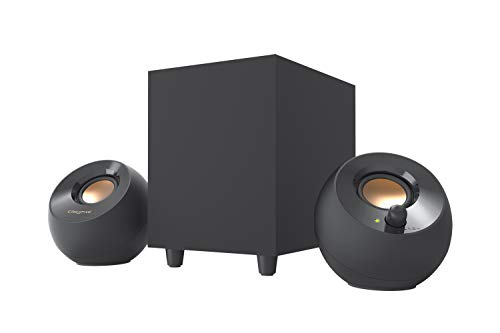
The Creative Pebble Plus takes the same pebble-shaped satellites as the V2 and adds a down-firing subwoofer, which gives the little system a fuller foundation for films, games, and bass-heavy music. The satellites keep the same 45-degree angle that lifts sound toward your ears, while the subwoofer sits on the floor and handles the low frequencies the small drivers cannot reach. USB power keeps the setup simple, and the 3.5mm input connects to a computer or a phone without fuss. It is still a compact system that fits a small room, but the subwoofer makes it feel like a much bigger setup.
Watch out for: The subwoofer needs floor space and a USB power source, so plan the cable run.
Which One Fits Your Situation
A bedroom that needs warm music
If your bedroom needs music that sounds warm and full, the Edifier R1280T is the best fit, with wooden cabinets that look at home on a shelf and a sound that suits long listening sessions. Place the pair at ear level, tune the bass and treble to taste, and the speakers will fill the room without needing a subwoofer.
A small room for films and games
If films and games matter most and your room is small, the Logitech Z313 gives you the bass for action scenes, with a subwoofer that adds weight without taking over the room. Put the satellites beside the monitor, the subwoofer on the floor near the wall, and the control pod within reach, and you have a simple system.
A crowded desk that needs better sound
If your desk is crowded and you just want sound that beats your laptop speakers, the Creative Pebble V2 is the tidy answer, with USB power and a pebble shape that tucks beside a monitor. It will not shake the room, but music, calls, and video sound clear and present. When space is tight, the smallest speaker that sounds good wins.
A dorm room that needs a little of everything
If your room must handle music, films, games, and study sessions in one small space, the Creative Pebble Plus covers the most ground, with tidy satellites plus a subwoofer for extra weight. Keep the subwoofer modest for neighbours, use the satellites alone for quiet study, and turn the system up when the room is yours.
Common Mistakes
- Placing desk speakers flat on the desk pointing at your chest, instead of angling them toward your ears where the sound actually matters.
- Buying a 2.1 system and then hiding the subwoofer in a cupboard, which muffles the bass and wastes the point of the extra speaker.
- Choosing speakers by looks alone, when driver size, power, and inputs shape the sound far more than the cabinet finish.
- Ignoring the input type, and discovering your new speakers cannot connect to your television or your phone without an adapter.
- Expecting deep bass from tiny USB speakers, which are built for clarity and convenience rather than low-end power.
Frequently Asked Questions
Are affordable speakers good enough for music?
Yes, for most everyday listening, because well-tuned drivers and cabinets sound far better than their size suggests. The Edifier R1280T has a warm, full presentation, and the Creative Pebble sets sound excellent on a desk. They will not match a large hi-fi system, but for a bedroom or a small office they are more than good enough.
Do I need a subwoofer for desk speakers?
It depends on what you listen to. Music, podcasts, and dialogue sound fine on a 2.0 pair, because the main speakers cover what matters most. Films, games, and bass-heavy music benefit from a subwoofer, which adds the low rumble small speakers cannot produce. If films and games dominate your evenings, a 2.1 system is worth it.
Can I connect these speakers to a television?
Yes, most of these speakers connect to a television through the 3.5mm headphone jack or the RCA audio outputs. The Edifier R1280T uses RCA inputs, while the Logitech and Creative models use a 3.5mm jack. Check your television’s audio outputs before you buy, and note that an optical-only television needs a small converter.
Why do my desk speakers sound better with the volume turned up?
Small speakers need some volume before their drivers move enough air for a full sound, so the bass can feel thin at very low volumes. Speakers angled toward your ears sound fuller, so placement matters. A bass control, like the one on the Edifier R1280T, boosts the low end without raising the volume.
FAQ
Are affordable speakers good enough for music?
Do I need a subwoofer for desk speakers?
Can I connect these speakers to a television?
Why do my desk speakers sound better with the volume turned up?
More from Amazon
Programs that pair well with the guide above. Offers and eligibility are set by Amazon and may change.
Free shipping on eligible items, Prime Video and more. Eligible new members can start with a free trial.
Start a Prime free trialAd-free music streaming. Eligible new subscribers can start with a free trial.
Try Music Unlimited freeA Prime membership for ages 18-24 with a trial period. Eligibility is set by Amazon.
See Prime for Young AdultsAudiobooks and podcasts to listen to on the go. Eligible new members can start with a free trial.
Try Audible freeAs an Amazon Associate we earn from qualifying purchases.