Key takeaways
- 1080p: both cards are often CPU-limited, so the gap shrinks to single digits in many games.
- 1440p: the 7900 XT typically leads by roughly 12-18%. Where the 6950 XT runs a demanding title at around 110-120 FPS on high settings, the 7900 XT often lands around 130-140 FPS.
- 4K: the gap is clearest here, roughly 15-20%, often the difference between dipping under 60 FPS and staying above it.
The RX 7900 XT is the better gaming card: it runs roughly 12-20% faster than the RX 6950 XT in rasterized games, pulls further ahead in ray tracing, carries 20 GB instead of 16 GB of VRAM and uses less power. The RX 6950 XT only wins when it is meaningfully cheaper, which in today’s used market it often is, making it a strong value pick for 1440p gamers who do not care much about ray tracing.
Our top picks
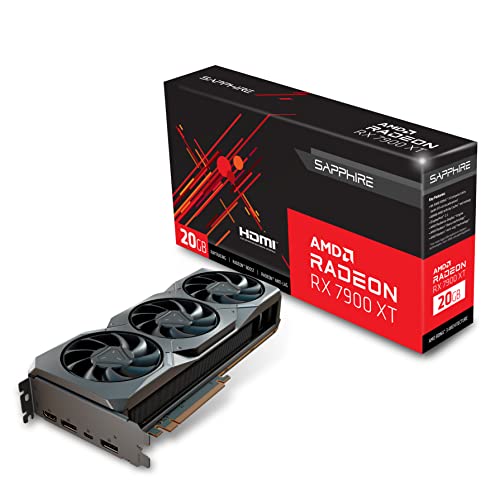 Sapphire 21323-01-20G AMD Radeon RX 7900 XT
- Memory Size: 20 GB
- Memory Interface: 320-bit DDR6
- Form Factor: 3 slot, ATX
| Product | Key specs | |
|---|---|---|
 AMD Radeon™ RX 6950 XT gddr6 Graphics AMD Radeon™ RX 6950 XT gddr6 Graphics | Check price | |
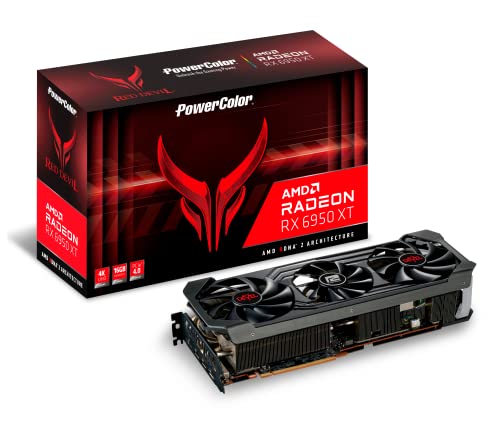 PowerColor Red Devil AMD Radeon RX 6950 PowerColor Red Devil AMD Radeon RX 6950 | Check price | |
| Sapphire 21323-01-20G AMD Radeon RX 7900 XT | Memory Size: 20 GB Memory Interface: 320-bit DDR6 Form Factor: 3 slot, ATX | Check price |
 Sapphire 11323-02-20G Pulse AMD Radeon RX 7900 Sapphire 11323-02-20G Pulse AMD Radeon RX 7900 | Boost Clock: Up to 2450 MHz Game Clock: Up to 2075 MHz Memory Size/Bus: 20GB/320 bit DDR6 | Check price |
As an Amazon Associate we earn from qualifying purchases at no extra cost to you.
Old Flagship vs New Upper Mid-Range
The RX 6950 XT launched in May 2022 at $1,099 as the final refresh of RDNA 2, a factory-boosted RX 6900 XT with faster memory. Just six months later, in November 2022, AMD launched the RX 7900 XT on RDNA 3 at $899. The newer card brought a chiplet design, a wider 320-bit bus and more memory at a lower launch price.
In 2026 both are previous-generation cards. The RX 9070 and RX 9070 XT now occupy this performance region with stronger ray tracing and FSR 4. Still, both cards are widely available second-hand, and the comparison remains relevant for anyone shopping used or clearing out remaining stock.
The Numbers on Paper
| Specification | RX 6950 XT | RX 7900 XT |
|---|---|---|
| Architecture | RDNA 2.0 | RDNA 3.0 |
| Release date | 10 May 2022 | 3 November 2022 |
| Launch MSRP | $1,099 | $899 |
| Stream processors | 5120 | 5376 |
| Boost clock | 2324 MHz | 2394 MHz |
| Process | 7 nm | 5 nm |
| VRAM | 16 GB GDDR6 | 20 GB GDDR6 |
| Bus / bandwidth | 256-bit / 576.0 GB/s | 320-bit / 800.0 GB/s |
| Infinity Cache (L3) | 128 MB | 80 MB |
| L2 cache | 4 MB | 6 MB |
| Board power | 335 W | 300 W |
| Power connectors | 2x 8-pin | 2x 8-pin |
| Length / width | 267 mm / 3-slot | 276 mm / 2-slot |
| Outputs | 1x HDMI 2.1, 2x DP 1.4a | 1x HDMI 2.1a, 2x DP 2.1, 1x USB-C |
The 6950 XT’s larger 128 MB Infinity Cache partly compensates for its narrower bus, but the 7900 XT’s 800 GB/s of raw bandwidth is about 39% higher, which shows most clearly at 4K.
Raster Gaming Results
At launch, KitGuru’s 4K testing put the RX 7900 XT about 12% ahead of the RX 6950 XT. Other reviews and aggregated benchmark data generally fall in a 12-20% range at 1440p and 4K, with newer games often at the higher end. Some community comparisons of reference 7900 XT cards against overclocked partner 6950 XT models show a narrower gap, and a few individual titles show near parity.
- 1080p: both cards are often CPU-limited, so the gap shrinks to single digits in many games.
- 1440p: the 7900 XT typically leads by roughly 12-18%. Where the 6950 XT runs a demanding title at around 110-120 FPS on high settings, the 7900 XT often lands around 130-140 FPS.
- 4K: the gap is clearest here, roughly 15-20%, often the difference between dipping under 60 FPS and staying above it.
These are approximate patterns; actual frame rates depend on settings, CPU, driver version and game patch.
Ray Tracing
RDNA 3’s improved ray accelerators widen the gap in ray-traced games. The RX 7900 XT’s lead in RT is usually larger than its raster lead, though both cards trail NVIDIA’s comparable RTX 40 and RTX 50 cards. Tom’s Hardware’s launch coverage noted that even the RX 7900 series could not match NVIDIA’s 40-series cards in its ray-traced suite. For heavy RT or path tracing, neither of these Radeon cards is ideal; for light RT effects, the 7900 XT is clearly the more comfortable choice.
Upscaling, Frame Generation and Media
Both cards support FSR 3.1 upscaling and frame generation in supported games, plus AMD Fluid Motion Frames through the driver. FSR 4’s machine-learning upscaler is designed for RX 9000 hardware, so neither card is AMD’s primary target for its newest image-quality improvements. On features, the 7900 XT has two practical advantages: AV1 hardware encoding for streaming and recording, and DisplayPort 2.1 outputs for very high refresh-rate 4K monitors.
VRAM Headroom: 16 GB vs 20 GB
16 GB is enough for current games at 1440p and nearly all at 4K. The 7900 XT’s 20 GB adds margin for very high texture settings, heavy mods, and memory-hungry ray tracing modes at 4K. It is a nice bonus rather than a deciding factor for most players, but it does make the 7900 XT the safer option for keeping a card four or five years.
Power, PSU and Physical Size
The newer card is more efficient, rated at 300 W against 335 W for the 6950 XT, while being faster. Both use two 8-pin connectors on reference designs; some partner cards use three.
- RX 6950 XT: 335 W + ~125 W CPU + ~150 W headroom = about 610 W, so a quality 750 W PSU is the sensible minimum.
- RX 7900 XT: 300 W + ~125 W CPU + ~150 W headroom = about 575 W, so 700-750 W is comfortable.
RDNA 2 flagships were known for short power spikes, so a quality unit matters more than the wattage label. Physically, the listed 6950 XT is a three-slot card at 267 mm, while the 7900 XT reference is two-slot at 276 mm. Partner cards of both models are frequently longer and thicker, so check clearance against the exact model.
Cost per Performance
At launch MSRP, with the RX 6950 XT as 100 and the RX 7900 XT at roughly 115:
- RX 6950 XT: $1,099 / 100 = about $11.00 per performance point
- RX 7900 XT: $899 / 115 = about $7.80 per point
At launch, the 7900 XT was simply the better deal. The used market changes the math. The RX 6950 XT usually trades around $380-$460 used and the RX 7900 XT around $480-$580. At $420 vs $530, for example, the cost per point becomes about $4.20 for the 6950 XT and about $4.60 for the 7900 XT, so the older card can edge ahead on pure raster value. The 7900 XT still earns its premium if ray tracing, efficiency or extra VRAM matter to you.
Pick X If, Pick Y If
| Priority | Pick |
|---|---|
| Lowest cost for high 1440p raster frame rates | RX 6950 XT (used) |
| 4K gaming | RX 7900 XT |
| Ray tracing in supported games | RX 7900 XT |
| Streaming with AV1 or DP 2.1 monitors | RX 7900 XT |
| Keeping a 650-700 W PSU | RX 7900 XT, with a quality unit |
| Prices within about 10% of each other | RX 7900 XT |
| Strong ray tracing and FSR 4 are must-haves | Look at RX 9070 XT instead |
Used-Buying Checklist
Both models were popular with enthusiasts who overclock, so check hotspot temperatures under a stress test, listen for coil whine or fan rattle, and look for signs of repasting or modifications. For reference 7900-series cards, confirm thermals look normal, since some early reference coolers had a vapor-chamber issue AMD resolved through replacements. A short gaming session with an overlay running is the quickest way to spot instability.
The Short Version
The RX 7900 XT is faster, more efficient, better at ray tracing and carries more memory, so it is the right choice when the price difference is modest. The RX 6950 XT remains a powerful 1440p raster card and can be the better value used when it is clearly cheaper. Anyone wanting ray tracing and FSR 4 should also compare both against the current RX 9070 XT.
Frequently Asked Questions
How much faster is the RX 7900 XT than the RX 6950 XT?
Reviews and aggregated benchmarks place the 7900 XT roughly 12-20% ahead at 1440p and 4K in rasterized games. The gap is smaller at 1080p, where both are often CPU-limited, and larger in ray-traced games.
Is the RX 6950 XT still worth buying in 2026?
It can be, as a used card for 1440p raster gaming at a good price. Its weaknesses are higher power draw, weaker ray tracing and no AV1 encoding. If the price gap to a 7900 XT or RX 9070 XT is small, the newer cards are better buys.
What PSU is needed for the RX 6950 XT?
A quality 750 W power supply is a sensible minimum for the 335 W RX 6950 XT with a typical gaming CPU. RDNA 2 high-end cards could produce short power spikes, so build quality matters as much as wattage.
Does the RX 7900 XT’s 20 GB VRAM matter for gaming?
Not often today. 16 GB covers current games at 1440p and nearly all at 4K. The extra 4 GB adds headroom for mods, maximum texture settings and future releases.
Do these cards support FSR 4?
FSR 4 is built for RX 9000 series GPUs, so neither card is its official target. Both support FSR 3.1 upscaling and frame generation plus AMD Fluid Motion Frames.