Our Short List of 3
All 4 Picks at a Glance
| Product | Specs | Action |
|---|---|---|
 BenQ X3100i | Check price on Amazon | |
 XGIMI HORIZON Ultra | Check price on Amazon | |
 BenQ X500i | Check price on Amazon | |
 BenQ HT4550i | Check price on Amazon |
Our Top Picks
As an Amazon Associate, we earn from qualifying purchases made through links on this page.
Projectors that combine 3D playback with built-in WiFi are harder to find than either feature on its own. Most current smart projectors have quietly dropped 3D support as streaming platforms moved on, while most projectors that still handle 3D are wired home theater or gaming models with no wireless networking at all. The overlap is a short list, and some well-known models fail one half of the test: the Epson Home Cinema 2350 has WiFi and Android TV but no 3D support in Epson’s own specification, and the Hisense C1 streams over WiFi while Hisense support confirms it cannot play 3D.
Every projector below was checked against its maker’s published specifications for both requirements: documented 3D support (frame packing, side-by-side, top-and-bottom or frame sequential playback, with DLP Link glasses support where the maker lists it) and documented WiFi, either built into the chassis or supplied by a maker streaming module that ships inside the box and sits in a dedicated compartment. On the three BenQ models, WiFi arrives through the included QS02 Android TV dongle; BenQ lists the wireless standard in each projector’s own smart system specification, and the dongle is a standard accessory rather than an add-on purchase. The XGIMI model carries its WiFi radio and Android TV system on the main unit itself.
What to look for in a 3D projector with WiFi
Which 3D formats are supported. Frame packing is the format used by 3D Blu-ray discs and is the one to insist on if you own a disc collection. Side-by-side and top-and-bottom formats cover 3D files and some broadcast or app content, and frame sequential playback matters for PC sources. A projector that lists only one or two of these will play some 3D sources and refuse others, so match the format list to the library you actually own.
Glasses are a separate purchase. All four projectors here use active shutter glasses synced by DLP Link, and none of them bundles a pair in the box. BenQ names its DGD5 glasses as an optional accessory for its models, and compatible third-party DLP Link glasses work with the XGIMI. Budget for at least two pairs, and note that glasses need charging or batteries before a movie night.
Brightness falls in 3D mode. Active shutter glasses block a large share of the light reaching each eye, so a projector that looks punchy in 2D will look dimmer in 3D at the same screen size. Higher maker brightness figures give more headroom, and a darkened room matters more for 3D than for anything else these projectors do. Keep screen sizes moderate if 3D is the main use.
How the WiFi is delivered. A built-in radio with a smart platform on the projector itself is the simplest arrangement. The dongle approach used by BenQ hides the streaming module inside the body, so there is nothing sticking out of an HDMI port, but the WiFi capability lives in that module: remove it and the projector becomes a wired display. Check the band support as well. Dual-band 802.11ac covers most homes, while the XGIMI adds WiFi 6 for crowded networks.
Resolution honesty. All four projectors use a 0.47-inch DLP chip with XPR pixel shifting to put a 3840 x 2160 image on screen; the chip itself is a 1080p device. That is the standard construction in this class and the makers state it openly. It also means 3D playback runs at 1080p on every model here, because the 3D formats these projectors accept are Full HD formats.
Input lag if you game. Three of the four are gaming-leaning models with published lag figures under 20 ms at 4K 60Hz, dropping further at 1080p high-refresh modes. 3D gaming from a PC uses the frame sequential mode on the BenQ models, so check that your source can output it.
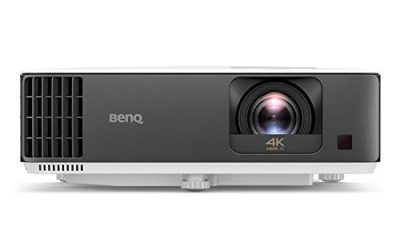
BenQ X3100i
Check the BenQ X3100i on Amazon
The X3100i is the brightest projector in this group and the one most clearly built for a mixed diet of games and films. BenQ rates it at 3,300 ANSI lumens from a 4LED light source, with 100 percent DCI-P3 coverage, HDR10 and its HDR-PRO tone mapping on top. The picture menu includes a dedicated 3D mode, and the projector accepts frame packing, side-by-side and top-and-bottom 3D at Full HD. Wireless duties are handled by the QS02 Android TV dongle in its rear compartment: BenQ’s specification lists WiFi 802.11 a/b/g/n/ac on both bands, AirPlay and Google Cast, and Bluetooth for audio.
For gaming, the published input lag is 16.7 ms at 4K 60Hz, 8.3 ms at 1080p 120Hz and 4.2 ms at 1080p 240Hz. The lens throws at 1.15 to 1.50 with 1.3x zoom, and vertical lens shift from 40 to 60 percent gives more placement freedom than most cube-style projectors. Two 5W treVolo speakers are built in, with eARC and optical outputs for a soundbar or receiver, including Dolby Atmos pass-through.
Who it fits: gamers who also keep a 3D Blu-ray shelf, and anyone lighting up a larger screen in a room that cannot go fully dark, where the extra brightness headroom helps 3D most.
Limitations: 3D tops out at 1080p, glasses are an extra purchase, and there is no horizontal lens shift, so off-center placement still leans on keystone correction. The smart system depends on the included dongle.
XGIMI HORIZON Ultra
Check the XGIMI HORIZON Ultra on Amazon
The HORIZON Ultra is the only model here with its smart platform and WiFi built into the projector itself rather than a module. XGIMI fits WiFi 6 on both bands, Bluetooth 5.2 and Android TV 11, with Chromecast built in. Its specification sheet lists 3D playback in top-and-bottom (including frame packing) and side-by-side formats, and retailer specification data confirms DLP Link 3D glasses are supported, so 3D Blu-ray discs and 3D files both play.
The light engine pairs LED with laser in XGIMI’s Dual Light design, rated at 2,300 ISO lumens with a 25,000-hour life, and it is the only projector in this group that handles Dolby Vision alongside HDR10 and HLG. Setup is the most automated here: ISA 3.0 brings auto focus, uninterrupted auto keystone, obstacle avoidance, screen alignment and wall color adaptation, and the 1.2 to 1.5 throw is an optical zoom rather than a digital crop. Two 12W Harman Kardon speakers are the strongest built-in audio in this roundup. Game mode latency is quoted at 18 ms or lower.
Who it fits: living-room users who want the projector to behave like a smart TV with no extra boxes, and Dolby Vision households willing to trade some brightness for the wider format support and hands-off setup.
Limitations: its brightness figure is the lowest of the four, and 3D will look dimmest here on a big screen. There is no lens shift, so placement relies on the automatic corrections. Glasses are bought on their own.
BenQ X500i
Check the BenQ X500i on Amazon
The X500i covers the rooms the other three cannot: its 0.69 to 0.83 short throw lens with 1.2x zoom puts a 100-inch picture on the wall from roughly a meter and a half away, so it can sit on a coffee table or a low cabinet where a standard-throw projector would need the back of the room. BenQ rates it at 2,200 ANSI lumens from a 4LED source, with HDR10 and HDR-PRO processing on a pixel-shifted 4K image.
3D support is Full HD 3D with frame packing and frame sequential playback documented, which suits both 3D Blu-ray and PC sources. Streaming and WiFi again come from the included Android TV dongle, with AirPlay, Chromecast and Miracast mirroring listed by BenQ. Input lag matches its bigger sibling at 4.2 ms for 1080p 240Hz and 16.7 ms at 4K 60Hz, and audio runs through two 5W treVolo speakers with eARC for external sound.
Who it fits: small rooms, renters who cannot ceiling-mount, and gamers who want the projector close to the seating position with short cable runs to a console.
Limitations: short throw is unforgiving about placement and screen flatness, and there is no lens shift at all. At 2,200 lumens it needs a dark room for 3D, and the WiFi depends on the dongle like the other BenQ models.
BenQ HT4550i
Check the BenQ HT4550i on Amazon
The HT4550i is the home theater entry in the group, aimed at a fixed installation in a dedicated room. It produces 3,200 ANSI lumens from a 4LED source, covers 100 percent of DCI-P3 and Rec.709 with factory calibration, and supports HDR10+, HDR10 and HLG with a FILMMAKER MODE among its picture presets. Its 3D support is the broadest here: frame packing (Full HD 3D), side-by-side, top-and-bottom and frame sequential are all listed in BenQ’s compatibility data.
Installation flexibility leads the group. The 1.15 to 1.50 lens has 1.3x zoom plus two-dimensional lens shift, 60 percent vertical and 15 percent horizontal, which no other model here matches. The QS02 Android TV dongle supplies Android 11, WiFi 802.11 a/b/g/n/ac on both bands, AirPlay and Google Cast, and Bluetooth 5.0. Input lag is 17.9 ms at 4K 60Hz, respectable for film-first use. At 6.6 kg it is also the largest and heaviest unit in this roundup, which suits a ceiling mount better than a shelf that gets rearranged.
Who it fits: dedicated theater rooms with a fixed mount and a real 3D disc collection, where lens shift and calibrated color matter more than portability.
Limitations: BenQ has discontinued this model, so current listings are remaining retail stock rather than fresh production. Glasses (BenQ DGD5) remain an optional extra, and the size and weight work against casual room-to-room use.
Also considered, and why they are not linked
The JMGO N1 Ultra meets the feature test on paper: JMGO documents Blu-ray 3D playback and WiFi 6 with Android TV. It is named without a link because its current Amazon US availability could not be confirmed in this check; a mirror of the listing showed it out of stock, and the freshest tracker page found was months old. The Epson Home Cinema 2350 has genuine built-in WiFi and Android TV, but Epson’s specification lists 3D support as absent, so it fails the first half of the keyword. The Hisense C1 likewise streams over WiFi on its VIDAA platform, and Hisense support states plainly that it does not support 3D. Both are reasonable smart projectors; neither belongs in a 3D roundup.
Comparison table
| Model | Picture | Brightness (maker figure) | 3D formats | Wireless | Throw ratio | Input lag at 4K 60Hz |
|---|---|---|---|---|---|---|
| BenQ X3100i | 4K XPR DLP, 4LED | 3,300 ANSI lumens | Frame packing, side-by-side, top-and-bottom | WiFi 5 via included Android TV dongle | 1.15–1.50 | 16.7 ms |
| XGIMI HORIZON Ultra | 4K XPR DLP, LED + laser | 2,300 ISO lumens | Frame packing, side-by-side, top-and-bottom | WiFi 6 built in, Android TV 11 | 1.2–1.5 | 18 ms or lower (game mode) |
| BenQ X500i | 4K XPR DLP, 4LED | 2,200 ANSI lumens | Frame packing, frame sequential | WiFi 5 via included Android TV dongle | 0.69–0.83 | 16.7 ms |
| BenQ HT4550i | 4K XPR DLP, 4LED | 3,200 ANSI lumens | Frame packing, side-by-side, top-and-bottom, frame sequential | WiFi 5 via included Android TV dongle | 1.15–1.50 | 17.9 ms |
Brightness figures are not directly comparable across rows: BenQ quotes ANSI lumens while XGIMI quotes ISO lumens, and each maker measures to its own published standard.
FAQ
Do any of these projectors include 3D glasses?
No. All four use active DLP Link glasses, and every maker treats them as an accessory bought on its own. BenQ names its DGD5 model for the three BenQ projectors; the HORIZON Ultra accepts DLP Link glasses as well.
Can I watch 3D content over WiFi, or do I need a cable?
Both routes work, for different formats. Frame packing, the 3D Blu-ray format, needs a player connected by HDMI. Side-by-side and top-and-bottom 3D files can be played by apps on the built-in smart platform or cast to the projector over your network, since those formats travel as an ordinary video stream.
Does 3D playback run at 4K on these projectors?
No. On all four, 3D modes run at Full HD 1080p, because the 3D formats they accept are 1080p formats. The 4K pixel-shifted image applies to 2D content.
How does WiFi work on the BenQ models if it uses a dongle?
BenQ ships its QS02 Android TV dongle in the box, and it lives in a covered compartment on the projector. BenQ’s own specification for each model lists the WiFi standard (802.11 a/b/g/n/ac, dual band) and the wireless projection features under the projector’s smart system, so the function is part of the product as sold; the XGIMI is the pick if you want the radio on the main board instead.
Which of these is brightest for 3D viewing?
By maker figures, the X3100i at 3,300 ANSI lumens, closely followed by the HT4550i at 3,200. Remember that 3D glasses cut perceived brightness on every model, so a dark room and a moderate screen size help any of them.
Conclusion
If 3D is a firm requirement and WiFi is non-negotiable, the realistic shortlist is short, and it is the four models above. The X3100i is the most rounded choice for mixed gaming and film use, the HORIZON Ultra is the one that behaves most like a self-contained smart TV and adds Dolby Vision, the X500i solves the small-room problem with its short throw lens, and the HT4550i serves a fixed theater installation with the best lens shift and the widest 3D format support, while its remaining stock lasts. Whichever you choose, add DLP Link glasses to the same order, because none of the four puts a pair in the box.
More from Amazon
Programs that pair well with the guide above. Offers and eligibility are set by Amazon and may change.
Free shipping on eligible items, Prime Video and more. Eligible new members can start with a free trial.
Start a Prime free trialAd-free music streaming. Eligible new subscribers can start with a free trial.
Try Music Unlimited freeA Prime membership for ages 18-24 with a trial period. Eligibility is set by Amazon.
See Prime for Young AdultsAudiobooks and podcasts to listen to on the go. Eligible new members can start with a free trial.
Try Audible freeAs an Amazon Associate we earn from qualifying purchases.