Our Top Picks
 Arteck Universal Backlit Wireless Bluetooth Keyboard for iPad9.72 x 0.24 x 5.91 inches0.4 poundsCheck on Amazon
Typing a long message on a phone screen works for a few lines. Past that, the glass gets in the way: thumbs crowd the keys, autocorrect rewrites words, and the on-screen board hides half of what you are writing. A physical keyboard changes that. It gives a phone real keys, real spacing, and a layout your fingers already know, and it turns a pocket device into a small workstation for notes, email, documents, and chat.
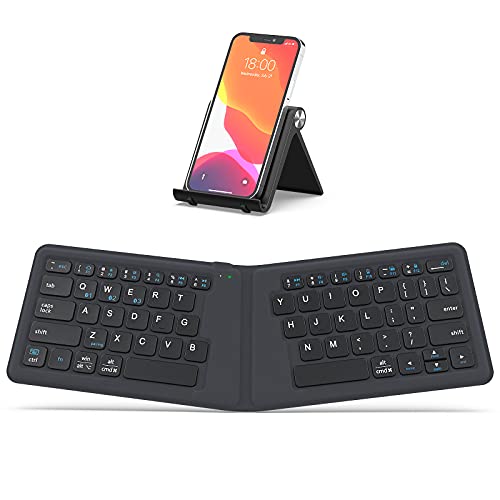
This guide covers physical keyboards made for phones: compact Bluetooth boards, folding travel keyboards, and boards with a cradle or cover built for a handset. Every pick here pairs with a phone over Bluetooth, and every one names iPhone and Android support on its listing. No on-screen keyboard app appears here, and no full-size desktop board either. A desk board can pair with a phone over Bluetooth, but it is not a phone keyboard, so it stays out.
Three of the five picks come from Logitech. That is a fact about the current shelf, not a preference: Logitech has the deepest line of compact multi-device boards, and the other makers in this space are smaller names with one or two models each. The Arteck and iClever picks below fill the gaps Logitech leaves, namely backlighting and a folding frame.
A note on checking stock: Amazon blocks direct page reads from here, so each listing below rests on exact-model search results plus recent tracker and roundup evidence. Confirm the exact model on the listing before ordering.
What to look for
Connection and switching. A phone keyboard lives or dies on Bluetooth. Look for a board that pairs with more than one device at once and switches between them with a key or a dial, so one board can serve a phone, a tablet, and a laptop without re-pairing each time. Avoid boards that need a USB receiver, because a phone has no port for one. All five picks here are Bluetooth boards with no receiver in the box.
Layout and key size. Phone keyboards shrink to fit a bag, and the shrink shows up in the keys. A compact board with near-full-size keys types almost like a laptop board, while a folding board splits the layout in two and can feel cramped at the seam. If you type with all ten fingers, favor boards with scissor keys and a familiar row layout, and check whether the number row and punctuation sit where your fingers expect them.
Portability and folding. The point of a phone keyboard is that it travels with the phone. A slim board slips into a bag pocket; a folding board collapses to half its typing size and fits a jacket pocket. If you type mostly at a desk, a rigid compact board is the steadier pick. If you type on trains and in waiting rooms, folding wins.
Battery. Phone keyboards use one of two power plans. Some run on AAA or AA cells and last for months or longer on a set, which means no charging cable to carry and no dead board at the wrong moment. Others use a built-in rechargeable cell that you top up over USB, which is lighter in the hand but needs a cable in the bag. Neither plan is better in the abstract; pick the one that matches how you travel.
Phone holder. A keyboard without a holder leaves the phone flat on the desk, which is fine for a quick reply and poor for a long session. A built-in cradle holds the phone upright at a readable angle, and a folding cover can double as a prop. Two picks in this guide have a cradle or cover built in; the other three need a separate stand, a case with a kickstand, or a phone leaned against a book.
Compatibility. Every board here names iPhone and Android on its listing, but the shortcut keys are not always neutral. Some boards lay out their function row for Apple devices, others for Windows and Android, and the labels on the keys may not match the phone in your hand. If you use one phone system only, pick a board whose shortcut row matches it.
Backlight. Typing in a dim room is easier with lit keys, and only one pick in this guide has a backlight. If you type at night, the backlit pick is the one to look at first. If you type in daylight, skip it and take the longer battery life of an unlit board.
The picks
Logitech K380 Multi-Device Bluetooth Keyboard
The K380 is the most widely used compact Bluetooth keyboard in this guide, and the strongest pick on evidence: roundups updated within the last two days still link its Amazon listing, and a fresh crawl shows the listing live. It is a small, round-keyed board that pairs with up to three devices over Bluetooth and switches between them with three yellow Easy-Switch keys. That switching is the heart of the board. You can pair a phone, a tablet, and a laptop, then jump between them with one tap, which suits anyone who writes on a phone but keeps a larger screen nearby.
The board runs on two AAA batteries, and Logitech claims up to two years of use from a set. That is a claim from the listing, not a promise for every reader: heavy daily use drains cells faster than light use. The scissor keys are quiet and low, with a short travel that feels close to a laptop board. The layout is compact with no number pad, and the function row doubles as shortcut keys for volume, media, and brightness.
What the K380 lacks is a phone holder. There is no cradle and no cover, so the phone sits flat or needs a separate stand. The board also has no backlight, so night typing means finding a lamp. It is the most flexible board here for anyone who types across a phone and other devices.
Key facts: Bluetooth, pairs with up to three devices, two AAA batteries, up to two years of battery life claimed, scissor keys, no phone holder, no backlight, works with Windows, Mac, Chrome OS, Android, iPhone, iPad, and Apple TV.
Logitech Keys-to-Go Super-Slim Bluetooth Keyboard
Keys-to-Go is the most phone-shaped board in this guide. Logitech built it for Apple devices first: iPhone, iPad, Mac, and Apple TV are named on the listing, and it is super-slim and super-light, with a built-in cover that folds over the keys and shields them in a bag. The cover turns the board into a flat slab that slides into a bag pocket without worry.
The board pairs with up to three Apple devices and switches between them with one tap. Its scissor keys stay quiet, so typing in a cafe or a waiting room draws no attention, and a full row of shortcut keys puts volume, media, and brightness within reach. The rechargeable battery means no cells to carry, and the board charges over a cable when it runs low.
Two limits matter. First, the board is built around Apple layouts, so its shortcut legends match Apple devices best; Android phones still type fine, but the shortcut row may not line up with what the labels say. Second, the keys are small and flat, closer to a tablet cover board than to a laptop board, so long sessions ask more of your fingers than the K380 does. There is also a newer model, Keys-to-Go 2, which has a longer battery claim and a wider device range; this listing is the original Keys-to-Go, so confirm the model on the listing before ordering.
Key facts: Bluetooth, super-slim with built-in cover, pairs with up to three devices, rechargeable battery, quiet scissor keys, shortcut row, built for iPhone, iPad, Mac, and Apple TV.
Logitech K480 Multi-Device Bluetooth Keyboard
The K480 is the only pick here with a built-in cradle for a phone, and that cradle is the reason to buy it. A slot along the top of the board holds a phone or tablet upright at a readable angle while you type, which turns a phone into a tiny laptop for long writing sessions. An Easy-Switch dial on the top-left corner flips between three paired Bluetooth devices, so the phone, tablet, and computer can share one board.
The layout is a 78-key QWERTY board with familiar shortcut keys for Windows and Mac, and the listing names Windows, macOS, iPadOS, Android, and Chrome OS. The board runs on a single AA battery, with up to 24 months of use claimed, and it pairs over Bluetooth 3.0. At 821 grams and roughly 11.7 by 7.9 inches, it is the heaviest board in this guide, which is a plus on a desk and a minus in a bag. The weight keeps it planted while you type, but it is not a board you slip into a jacket pocket.
The trade is clear: the K480 is the best desk pick for phone typing and the worst travel pick. If your phone typing happens at a table, the cradle earns its place. If it happens on the move, the K380 or Keys-to-Go travels better.
Key facts: Bluetooth 3.0, Easy-Switch dial for three devices, built-in phone and tablet cradle, 78-key QWERTY layout, one AA battery, up to 24 months of battery life claimed, 821 grams, works with Windows, macOS, iPadOS, Android, and Chrome OS.
Arteck HB030B Universal Bluetooth Keyboard
The Arteck HB030B is the only backlit board in this guide, and the only pick from a smaller maker that matches Logitech on portability. It is an ultra-light, slim Bluetooth 3.0 board with a seven-color backlight and adjustable brightness, which makes it the pick for anyone who types in dim rooms, on night trains, or in bed. The backlight cycles through seven colors with a key combination, and the brightness steps up and down from the board.
The board is universal in the listing’s own wording: it names iOS, Android, and Windows tablets, PCs, and smartphones, so it pairs with an iPhone or an Android phone without fuss. A built-in rechargeable battery powers the board, and the listing claims up to six months of use per charge, though backlight use shortens that; the backlight is the main drain on the cell, so heavy night typing means charging more often. The keys are low and quiet, and the board is thin enough to slide into a bag beside the phone.
Evidence for this listing is thinner than for the Logitech picks: the most recent direct crawl of the Amazon page is 227 days old, but a roundup updated one day ago lists the board as in stock on Amazon. Treat that as moderate evidence and confirm the live buying options before ordering.
Key facts: Bluetooth 3.0, seven-color backlight with adjustable brightness, ultra-light slim frame, built-in rechargeable battery, up to six months of battery life claimed, universal pairing with iOS, Android, and Windows devices including smartphones.
iClever BK06 Ergonomic Foldable Bluetooth Keyboard
The iClever BK06 is the only folding board in this guide, and the pick with the weakest evidence. It splits in half and folds to pocket size, then opens to a full-size layout with an ergonomic split in the middle. That split angles each hand slightly inward, which some typists find easier on the wrists over long sessions. A PU leather cover comes in the box, the board charges over USB-C, and it pairs with up to three devices over Bluetooth 5.1, the newest Bluetooth version in this guide.
Folding is the whole case for this board. Folded, it fits a jacket pocket or a small bag pouch, which no rigid board here can do. Unfolded, it gives full-size keys with scissor switches, so it types like a larger board than it carries like. The USB-C charging matches a modern phone cable, so one cable can serve both devices on a trip.
The evidence for this listing is mixed, and the article says so plainly. One tracker page from eight days ago marks the listing unavailable, and mirror stores list it out of stock, while a roundup updated two days ago shows the Amazon listing in stock through its live data feed. Those two signals cannot both be right at the same moment, so this is the pick to confirm first: open the listing and read the buying options before ordering, and if no new unit shows, the guide stands on the other four boards.
Key facts: split folding frame, Bluetooth 5.1, USB-C rechargeable, PU leather cover included, pairs with up to three devices, full-size scissor keys, ergonomic split layout, works with iOS, Android, Windows, tablets, smartphones, laptops, and Mac.
Comparison
| Keyboard | Connection | Layout | Battery | Phone holder |
|---|---|---|---|---|
| Logitech K380 | Bluetooth, 3 devices | Compact, scissor keys | 2 AAA, up to 2 years claimed | None |
| Logitech Keys-to-Go | Bluetooth, 3 devices | Slim, scissor keys | Rechargeable | Built-in cover |
| Logitech K480 | Bluetooth 3.0, 3 devices | 78-key QWERTY | 1 AA, up to 24 months claimed | Built-in cradle |
| Arteck HB030B | Bluetooth 3.0 | Slim, low keys | Rechargeable, up to 6 months claimed | None |
| iClever BK06 | Bluetooth 5.1, 3 devices | Folding split, full-size keys | Rechargeable over USB-C | PU leather cover |
Frequently asked questions
Do these keyboards work with both iPhone and Android?
Yes. Every board in this guide names iPhone and Android on its listing, and all five pair over Bluetooth, which both phone systems speak. The letters, numbers, and punctuation work the same on either system. The difference is the shortcut row: some boards lay out their function keys for Apple devices and others for Windows and Android, so the labels on those keys may not match the phone in your hand. If you use one phone system only, pick a board whose shortcut row matches it, and check the listing for the exact system names before ordering.
Do I need a phone holder or stand?
It depends on the board. The K480 has a cradle built in, and the Keys-to-Go cover and the BK06 leather cover help prop or shield the phone, but the K380 and the Arteck HB030B have no holder at all. With those two, the phone lies flat on the desk, which works for a quick reply and strains the neck over a long session. A small folding stand, a case with a kickstand, or even a book leaned against the phone fixes that for little weight. If you write long documents on your phone, treat a cradle or a stand as part of the kit, not an extra.
Can I use any Bluetooth keyboard with my phone?
Mostly yes, if the board speaks Bluetooth and your phone pairs with it. A phone accepts a standard Bluetooth keyboard without extra software, and the keys work as soon as the pair completes. But a full-size desk board is awkward to carry, a board that needs a USB receiver has nowhere to plug in, and a gaming board with software-only features loses those features on a phone. The boards in this guide are picked because they are built for phones: compact or folding frames, multi-device pairing, and no receiver.
How to choose
Match the board to where you type. If you type at a desk, buy the K480: the cradle holds the phone upright and the weight keeps the board planted. If you type across a phone, a tablet, and a laptop, buy the K380: the three-device switching is the smoothest in this guide and the AAA batteries last for months. If you travel light and use Apple devices, buy Keys-to-Go: the built-in cover and the slim frame make it the easiest board here to carry. If you type in dim rooms, buy the Arteck HB030B: the seven-color backlight is the only one in this guide, and the board is light enough to carry anywhere. If you want the smallest folded size, look at the iClever BK06, but confirm the live listing first, since its stock evidence is mixed and the guide stands on four boards without it.
Whatever you pick, confirm the exact model name and the live buying options on the listing before ordering.
Disclosure: As an Amazon Associate, we may earn a commission from qualifying purchases made through links in this article, at no additional cost to you.
FAQ
Do these keyboards work with both iPhone and Android?
Do I need a phone holder or stand?
Can I use any Bluetooth keyboard with my phone?
More from Amazon
Programs that pair well with the guide above. Offers and eligibility are set by Amazon and may change.
Free shipping on eligible items, Prime Video and more. Eligible new members can start with a free trial.
Start a Prime free trialAd-free music streaming. Eligible new subscribers can start with a free trial.
Try Music Unlimited freeA Prime membership for ages 18-24 with a trial period. Eligibility is set by Amazon.
See Prime for Young AdultsAudiobooks and podcasts to listen to on the go. Eligible new members can start with a free trial.
Try Audible freeAs an Amazon Associate we earn from qualifying purchases.