Key takeaways
- Five pocket projectors that turn a phone into a big screen, compared on battery life, brightness, mirroring, and size so you can pick the right one.
A phone screen works for one person, but it fails the moment two people want to watch the same video, or a small group wants to see photos from a trip. A mini projector solves that problem by throwing the phone image onto a wall, a ceiling, or a sheet, turning any dark room into a screen that everyone in the room can see at once.
This guide is for travelers who pack light, parents who run movie nights in hotel rooms, presenters who show slides from a phone, and anyone who wants a bigger picture without carrying a full-size projector. The five projectors below were chosen from the names and specifications shown on their Amazon product pages, and every one of them is a pocket or soda-can sized model that connects to a phone.
Quick Picks
As an Amazon Associate we earn from qualifying purchases
| Product | Best for | Key spec from title |
|---|---|---|
| Anker Nebula Capsule 3 GTV | A true 1080p picture with streaming built in | 1080P Smart Projector with Wi-Fi |
| ViewSonic M1 Mini Plus | The lightest pocket pick with a JBL speaker | Ultra Portable LED Projector with JBL Speaker |
| KODAK Luma 350 | Simple wireless mirroring from a phone | Portable Smart Projector with Wi-Fi and Mirroring |
| AKASO WT50 | A phone-sized projector with Android apps | 1080P DLP Portable Projector with Android System |
| Aurzen ZIP | The smallest foldable pick for vertical phone video | Tri-Fold DLP Pocket Projector with Screen Mirroring |
How to Choose
Brightness decides where you can use it
Brightness is the first number that matters, because a pocket projector only looks good in a dim room. The models in this guide range from 50 to 200 lumens, which is far less than a living-room projector, so expect the best results after sunset, in a bedroom with the curtains closed, or in a tent. If you plan to use the projector outdoors, pick the brightest model you can carry and bring a light-colored sheet or a plain wall as your screen. A dimmer model still works well for a ceiling movie in bed or a slideshow in a dark meeting room.
Native resolution sets the real sharpness
Many listings advertise 1080p, but that often means the projector accepts a 1080p signal while its panel is smaller. Only one pick in this guide has a true 1080p panel, while the others use 720p or 854 by 480 panels that downscale the incoming signal. For phone photos and short clips, a 720p or 480p panel still looks fine at the sizes these projectors throw. For reading text on slides or watching a full movie, the true 1080p model shows noticeably sharper edges, so match the resolution to how much text you will read.
Phone connection is the whole point
A smartphone projector is only useful if the phone connects quickly and stays connected. Check whether the model mirrors over Wi-Fi, needs a cable, or runs apps on its own. Wireless mirroring is the easiest option for showing photos and home videos, but some streaming apps block wireless casting for copyright reasons, so a model with built-in streaming apps or an HDMI input gives you a backup route. iPhone owners should check whether the projector supports AirPlay, while Android owners should check for Miracast or a USB-C connection.
Battery life and size decide if it travels
Every projector here has a built-in battery, but playtime ranges from about 90 minutes to two and a half hours, which may not cover a full film. If you watch long movies, plan to plug the projector into a power bank or a wall outlet partway through, and check whether it can charge while it plays. Size matters just as much: the smallest models fold flat or fit in a jacket pocket, while the soda-can models need a bag pocket. Weigh the projector against how you travel before you pick.
The 5 Best Options
Anker Nebula Capsule 3 GTV

The Capsule 3 GTV is the strongest all-round pick in this guide because it is the only one with a true 1080p panel and licensed Netflix built in, so it works as a complete streaming device without a phone at all. Its soda-can shape holds a battery that runs for up to two and a half hours in eco mode, and it casts photos and videos from a phone with a single touch. Automatic focus and keystone correction set the picture up in about three seconds.
Specs
- Native 1080p resolution, DLP with LED light source
- 200 ANSI lumens brightness
- Google TV with officially licensed Netflix
- Cast from phone or laptop with a single touch
- Battery up to 2.5 hours in eco mode, up to 120-inch image
- 8W Dolby speaker, autofocus, auto keystone, screen fit and obstacle avoidance
- HDMI input, 1.83 pounds, 3.15 x 3.15 x 6.3 inches
Best for: Travelers who want a true 1080p picture with streaming apps built in.
Watch out for: At 200 lumens it still needs a dim room, and it is the largest model in this guide.
ASIN: B0CHW11C8H
ViewSonic M1 Mini Plus
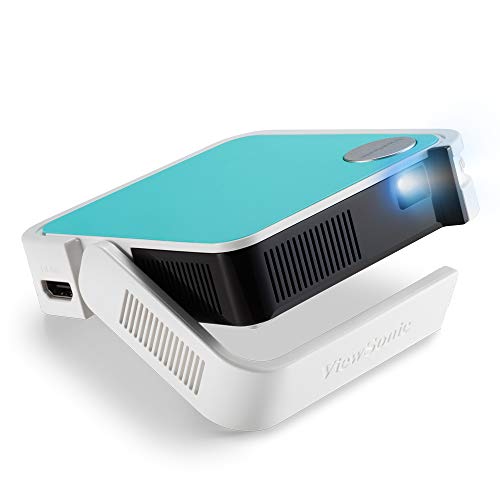
The M1 Mini Plus is the lightest projector in this guide at well under a pound, and it folds its smart stand over the lens so it survives in a bag without a case. Its built-in JBL speaker sounds better than the tiny speakers in most pocket projectors, and its Wi-Fi mirroring pulls a phone screen onto a wall without a cable. The swappable color panels let you change its look, and a power bank can extend its short battery.
Specs
- Native WVGA 854 x 480 resolution, DLP, 1080p input support
- 120 LED lumens brightness
- Built-in JBL Bluetooth speaker, Bluetooth in and out
- Smart Wi-Fi with Aptoide app store, screen mirroring
- Battery up to 1.5 hours, power-bank compatible, up to 100-inch image
- Auto vertical keystone, 8GB built-in storage, 30,000-hour LED life
- HDMI, USB-C and USB-A, 0.66 pounds, 4.1 x 1.1 x 4.1 inches
Best for: Anyone who wants the smallest, lightest projector with decent sound.
Watch out for: The 854 by 480 panel is soft for text-heavy slides, and 90 minutes of battery may not cover a full movie.
ASIN: B085F3HSWH
KODAK Luma 350
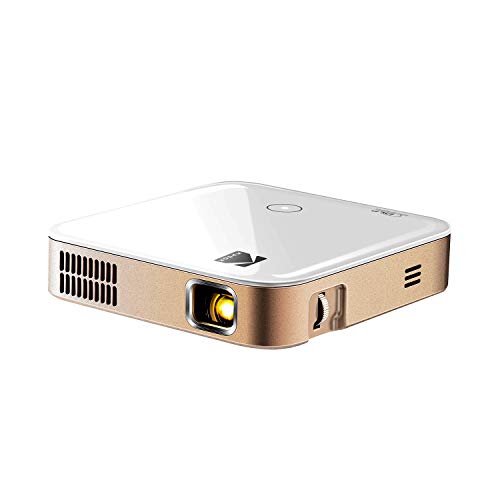
The Luma 350 is the simplest projector in this guide to use with a phone, because its whole design centers on wireless mirroring and a companion app that walks you through the connection. It runs Android on board, so streaming apps live on the projector itself, and its flat square body slips into a pocket or a bag side pocket. A tripod mount on the base makes it easy to aim at a wall or a ceiling.
Specs
- Native 854 x 480 resolution, DLP, 150 lumens
- Onboard Android 6.0 with streaming apps, Wi-Fi and Bluetooth
- Mobile-to-screen mirroring, Luma app control, remote control included
- 7,500 mAh rechargeable battery, up to 150-inch image
- HDMI, USB and 3.5mm audio jack, tripod mount
- 30,000-hour lamp life, 4.41 x 4.41 x 1.1 inches, 821 grams
- 1-year warranty
Best for: First-time buyers who want the easiest wireless phone connection.
Watch out for: The listing gives two brightness figures, 150 lumens in the specs and a 350-lumen lamp in the description, so expect modest brightness in anything but a dark room.
ASIN: B07RB7P439
AKASO WT50
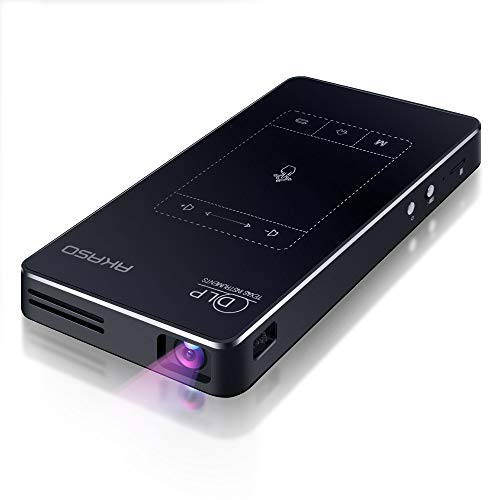
The WT50 is barely larger than a phone, which makes it the easiest projector in this guide to carry in the same pocket as the device it serves. It runs Android with built-in apps, mirrors over dual-band Wi-Fi, and also takes a wired HDMI connection for anything wireless mirroring will not carry. A mini tripod comes in the box, so you can set it on a nightstand and aim it at the ceiling for a movie in bed.
Specs
- Native WVGA 854 x 480 resolution, supports 1920 x 1080 input
- 50 ANSI lumens brightness, DLP
- Built-in Android system, dual-band Wi-Fi, AirPlay and Miracast
- 5,000 mAh battery, 30 to 120-inch image, 30,000-hour lamp life
- HDMI, 2 x USB 2.0, microSD up to 32GB, Bluetooth, 3.5mm audio out
- 5.5 x 3.1 x 0.8 inches, 1.74 pounds, mini tripod included
Best for: Travelers who want a projector the same size as their phone.
Watch out for: The listing notes that Netflix and Hulu cannot be mirrored wirelessly for copyright reasons, so use the built-in apps or an HDMI cable for those services.
ASIN: B07RJM3N9T
Aurzen ZIP

The Aurzen ZIP folds into a wallet-sized slab and opens into a Z-shaped stand, which makes it the most pocketable projector in this guide and the only one built around vertical phone video. Its full-screen mode turns the projector sideways so TikTok clips and vertical photos fill the wall instead of sitting in a narrow strip, and one-click mirroring needs no Wi-Fi at all. Focus and keystone adjust themselves the moment you move it.
Specs
- Native 720p resolution, 1080p supported, DLP
- 100 ANSI lumens brightness
- Tri-fold design with built-in Z-shaped stand, vertical full-screen mode
- One-click screen mirroring, no Wi-Fi needed
- 5,000 mAh battery, up to 1.5 hours, Type-C PD fast charging
- Zero-lag ToF autofocus and vertical keystone correction, Bluetooth 5.4
- 280 grams, 8.4 x 7.8 x 2.6 centimeters
Best for: People who watch vertical phone video and want the smallest projector possible.
Watch out for: It does not support Google Cast, so it will not work with Pixel or Motorola phones or with Chromecast, and 90 minutes of battery is short for a film.
ASIN: B0DYJH4G14
Which One Fits Your Situation
For hotel movie nights while traveling
Pick the Nebula Capsule 3 GTV, because its true 1080p panel and built-in Netflix mean you only need the projector and a wall, with no phone in the loop at all. The two and a half hour battery covers most films, and the automatic setup gets the picture straight in seconds. Bring a white sheet if the hotel walls are colored, since color shifts the picture.
For showing photos to family at home
Pick the KODAK Luma 350, because its wireless mirroring and companion app make it the fastest way to get a phone gallery onto a wall for a group. The flat body sits steadily on a table, and the 150-inch maximum image is more than enough for a living room. Keep the room dark and the phone charged while it mirrors.
For a pocket kit that goes everywhere
Pick the Aurzen ZIP, because it folds flat enough to ride in a jacket pocket next to the phone it mirrors. Its vertical full-screen mode suits the short clips people actually watch on phones, and one-click mirroring means no network setup at a friend’s house. Carry a power bank, since 90 minutes of battery runs out before a long movie ends.
For presentations and slides from a phone
Pick the ViewSonic M1 Mini Plus, because its light weight and lens-covering stand make it easy to carry into a meeting, and its JBL speaker is loud enough for a small room without extra gear. Its 854 by 480 panel is a weakness for dense text, so keep slides short and use large type. Plug it into a power bank for longer sessions.
Common Mistakes
- Buying on the advertised 1080p claim without checking the native panel resolution, which is often 720p or 480p.
- Expecting a pocket projector to look good in daylight, when even the brightest models need a dim room.
- Assuming every streaming app mirrors wirelessly, when some services block casting and need the projector’s own apps or an HDMI cable.
- Forgetting that a 90-minute battery may stop before a film ends, so no power bank or charger is packed.
- Skipping the sound plan, since built-in speakers are small and a Bluetooth speaker often improves the experience.
Frequently Asked Questions
Can a smartphone projector replace a TV?
A mini projector can replace a TV for occasional movie nights and photo sharing, but it is not a full-time TV. The image is dimmer than a television, the battery limits viewing time, and the built-in speakers are small. It works best as a second screen for travel, bedrooms, and small gatherings, while a TV stays the better choice for bright rooms and daily viewing.
Do I need Wi-Fi to mirror my phone to a projector?
Most models in this guide mirror over Wi-Fi, but the Aurzen ZIP mirrors without any network, and every model here also accepts a wired HDMI connection. If your phone and the projector share the same Wi-Fi network, mirroring is usually a one-tap setup. Without Wi-Fi, a cable or the projector’s built-in apps are the reliable fallback.
How big can the picture get?
The projectors in this guide throw images from 100 to 150 inches at their maximum, but the picture gets dimmer as it gets bigger. A 60 to 80-inch image usually looks best, with sharper detail and brighter colors. Place the projector closer to the wall for a smaller, brighter image, and move it back only when the room is fully dark.
Will any phone work with these projectors?
All five models work with iPhones and Android phones, but the connection method differs. iPhones use AirPlay or a cable, while Android phones use Miracast or a cable, and the Aurzen ZIP does not support Google Cast. Check your phone model against the projector’s mirroring list before buying, especially if you use a Pixel or Motorola phone.
FAQ
Can a smartphone projector replace a TV?
Do I need Wi-Fi to mirror my phone to a projector?
How big can the picture get?
Will any phone work with these projectors?
More from Amazon
Programs that pair well with the guide above. Offers and eligibility are set by Amazon and may change.
Free shipping on eligible items, Prime Video and more. Eligible new members can start with a free trial.
Start a Prime free trialAd-free music streaming. Eligible new subscribers can start with a free trial.
Try Music Unlimited freeA Prime membership for ages 18-24 with a trial period. Eligibility is set by Amazon.
See Prime for Young AdultsAudiobooks and podcasts to listen to on the go. Eligible new members can start with a free trial.
Try Audible freeAs an Amazon Associate we earn from qualifying purchases.