Key takeaways
- Choose a base at least 8–10 mm thick for a visibly weighted feel.
- Prefer a short glass around 3.5–4.5 inches tall rather than a tall, narrow square tumbler.
- Look for a flat bottom with no pronounced external bevels that can rock on a table.
- For a desk or gaming setup, select lead-free crystal or tempered glass and avoid fragile deep-cut designs.
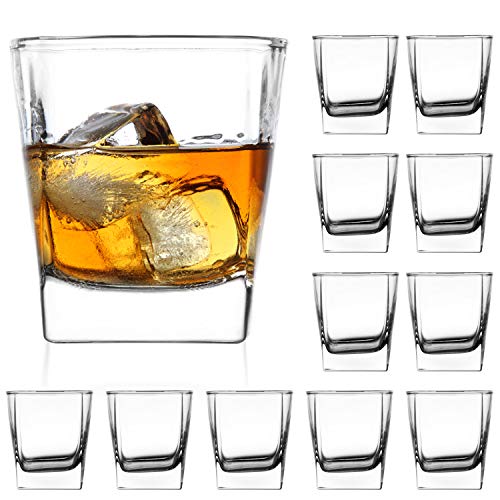
The best square whiskey glasses for most drinkers are the Nachtmann Highland Tumbler for crystal clarity and presentation, the RIEDEL Drink Specific Glassware Rocks Glass for a balanced everyday option, and a heavy-base lead-free crystal or soda-lime tumbler in the 9–11 oz range for maximum stability and dishwasher practicality.
Square whiskey glasses are usually chosen for their broad, architectural shape rather than for a radically different tasting experience. The useful differences are practical: how thick the walls and base feel, how much whiskey remains after adding ice, whether the glass stays planted on a table, and whether repeated dishwasher cycles leave the surface clear.
Our top picks


As an Amazon Associate we earn from qualifying purchases at no extra cost to you. Ratings are shown as listed on Amazon.
Best square whiskey glasses compared
| Glass or glass type | Typical capacity | Construction | Best feature | Dishwasher suitability | Typical price range |
|---|---|---|---|---|---|
| Nachtmann Highland Tumbler | About 11–12 oz | Lead-free crystal, faceted square styling | Clarity and decorative light refraction | Usually dishwasher-safe; use a gentle cycle | Usually $25–$45 for a pair |
| RIEDEL Drink Specific Glassware Rocks Glass | About 10–11 oz | Machine-made crystal | Balanced proportions for neat pours and ice | Generally dishwasher-safe, though hand washing preserves polish | Usually $25–$45 for a pair |
| Heavy-base lead-free crystal tumbler | 9–12 oz | Thick walls and weighted base | Stability and resistance to tipping | Depends on the manufacturer; check the care label | Usually $15–$40 for a pair |
| Thick soda-lime square tumbler | 10–14 oz | Tempered or ordinary glass | Low replacement cost and easy everyday use | Often dishwasher-safe | Usually $10–$30 for a set |
| Premium cut-crystal square tumbler | 8–11 oz | Heavier crystal with deep cuts | Formal presentation and tactile weight | Often hand-wash only | Usually $80–$250 or more for a pair |
1. Nachtmann Highland Tumbler: best for clarity and visual detail
The Nachtmann Highland Tumbler is the strongest choice when the glass itself is part of the presentation. Its faceted exterior creates the familiar square, cut-glass appearance while lead-free crystal keeps the edges visually bright. The pattern is more decorative than a plain square tumbler, so it suits an Old Fashioned served with a large clear cube or a short pour of bourbon.
The trade-off is weight and cleaning. Facets can conceal residue around the lower corners, and a patterned exterior makes water spots more noticeable. It is commonly listed as dishwasher-safe, but a low-temperature cycle, mild detergent, and prompt removal will do less damage to clarity than hot, aggressive cycles.
How it handles ice
The broad base gives a large cube or two standard cubes room to sit without forcing the whiskey into a narrow stack. A large cube is usually the better match: it cools the drink while limiting dilution. Three or four small cubes can fill the lower half quickly, making the glass look full but leaving less room for stirring.
2. RIEDEL Rocks Glass: best all-rounder for whiskey and cocktails
The RIEDEL Drink Specific Glassware Rocks Glass is a sensible middle ground. It has enough capacity for neat whiskey, a few cubes, or short cocktails such as an Old Fashioned, without the oversized bowl that can make a modest pour look lost. Its machine-made crystal construction typically offers a cleaner rim and more consistent shape than inexpensive molded glass.
This is the better choice for a household that wants one square-leaning rocks glass to cover several drinks. It is less visually dramatic than deeply cut crystal, but that also makes it easier to read the color of the whiskey and easier to clean.
How it handles whiskey stones
Whiskey stones occupy more space than many people expect. A typical stone or stainless-steel cube is roughly 1 inch across, so four pieces can displace approximately 4 cubic inches of space. Since 1 US fluid ounce equals about 1.8 cubic inches, that displacement is equivalent to more than 2 fluid ounces of volume. The practical result is that a 10-ounce glass with a 2-ounce pour and four stones may feel crowded even though the arithmetic suggests plenty of capacity.
Use two or three stones in a 10–11 oz square tumbler, and chill them fully before adding the whiskey. Stones reduce temperature without adding water, so they are most useful when you want a cooler, undiluted drink. They do not reproduce the gradual dilution of melting ice.
3. Heavy-base lead-free crystal: best for stability
If your priority is a glass that stays put, choose a square tumbler with a thick base, a low center of gravity, and a footprint at least 2.5 inches wide. The exact brand matters less than those proportions. A heavy base is particularly valuable on a desk, coffee table, or side table where a light tap could otherwise send a drink over the edge.
Thick walls also soften the clink of ice and protect the hand from a very cold drink. However, thickness reduces usable interior space. Two glasses advertised at 10 ounces may feel different if one has a thick base and the other has a thin base with a taller bowl.
Stability decision rule
- Choose a base at least 8–10 mm thick for a visibly weighted feel.
- Prefer a short glass around 3.5–4.5 inches tall rather than a tall, narrow square tumbler.
- Look for a flat bottom with no pronounced external bevels that can rock on a table.
- For a desk or gaming setup, select lead-free crystal or tempered glass and avoid fragile deep-cut designs.
4. Thick soda-lime glass: best for everyday durability
A thick soda-lime square tumbler is often the practical winner for frequent use. It generally costs less, tolerates routine dishwasher cleaning better, and is less painful to replace if a glass is chipped. It may not have the same bright clarity or ringing tone as crystal, but the difference is usually more apparent under strong lighting than during an ordinary drink.
Check whether the product is tempered. Tempered glass can resist thermal shock better than ordinary glass, but no tumbler should be moved directly from a freezer to a hot dishwasher or filled with boiling liquid. Square corners can also be vulnerable: a chip on one corner is more likely than a small, gradual rim mark to become a sharp edge.
Capacity: choose for your actual pour
Capacity should be matched to the drink rather than maximized. For a 2 oz whiskey pour, a 9–11 oz glass is usually the most balanced size. It leaves room for ice and swirling without making the drink appear undersized. A 12–14 oz tumbler is more flexible for cocktails or large cubes, but it can make neat whiskey look visually sparse.
| Your usual drink | Recommended capacity | Best interior shape | Why |
|---|---|---|---|
| Neat 1.5–2 oz pour | 8–10 oz | Short, moderately wide | Keeps the pour visually proportionate |
| Whiskey with one large cube | 9–11 oz | Wide square base | Allows the cube to sit flat and melt evenly |
| Whiskey with two or three stones | 10–12 oz | Wide opening and deep bowl | Leaves space for stones and stirring |
| Old Fashioned or short cocktail | 11–14 oz | Broad bowl | Accommodates ice, garnish, and mixing |
Crystal clarity versus glass thickness
Crystal usually provides a clearer, more luminous appearance and a thinner, cleaner rim, although modern lead-free crystal varies by manufacturer. Thickness is a separate issue. A thick crystal glass can be extremely clear but still feel bulky; a thin soda-lime glass can look clear when new but show scratches more quickly.
For the best balance, look for a moderately thin rim paired with a weighted base. An extremely thin rim is pleasant for sipping but less forgiving of knocks, while an extremely thick rim can make a premium whiskey feel less refined.
Dishwasher safety and maintenance
“Dishwasher-safe” does not mean immune to clouding or impact. Place square glasses between the rack prongs rather than over them, leave space between neighboring glasses, and use a lower-temperature or glassware cycle when available. Avoid mixing them with metal utensils. Hard-water minerals can create a white film that resembles permanent damage; a brief soak in diluted white vinegar can remove mineral deposits, but do not use abrasive powder or a rough scrubber.
Hand washing is preferable for premium cut crystal, gold-rimmed designs, and glasses with unusually thin rims. Dry the inside with a lint-free cloth instead of twisting a towel forcefully into the bowl, which can stress the rim.
Which square whiskey glass should you buy?
- Choose the Nachtmann Highland Tumbler if faceted crystal appearance is your main priority.
- Choose the RIEDEL Rocks Glass if you want the most versatile balance for neat whiskey, ice, and short cocktails.
- Choose a heavy-base lead-free crystal tumbler if stability and a premium hand feel matter more than decorative cuts.
- Choose a thick soda-lime square tumbler if the glasses will see daily dishwasher use or frequent replacement.
- Choose a 10–12 oz model if you regularly use whiskey stones or large cubes.
- Choose an 8–10 oz model if most drinks are neat 1.5–2 oz pours.
For most people, the best square whiskey glasses are moderately sized, heavy enough to resist tipping, clear enough to show the whiskey’s color, and explicitly rated for dishwasher use. The ideal shape leaves room for one large cube or two to three stones without turning a normal pour into a crowded, unstable drink.