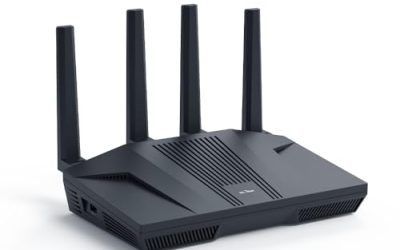
Our Top Picks

A full-size router can dominate a desk, crowd a media shelf, or refuse to fit in a travel bag. The best small routers solve that problem without giving up the features that matter: dual-band Wi-Fi, wired Ethernet ports, VPN support, and a setup process that takes minutes. Whether for a hotel room, a dorm desk, or a spot behind a television, a small router does a large job from a small footprint.
Small does not mean weak: modern compact routers run the same Wi-Fi 6 radios found in much larger boxes, and several models here include a 2.5-gigabit WAN port, hardware VPN clients, and support for dozens of devices at once. The trade-offs are real, though: a pocket-sized router usually covers a single room rather than a whole house, and it may have only two or three Ethernet ports. Every model below is a router in its own right, not a range extender or a hotspot dongle.
At a Glance
| Router | Wi-Fi | Wired Ports | Standout Feature | Best For |
|---|---|---|---|---|
| GL.iNet Beryl AX (GL-MT3000) | Wi-Fi 6, AX3000 | 2.5G WAN, 1G LAN | Fast VPN client with 2.5G WAN | Most travelers and small desks |
| GL.iNet Slate AX (GL-AXT1800) | Wi-Fi 6, AX1800 | 3x Gigabit | Three gigabit ports plus microSD slot | Wired devices and media sharing |
| GL.iNet Opal (GL-SFT1200) | Wi-Fi 5, AC1200 | 3x Gigabit | Compact dual-band VPN router | Everyday travel on a modest footprint |
| GL.iNet Mango (GL-MT300N-V2) | Wi-Fi 4, 300 Mbps | 2x 100M | Weighs about 39 grams | Ultralight backup and simple secure browsing |
| TP-Link TL-WR902AC | Wi-Fi 5, AC750 | 1x Ethernet, USB 2.0 | Multi-mode pocket router | Simple hotel and hotspot sharing |
1. GL.iNet Beryl AX (GL-MT3000)
The GL.iNet Beryl AX, model GL-MT3000, is the most capable small router in this guide and the one that suits the widest range of uses. It measures about 120 by 83 by 34 millimeters and weighs around 196 grams, so it slips into a laptop sleeve or a jacket pocket without adding noticeable bulk. Despite that size, it carries Wi-Fi 6 with combined dual-band speeds up to AX3000, which covers a laptop, a phone, a tablet, and a streaming stick at the same time without strain. A USB 3.0 port accepts a storage drive for simple file sharing or a cellular modem for a backup connection, and two folding antennas tuck flat for packing.
The headline hardware feature is a 2.5-gigabit WAN port beside a gigabit LAN port. That faster WAN port matters when the wired connection feeding the router is quicker than a gigabit, which is increasingly common in hotels, apartments, and coworking spaces. VPN support is where the Beryl AX pulls ahead of most compact routers: it ships with WireGuard and OpenVPN clients and servers built in, and its WireGuard throughput reaches around 300 Mbps over Ethernet, enough to keep a full room of devices behind an encrypted tunnel while streaming video. A physical toggle switch can turn the VPN on or off. In repeater mode it joins a hotel network once, handles the captive portal login, and shares that connection with every device behind it.
Considerations
The Beryl AX covers a room comfortably, but it is not a whole-home router: its compact antennas and single-room focus mean the signal fades through several walls. It has only one LAN port, so a wired setup with several devices needs a small switch beside it. It draws power over USB-C, but a charger is not always included, so check the listing contents before packing.
2. GL.iNet Slate AX (GL-AXT1800)
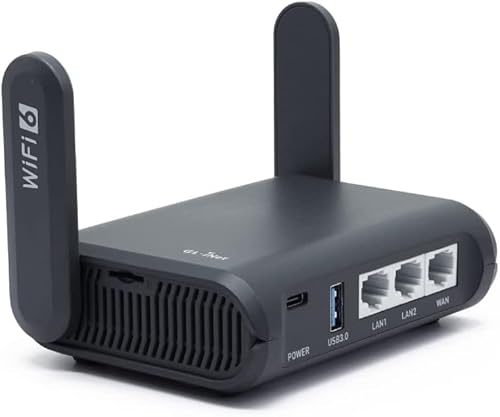
The GL.iNet Slate AX, model GL-AXT1800, is the pick for anyone who wants a small router with more wired connections. It is a pocket-sized Wi-Fi 6 router with three gigabit Ethernet ports: one WAN and two LAN. That extra LAN port makes a practical difference on a desk where a laptop and a console both benefit from a cable, or in a hotel room where a wired television and a laptop can both plug in at once. The unit measures about 125 by 82 by 36 millimeters and weighs around 245 grams, still small enough to carry daily.
Dual-band Wi-Fi 6 reaches up to 1800 Mbps combined, with 600 Mbps on the 2.4 GHz band and 1200 Mbps on the 5 GHz band. VPN performance is a genuine strength: WireGuard throughput over Ethernet reaches around 550 Mbps, faster than the Beryl AX and quick enough that the encrypted tunnel rarely becomes the bottleneck for streaming or large downloads. OpenVPN is also built in, along with support for more than 30 VPN service providers. The microSD card slot is a feature the other routers in this guide lack: with a card inserted, the Slate AX can share files across the local network or serve media to devices in the room.
Considerations
The Slate AX has no 2.5-gigabit port, so its wired WAN tops out at gigabit speed. For most hotel, apartment, and home connections that is plenty, but anyone with a multi-gigabit wired feed will leave some headroom unused. It is also the heaviest router in this guide at around 245 grams, still light in absolute terms but noticeable next to the featherweight Mango. The interface is rich with settings; the quick-setup wizard covers the basics.
3. GL.iNet Opal (GL-SFT1200)
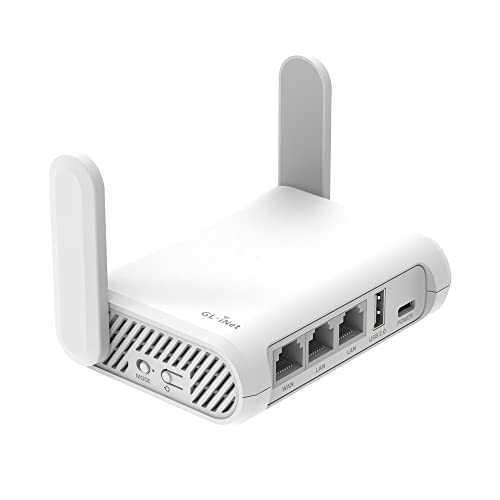
The GL.iNet Opal, model GL-SFT1200, is the sensible middle ground of this guide: a compact dual-band router with full VPN support and three gigabit ports, built on older Wi-Fi 5 hardware that keeps the design simple and proven. It weighs about 145 grams and fits easily in a bag side pocket, a desk drawer, or a carry-on pouch. For everyday travel, a small apartment, or a dorm room, its AC1200 wireless is enough for browsing, video calls, streaming, and light gaming.
Dual-band Wi-Fi runs at up to 300 Mbps on the 2.4 GHz band and 867 Mbps on the 5 GHz band. The 5 GHz band handles streaming, while 2.4 GHz reaches a little farther through walls. Three gigabit Ethernet ports, one WAN and two LAN, let two wired devices connect directly. Security features are the Opal’s strongest suit relative to its size: OpenVPN and WireGuard are pre-installed with support for more than 30 VPN service providers, and Cloudflare encrypted DNS and IPv6 are supported. A physical toggle switch can enable or disable a chosen feature such as the VPN client or AdGuard Home, and repeater mode converts a public wired or wireless network into a private Wi-Fi network.
Considerations
Wi-Fi 5 is the main compromise. Compared with the Wi-Fi 6 models in this guide, the Opal moves less data at peak and handles crowded airwaves less efficiently. WireGuard throughput reaches around 65 Mbps over Ethernet, which covers browsing, calls, and standard streaming behind a VPN, but it will not keep up with a very fast connection while the tunnel is active. The Opal has no USB-C power input, using a barrel-style adapter instead, so it is less convenient to run from a laptop charger or a power bank than the newer models.
4. GL.iNet Mango (GL-MT300N-V2)
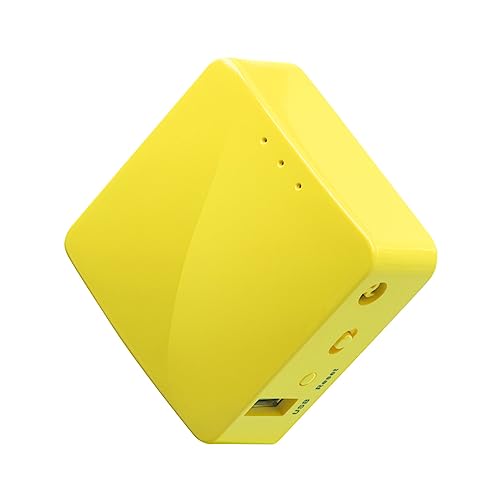
The GL.iNet Mango, model GL-MT300N-V2, is the smallest router in this guide by a wide margin. It weighs about 39 grams, roughly the same as a few coins, and its body is barely larger than a matchbox. It draws power from any USB port, so a laptop, a power bank, or a phone charger can run it. For anyone who wants a backup router that is always in the bag, or a first travel router for simple secure browsing, nothing else here comes close on size and weight.
The Mango is a single-band Wi-Fi 4 router with wireless speeds up to 300 Mbps on the 2.4 GHz band. That is modest by modern standards, and it shows when several devices stream at once, but it is ample for email, messaging, web browsing, and video calls for one or two people. Two 100-megabit Ethernet ports cover a wired hotel jack or a laptop. What makes the Mango worth including despite its modest wireless is its VPN support: it runs OpenVPN and WireGuard clients, so even this tiny box can put a whole room of devices behind an encrypted tunnel on public Wi-Fi.
Considerations
The limits here are plain and should be weighed honestly. Wi-Fi 4 and 100-megabit Ethernet cap both wireless and wired throughput well below the other routers in this guide, so the Mango is not the right choice for streaming in high quality on several devices at once or for moving large files. WireGuard throughput is modest, around 45 Mbps, which covers browsing and calls behind a VPN but not much more. It has no 5 GHz band, so it shares the crowded 2.4 GHz band with every nearby network.
5. TP-Link TL-WR902AC

The TP-Link TL-WR902AC is a long-running pocket router from a mainstream networking brand, and its appeal is simplicity. It is a dual-band AC750 travel router small enough to sit in a pocket, with several operating modes that cover the common travel situations: router mode for a wired connection, hotspot mode for sharing a wireless connection, bridge and range extender modes for stretching an existing network, access point mode for adding Wi-Fi to a wired network, and client mode for giving a wired-only device a wireless link.
Dual-band Wi-Fi runs at up to 300 Mbps on the 2.4 GHz band and 433 Mbps on the 5 GHz band, enough for browsing, calls, and streaming on a few devices in a hotel room or a small apartment. A single Ethernet port handles the wired side. The router is powered over micro USB, so a standard phone charger or a power bank can run it. Setup is deliberately straightforward: TP-Link’s web interface walks through mode selection and network setup in a few screens. For a traveler who wants a pocket router without VPN configuration and without a learning curve, the TL-WR902AC is the least demanding model in this guide.
Considerations
The TL-WR902AC has no built-in VPN client, which is the largest gap against the GL.iNet models in this guide. Anyone who wants router-wide encryption on public Wi-Fi will need to run VPN software on each device instead. Its wireless is Wi-Fi 5 generation AC750, so peak speeds and device capacity sit below the Wi-Fi 6 models, and its single Ethernet port means only one wired device can connect at a time without a switch. The micro USB power port is an older connector than the USB-C ports on newer travel routers, so packing a matching cable matters.
How to Choose
Start with where the router will live. A travel router spends its life in a bag and on hotel desks, so weight, USB power, and repeater mode matter most. A small desk router stays in one place, so wired ports, Wi-Fi generation, and coverage of one or two rooms matter more. For a dorm room or small apartment, device capacity and stable dual-band Wi-Fi deserve priority over pocketability.
Wi-Fi generation is the next decision. Wi-Fi 6 routers handle several devices more efficiently and move data faster at peak, which shows when a household streams, games, and video-calls at the same time. Wi-Fi 5 routers remain perfectly capable for a handful of devices in a single room. Wi-Fi 4, as in the Mango, is best reserved for light use and backup duty. Match the generation to the workload rather than buying the newest radio by default.
Wired ports deserve a careful count. A single LAN port is fine when everything connects over Wi-Fi, but a desk with a laptop and a console, or a hotel room with a wired television, quickly needs two LAN ports. A 2.5-gigabit WAN port only matters when the incoming wired connection is faster than a gigabit; otherwise a gigabit WAN is enough. USB ports add flexibility for storage sharing, and the Slate AX microSD slot adds local media sharing.
VPN support separates the models in this guide more than any other feature. If the router will join hotel, airport, or coworking networks, a built-in WireGuard or OpenVPN client protects every device behind it at once, including televisions and consoles that cannot run VPN software themselves. Check the expected VPN throughput, not just the presence of a VPN menu: a router that encrypts at 65 Mbps will feel very different on a fast connection from one that manages 300 Mbps or more. USB-C power means the router can share a laptop charger or run from a power bank, while barrel adapters and micro USB need their own charger and cable.
Fit and Installation Considerations
Placement decides how well a small router performs. Put it in the open, at about desk height, away from thick walls, metal shelving, and large appliances. A router tucked behind a television or inside a closed cabinet will lose signal strength quickly. For a single room, a central spot on a desk or a shelf is ideal. For a small apartment, place the router near the middle of the space rather than in a far corner, and keep it away from the floor.
Antenna position matters on models with folding antennas. Flip them upright and spread them slightly apart rather than leaving them flat against the case, and avoid pointing them directly at the devices they serve; antennas radiate strongest to their sides. Installation usually takes only a few minutes: connect the router to power, join its default wireless network or plug in an Ethernet cable, and open the setup wizard in a browser. For travel use, connect the router to the hotel network first, complete any captive portal login once, and then connect personal devices to the router’s own network. Change the default admin password and the default Wi-Fi password during setup.
Keep the firmware current. Manufacturers release updates that fix security issues and improve stability, and a small router that travels between networks benefits from those fixes as much as a large one. Leave space around the vents, do not stack items on top of the unit, and avoid placing it on a heat source such as a cable box.
Frequently Asked Questions
Is a small router powerful enough to be a main home router?
It can be, for a small space. A compact Wi-Fi 6 router such as the Beryl AX or the Slate AX serves a studio, a dorm room, or a one-bedroom apartment well, covering a few rooms and a handful of devices. For a larger home with several rooms, thick walls, or many connected gadgets, a full-size router or a mesh system will cover the space more evenly.
Do small routers work in hotels with login pages?
Yes, and this is one of their best uses. A travel router joins the hotel network once and completes the captive portal login on its own screen. After that, every device connected behind the router shares the authenticated connection without logging in separately. It works with wireless networks and wired Ethernet jacks alike, adding the router’s firewall and VPN between personal devices and the public network.
What is the difference between a small router and a portable hotspot?
A small router creates a private Wi-Fi network from an existing internet connection, whether that connection is wired Ethernet or another Wi-Fi network. A portable hotspot creates its own internet connection from a cellular signal using a SIM card. Choose a router when hotels, apartments, and offices already provide internet, and a hotspot when the location has no usable connection at all.
How many devices can a small router handle?
The models in this guide support dozens of simultaneous connections, with the Slate AX listing capacity for up to 120 devices. In practice, the comfortable limit depends on what those devices are doing: a dozen phones and laptops browsing and streaming is easy, while many devices streaming high-quality video at once will strain any compact router.
Conclusion
The best small routers prove that a capable network does not need a large box. The GL.iNet Beryl AX leads this guide for most people, pairing Wi-Fi 6 with a 2.5-gigabit WAN port and fast VPN support in a pocket-sized case. The GL.iNet Slate AX suits desks with several wired devices, adding a third gigabit port and a microSD slot for media sharing. The GL.iNet Opal covers everyday travel with proven dual-band Wi-Fi and full VPN support in a light, simple package. The GL.iNet Mango is the ultralight backup for travelers who count every gram, and the TP-Link TL-WR902AC keeps things simple with multi-mode operation and an easy setup flow.
Match the router to the job, check the fit where it will sit, and keep the firmware current.
As an Amazon Associate, we earn from qualifying purchases.
FAQ
Is a small router powerful enough to be a main home router?
Do small routers work in hotels with login pages?
What is the difference between a small router and a portable hotspot?
How many devices can a small router handle?
More from Amazon
Programs that pair well with the guide above. Offers and eligibility are set by Amazon and may change.
Free shipping on eligible items, Prime Video and more. Eligible new members can start with a free trial.
Start a Prime free trialAd-free music streaming. Eligible new subscribers can start with a free trial.
Try Music Unlimited freeA Prime membership for ages 18-24 with a trial period. Eligibility is set by Amazon.
See Prime for Young AdultsAudiobooks and podcasts to listen to on the go. Eligible new members can start with a free trial.
Try Audible freeAs an Amazon Associate we earn from qualifying purchases.