Key takeaways
- Three curved ultrawide monitors that suit a MacBook Pro — two Samsung ViewFinity models with USB-C or Thunderbolt charging and a Dell UltraSharp hub monitor — compared on listing specs.
A curved monitor earns its place next to a MacBook Pro only if it solves the laptop’s two desk problems at once: one cable instead of a nest of adapters, and enough power delivery to keep the battery full while it drives the screen. Plenty of curved ultrawides were designed for Windows desktops and treat USB-C as an afterthought, which leaves Mac owners with a beautiful panel and a separate charger, hub and dongle chain.


The three monitors below are all 34-inch curved ultrawides whose listings state USB-C or Thunderbolt connectivity with power delivery, so a MacBook Pro connects, displays and charges over a single lead. They differ in how much docking hardware they absorb — one is a full Thunderbolt dock with Ethernet and a KVM, one is the simpler one-cable option, and one is a colour-focused hub monitor from Dell.
Quick Picks
As an Amazon Associate we earn from qualifying purchases.
| Product | Best for | Key spec from title |
|---|---|---|
| Samsung ViewFinity S65TC | Replacing a separate dock entirely | Thunderbolt 4 with 90W charging |
| Samsung ViewFinity S65UA | One-cable simplicity | USB-C connectivity, 100Hz panel |
| Dell UltraSharp U3421WE | Colour work with a built-in hub | USB-C hub monitor with 90W power delivery |
How to Choose
Match the power delivery to your MacBook Pro
The monitor’s charging wattage is printed in the listing, and it decides whether the laptop’s own power brick can leave the desk. The monitors here state 90W delivery, which keeps MacBook Pro models charged through ordinary work. Under sustained maximum load a larger MacBook Pro can draw close to what its own adapter supplies, so if your work pins the processor for hours, treat the monitor’s feed as a maintainer rather than a fast charger. Either way, confirm the listing’s stated wattage before buying — curved monitors with USB-C video but weak or absent charging still exist.
Prefer Thunderbolt if peripherals live on your desk
A plain USB-C monitor carries video, power and some data. A Thunderbolt monitor adds a real docking layer: a USB hub for your keyboard receiver and webcam, sometimes Ethernet, sometimes a KVM switch for a second computer. Count what currently plugs into your MacBook Pro. If the answer is just a charger, a USB-C model is enough and cheaper. If a hub already lives on your desk, a Thunderbolt monitor can retire it, and the listing’s hub and LAN lines are the specs to compare, not the panel’s marketing name.
Understand what 3440×1440 means on macOS
All three monitors run at 3440×1440 across 34 inches. On macOS that resolution gives a wide, single-space desktop — two documents side by side without a bezel — rendered at standard scaling rather than the pixel-doubled Retina mode Apple’s own displays use. Text is perfectly readable but not quite as fine as on a Retina panel, which matters if your day is mostly close reading and code. For timelines, spreadsheets, design canvases and general productivity, the extra width usually outweighs the difference. The curve radius, stated as 1000R or 1900R in the listings, shapes how that width wraps around a single centred viewer.
Check the stand and the second input
A 34-inch panel on a fixed stand is a neck problem waiting to happen, so look for height adjustment in the listing if your desk setup is fixed; two of the monitors here state adjustable stands. Also check the second video input. A spare HDMI or DisplayPort lets a game console, a work laptop or a desktop share the screen, and picture-by-picture modes on some models show two sources at once. MacBook-first desks often become two-computer desks within a year, and the input list is what decides whether the monitor survives that change.
The 3 Best Options
1. Samsung ViewFinity S65TC
The S65TC is the monitor that replaces the dock, the speakers and the charger in one purchase. Its listing states a 34-inch curved panel with a 1000R radius at 3440×1440 and a 100Hz refresh rate, then adds the hardware a MacBook desk actually needs: Thunderbolt 4 connectivity with 90W charging for the connected laptop, a USB hub, a LAN port for wired networking, a built-in KVM switch for sharing a keyboard and mouse with a second computer, and built-in speakers. A height-adjustable stand is included. For a MacBook Pro that shares the desk with another machine, nothing else in this guide consolidates as much into a single cable.
- Specs:
- Panel: 34-inch curved, 1000R
- Resolution: 3440 × 1440 (Ultra-WQHD)
- Refresh rate: 100Hz
- HDR: HDR10
- Connectivity: Thunderbolt 4 with 90W charging, HDMI, DisplayPort, USB hub, LAN
- Extras: Built-in KVM switch, built-in speakers, height-adjustable stand
- Model: LS34C650TANXGO
- Best for: MacBook Pro owners who want the monitor to be the entire docking station
- Watch out for: The docking premium only pays off if your desk actually has peripherals and a second machine to consolidate
2. Samsung ViewFinity S65UA
The S65UA keeps the same panel formula — a 34-inch 1000R curved screen at 3440×1440 with a 100Hz refresh rate and HDR10 — and strips the docking layer back to the essentials. Its listing describes USB-C connectivity with charging up to 90W for the connected laptop, alongside HDMI and DisplayPort inputs, and a height-adjustable stand. That is the right scope for a desk where the MacBook Pro travels daily and the only permanent residents are a keyboard and mouse: plug in one cable and the wide desktop appears while the battery fills. It gives up the S65TC’s Ethernet, KVM and speakers, so desks with wired networking still need a hub.
- Specs:
- Panel: 34-inch curved, 1000R
- Resolution: 3440 × 1440 (Ultra-WQHD)
- Aspect ratio: 21:9
- Refresh rate: 100Hz
- HDR: HDR10
- Connectivity: USB-C with up to 90W charging per listing, HDMI, DisplayPort
- Extras: Height-adjustable stand
- Model: LS34A654UBNXGO
- Best for: A clean one-cable MacBook Pro desk without a separate hub
- Watch out for: No built-in Ethernet or speakers in the listing, unlike the S65TC above
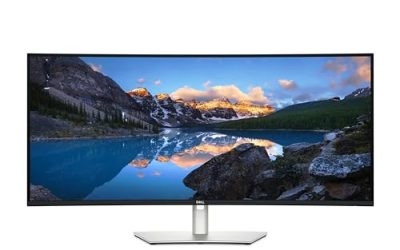
3. Dell UltraSharp U3421WE
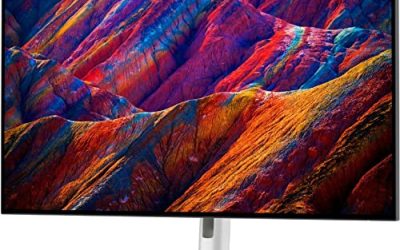
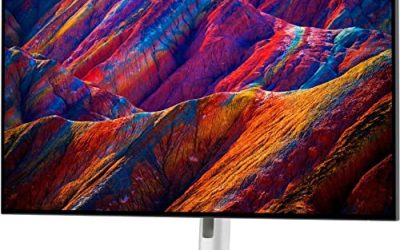
Dell’s UltraSharp entry takes a gentler curve and a colour-first panel. Its listing describes a 34-inch IPS screen at 3440×1440 with a 1900R radius — a shallower wrap that suits shared viewing and layout work where edges should stay calm — running at 60Hz. The hub side is complete: USB-C connectivity with 90W power delivery, an RJ45 Ethernet port, and hub ports for peripherals, so the MacBook Pro still docks over one cable. The UltraSharp line is Dell’s colour-focused range, which makes this the natural pick of the three for photo and design work, at the cost of the Samsungs’ faster refresh.
- Specs:
- Panel: 34-inch curved IPS, 1900R
- Resolution: 3440 × 1440 (WQHD)
- Refresh rate: 60Hz
- Connectivity: USB-C with 90W power delivery, HDMI, DisplayPort, USB hub, RJ45 Ethernet
- Model: U3421WE
- Best for: Colour-sensitive work on a MacBook Pro with full one-cable docking
- Watch out for: The 60Hz refresh rate is fine for productivity but a step down from the 100Hz Samsungs for fast-moving content; confirm current stock at checkout, as availability on this model runs through marketplace sellers at times
Which One Fits Your Situation
Your desk holds a MacBook Pro and a second computer
Take the S65TC. The built-in KVM moves one keyboard and mouse between the two machines, Thunderbolt serves the MacBook while the second input serves the other computer, and the speakers cover both. It is the only option here designed from the start for a shared desk rather than adapted to one.
You carry the MacBook Pro away every evening
The S65UA fits a travelling laptop best. One USB-C cable at the desk handles display and charging, the stand adjusts to your chair, and there is no dock to unplug or leave behind. When you return, the whole desk reconnects in a single motion, which is the entire point of this category.
You edit photos or design on the MacBook Pro
Choose the Dell U3421WE. The IPS panel and shallower curve suit colour judgement and layouts, and the hub still gives you one-cable docking with Ethernet. The 90W feed also keeps the laptop charged through long editing sessions. Accept the 60Hz ceiling as the trade for the panel type — for still-image and design work it will not be the limiting factor.
Common Mistakes
- Buying a curved ultrawide whose USB-C port carries video but little or no charging, then keeping the laptop’s brick on the desk anyway.
- Assuming every Thunderbolt monitor includes Ethernet and a hub — those features are model-specific and must appear in the listing.
- Expecting Retina-grade text sharpness from a 3440×1440 panel; macOS runs it at standard scaling, which suits width-first work.
- Ignoring the curve radius: a deep 1000R curve is a one-viewer design, while a shallow curve shares better with a second chair.
- Forgetting the stand — a fixed-height 34-inch screen at the wrong height undoes every ergonomic gain the curve offers.
Frequently Asked Questions
Will one cable really charge a MacBook Pro and run the screen?
Yes, on the monitors here. Their listings state USB-C or Thunderbolt connections with 90W power delivery, and a single cable carries the picture, the charge and the hub’s data together. Keep the laptop’s own adapter in your travel bag; the desk no longer needs it. Under the heaviest sustained loads, charging may be slower than with the original adapter.
Does macOS work well with a 3440×1440 ultrawide?
It works as a wide single desktop with two comfortable document widths side by side. The difference from Apple’s own displays is scaling: macOS renders this resolution at standard density rather than Retina pixel-doubling, so text is clear but not quite as fine. For productivity, timelines and spreadsheets the width is worth more than the last degree of sharpness.
Thunderbolt or plain USB-C — which should a Mac owner choose?
Choose Thunderbolt if you plug anything else into your setup: the hub, Ethernet and KVM features in the S65TC’s listing only exist on the Thunderbolt model. Choose plain USB-C, like the S65UA, if the laptop plus a wireless keyboard and mouse is the whole desk. The panel and charging are the same; the docking layer is what changes.
Can these monitors also serve a Windows PC or console?
Yes. All three listings include HDMI and DisplayPort inputs alongside the USB-C or Thunderbolt connection, so a second machine can share the panel. The S65TC’s built-in KVM makes that switching graceful with one keyboard and mouse. A console will use the screen at its own output resolution, centred on the ultrawide panel.
FAQ
Will one cable really charge a MacBook Pro and run the screen?
Does macOS work well with a 3440×1440 ultrawide?
Thunderbolt or plain USB-C — which should a Mac owner choose?
Can these monitors also serve a Windows PC or console?
More from Amazon
Programs that pair well with the guide above. Offers and eligibility are set by Amazon and may change.
Free shipping on eligible items, Prime Video and more. Eligible new members can start with a free trial.
Start a Prime free trialAd-free music streaming. Eligible new subscribers can start with a free trial.
Try Music Unlimited freeA Prime membership for ages 18-24 with a trial period. Eligibility is set by Amazon.
See Prime for Young AdultsAudiobooks and podcasts to listen to on the go. Eligible new members can start with a free trial.
Try Audible freeAs an Amazon Associate we earn from qualifying purchases.