Our Short List of 3
All 5 Picks at a Glance
| Product | Specs | Action |
|---|---|---|
 JBL 308P MkII | Check price on Amazon | |
 Yamaha HS8 | Check price on Amazon | |
 ADAM Audio T8V | Check price on Amazon | |
 PreSonus Eris Studio 8 | Check price on Amazon | |
 ADAM Audio T7V | Check price on Amazon |
Key takeaways
- Compare the best mid field monitors for mixing and listening at mid distance, with 7 and 8 inch woofers, flat response, and honest low end.
The best mid field monitors sit between nearfield speakers and large main monitors, filling the gap for rooms where the listening position is a few metres from the speakers. Mid field monitors use larger woofers, usually seven or eight inches, which gives them deeper low end and more output than small desktop speakers. They suit mixing rooms, project studios, and listening spaces where the engineer sits further back than a typical nearfield setup allows.
A mid field monitor earns its place when it stays accurate at distance. The sound should stay balanced as you move back from the speakers, with a flat response that does not flatter the mix. The five monitors below all use seven or eight inch woofers, and all are sold as single cabinets, so a stereo pair needs two units of each. Read the buying criteria first, since room size and placement matter more with mid field monitors than with small desktop speakers.
How to Choose
Woofer size and low end
Mid field monitors use seven or eight inch woofers, which reach lower frequencies than five inch nearfields. An eight inch woofer typically extends the low end far enough to judge bass without a subwoofer, while a seven inch unit is a middle step. Check the stated low-frequency limit and remember that room acoustics shape the bass you actually hear.
Flat frequency response
Studio monitors should reproduce sound without adding colour. A flat response means the mix you hear is close to the mix you made, so it translates well to other speakers. Look for monitors with a reputation for neutral tuning rather than ones that boost bass or treble to sound impressive in the shop.
Listening distance
Mid field monitors are designed for listening distances of roughly two to four metres. Closer than that, and the drivers do not blend properly; further away, and the room dominates the sound. Measure your room and your seating position before choosing, and make sure your desk or stands place the monitors at the right distance.
Room size and acoustics
Larger woofers excite room modes more strongly, so mid field monitors need a room with some acoustic treatment. Bare walls and hard floors will colour the bass and blur the stereo image. Budget for basic treatment such as bass traps and absorption panels if your room has none, since the monitors can only sound as good as the room allows.
Amplifier type
Most mid field monitors are active, with a built-in amplifier matched to the drivers. Active designs remove the guesswork of amplifier matching and usually include room-correction controls on the rear panel. Passive monitors need a separate amplifier and give more flexibility, but they add cost and complexity to the setup.
Connectivity
Check the inputs on the rear panel. Balanced XLR and TRS inputs reject interference over long cable runs, which matters when the monitors sit metres from the audio interface. Unbalanced RCA inputs are fine for short runs but can pick up hum in larger rooms. Match the inputs to your interface outputs before buying.
Single or pair pricing
Mid field monitors are usually sold singly, so the cost of a stereo pair is twice the listed figure for one cabinet. Check whether the listing is for one speaker or a pair, and confirm that both units are the same model and revision. Mixing different revisions in a pair can unbalance the stereo image.
Top Picks
JBL 308P MkII
View the JBL 308P MkII on Amazon
The JBL 308P MkII is an eight inch active studio monitor with a two-way design, a 112-watt amplifier, and JBL’s waveguide for a wide sweet spot. It is one of the most widely used mid field monitors in project studios, and its appeal is a neutral sound with enough output for a mid-size room.
The 308P MkII uses an eight inch woofer and a one inch tweeter, with a built-in amplifier that drives both. The waveguide shapes the high frequencies so the stereo image stays stable across a wider listening area, which helps when you move around the room. Boundary compensation and high-frequency trim controls on the rear panel let you adjust the sound for placement near walls.
Who it is for: project studio owners who want an affordable eight inch monitor with a wide sweet spot and enough output for mid field listening. It suits mixing, editing, and general listening in a treated room.
Caveats: the listing is for a single speaker, so a stereo pair needs two units. The eight inch woofer excites room modes in untreated rooms, so basic acoustic treatment is worth adding. Confirm the listing is the single-unit version before ordering.
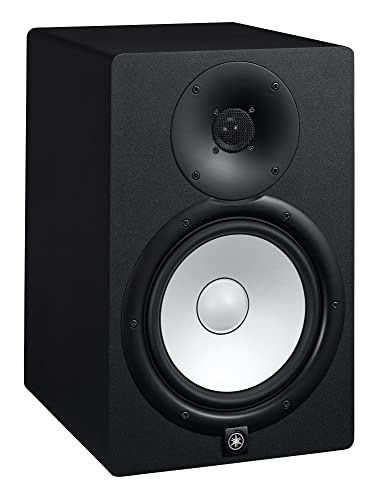
Yamaha HS8
The Yamaha HS8 is an eight inch active studio monitor known for its flat, honest response and its white cone. It is a long-standing choice for mixing rooms where accuracy matters more than flattery, and its sound is deliberately uncoloured.
The HS8 uses an eight inch woofer and a one inch dome tweeter, with a bi-amplified design that gives each driver its own amplifier. Room control and high trim switches on the rear panel let you adjust the low end and highs for your room. The response is famously flat, which means mixes that sound right on the HS8 tend to translate well to other systems.
Who it is for: mix engineers who want an honest monitor that exposes problems rather than hiding them. It suits dedicated mixing rooms and anyone who values translation over a pleasant sound.
Caveats: the flat response can sound plain at first if you are used to hi-fi speakers with boosted bass. The listing is for a single speaker, so a pair needs two units. The HS8 is a large cabinet, so check your desk or stands can hold it.
ADAM Audio T8V
View the ADAM Audio T8V on Amazon
The ADAM Audio T8V is an eight inch active studio monitor with ADAM’s U-ART ribbon tweeter, a two-way design, and a wide frequency range. It brings ADAM’s detailed high end to the mid field class at a project-studio level.
The T8V pairs an eight inch woofer with a ribbon tweeter that extends the high frequencies well beyond a conventional dome. The result is a detailed, open top end that suits critical listening. The rear panel carries high-shelf and low-shelf controls for room adjustment, and the cabinet is front-ported, which gives more placement flexibility near walls.
Who it is for: engineers and producers who want detailed highs and a wide soundstage in a mid field monitor. It suits mixing, mastering preparation, and listening rooms where detail matters.
Caveats: the listing is for a single speaker, so a pair needs two units. Ribbon tweeters reward careful placement and a treated room. Confirm the listing is the single T8V rather than a bundle, since bundle listings carry different codes.
PreSonus Eris Studio 8
View the PreSonus Eris Studio 8 on Amazon
The PreSonus Eris Studio 8 is an eight inch active studio monitor with a silk-dome tweeter, an EBM waveguide, and acoustic tuning controls. It is built for project studios that want a large monitor with flexible room adjustment.
The Studio 8 uses an eight inch woven composite woofer and a one inch silk-dome tweeter, with a 140-watt amplifier. The EBM waveguide shapes the high frequencies for a wide sweet spot, and the rear panel carries low-cut, mid, and high controls plus a three-way acoustic space switch for placement near walls or corners. The front-firing port helps with placement in tight rooms.
Who it is for: project studio owners who want an eight inch monitor with strong room-tuning controls. It suits mixing in rooms where placement is less than perfect, since the controls help compensate.
Caveats: the listing is for a single speaker, so a pair needs two units. The extensive controls help, but they cannot fix a badly treated room. Confirm the listing is the US single-unit version before ordering.
ADAM Audio T7V
View the ADAM Audio T7V on Amazon
The ADAM Audio T7V is a seven inch active studio monitor with ADAM’s U-ART ribbon tweeter and a compact cabinet. It is the smallest monitor in this guide, but its seven inch woofer and ribbon tweeter give it a place in mid field setups where space is tight.
The T7V pairs a seven inch woofer with the same ribbon tweeter family as the larger T8V, giving a detailed top end in a smaller box. The rear panel carries high-shelf and low-shelf controls, and the cabinet is rear-ported. It suits rooms where an eight inch monitor is too large but a five inch nearfield is too small.
Who it is for: producers and engineers with smaller rooms who still want mid field reach and ADAM’s detailed highs. It suits project studios, editing suites, and listening rooms with limited space.
Caveats: the seven inch woofer reaches less deep than the eight inch models above, so very low bass may need a subwoofer. The listing is for a single speaker, so a pair needs two units. Confirm the listing is the single T7V rather than a bundle.
Comparison Table
| Monitor | Woofer | Tweeter | Amplifier | Standout Feature |
|---|---|---|---|---|
| JBL 308P MkII | 8 inch | 1 inch dome | 112 W | Wide sweet spot waveguide |
| Yamaha HS8 | 8 inch | 1 inch dome | Bi-amplified | Flat, honest response |
| ADAM Audio T8V | 8 inch | Ribbon U-ART | 90 W | Detailed ribbon highs |
| PreSonus Eris Studio 8 | 8 inch | 1 inch silk dome | 140 W | Three-way room tuning |
| ADAM Audio T7V | 7 inch | Ribbon U-ART | 70 W | Compact mid field size |
Which One Is Right for You?
Choose the JBL 308P MkII if you want a proven eight inch monitor with a wide sweet spot and a neutral sound. Choose the Yamaha HS8 if you want the most even, most honest response and you value translation above all. Choose the ADAM Audio T8V if you want detailed ribbon highs in a full-size mid field cabinet. Choose the PreSonus Eris Studio 8 if your room needs the most tuning control. Choose the ADAM Audio T7V if your room is too small for an eight inch monitor but you still want mid field reach.
If you are unsure, measure your listening distance first. Mid field monitors need two to four metres of space to blend properly, and a room that is too small will favour a nearfield monitor instead. Treat the room as part of the purchase: even the best monitor in this guide will underperform in a bare, untreated space.
Frequently Asked Questions
What is the difference between nearfield and mid field monitors?
Nearfield monitors are designed for listening at arm’s length, usually one to two metres, and use smaller woofers. Mid field monitors use larger woofers and are designed for listening at two to four metres, with more output and deeper low end. The right choice depends on your room size and seating distance.
Do I need a subwoofer with mid field monitors?
Most eight inch mid field monitors reach low enough for mixing without a subwoofer. A subwoofer adds the lowest octave for genres that rely on deep bass, but it also adds setup complexity and can unbalance the room if it is not calibrated. Many engineers mix on eight inch monitors alone and check the lowest frequencies on headphones.
Why are studio monitors sold singly?
Studio monitors are sold singly because buyers may need one speaker for a mono setup or a centre channel, and because pairs are assembled from two identical units. Always confirm whether a listing is for one speaker or a pair, since the two are easy to confuse.
How important is room treatment for mid field monitors?
Very important. Larger woofers excite room modes that colour the bass, and bare walls blur the stereo image. Basic treatment such as bass traps in the corners and absorption at the first reflection points makes a bigger difference to the sound than upgrading to a more expensive monitor.
Disclosure: As an Amazon Associate, we may earn from qualifying purchases.
FAQ
Which One Is Right for You?
What is the difference between nearfield and mid field monitors?
Do I need a subwoofer with mid field monitors?
Why are studio monitors sold singly?
How important is room treatment for mid field monitors?
More from Amazon
Programs that pair well with the guide above. Offers and eligibility are set by Amazon and may change.
Free shipping on eligible items, Prime Video and more. Eligible new members can start with a free trial.
Start a Prime free trialAd-free music streaming. Eligible new subscribers can start with a free trial.
Try Music Unlimited freeA Prime membership for ages 18-24 with a trial period. Eligibility is set by Amazon.
See Prime for Young AdultsAudiobooks and podcasts to listen to on the go. Eligible new members can start with a free trial.
Try Audible freeAs an Amazon Associate we earn from qualifying purchases.