Our Short List of 3

- Best for: Working in rented rooms and cabins where outlets and desk space are unpredictable.
- 4-inch woofer, 105 dB SPL per pair
- Frequency response from 50 Hz to 20 kHz (±2 dB)
- Battery playback time of 20 hours, 2-hour charging time
- W+ Link wireless with 16 ms latency, uncompressed 44.1 kHz 16-bit audio

- Best for: A carry-on rig for editing and rough mixes where every centimetre of bag space counts.
- 3-inch woofer per speaker
- 50 watts total Class D amplification
- Bass extension down to 55 Hz (-3 dB)
- Bluetooth streaming
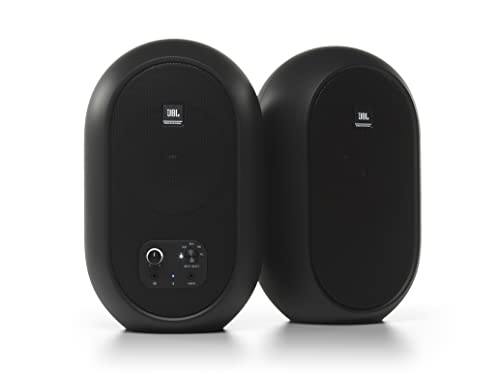
- Best for: Moving between a home desk and a second workspace where both spots have power and gear waiting.
- 4.5-inch coaxial woofer with 0.75-inch soft-dome tweeter
- 60-watt Class D amplifier, 30 watts per speaker
- Bluetooth 5.0
- Dual 1/4-inch balanced TRS, dual RCA and 1/8-inch aux inputs
All 4 Picks at a Glance
| Product | Specs | Action |
|---|---|---|
| AIAIAI UNIT-4 Wireless+ |
| Check price on Amazon |
| IK Multimedia iLoud Micro Monitor |
| Check price on Amazon |
| JBL 104-BT |
| Check price on Amazon |
 ADAM Audio D3V |
| Check price on Amazon |
Key takeaways
- Four portable studio monitors compared on battery life, cabinet size, weight and inputs, so you can mix honestly in hotel rooms and small travel rigs.
Mixing away from your own room changes the question. At home you ask how accurate a monitor is; in a hotel room, a tour bus bunk or a borrowed spare room, you first ask whether the pair fits the bag, runs from the power you actually have, and still tells the truth about a vocal or a kick drum. Headphones cover the gap for a while, but they tire your ears and flatter the stereo image, so a small pair of real monitors earns its luggage space quickly.
This guide serves producers, songwriters and video editors who work in more than one place and need monitoring that travels. Every pick is a genuine studio monitor sold on Amazon, chosen because its product page prints a portability trait you can verify: battery hours, weight per speaker, cabinet dimensions or a USB-C audio input. No pick is a party speaker in disguise, and the specs below come only from those pages.
Quick Picks
As an Amazon Associate we earn from qualifying purchases
| Product | Best for | Key spec from title |
|---|---|---|
| AIAIAI UNIT-4 Wireless+ | Mixing with no cables at all | Battery powered with 20 hours of playback |
| IK Multimedia iLoud Micro Monitor | The smallest bag footprint | 3-inch woofer, 1.72 kg per speaker |
| JBL 104-BT | Moving between two desks | 4.5-inch coaxial driver |
| ADAM Audio D3V | A laptop-only travel rig | USB-C audio input, 3.5-inch woofer |
How to Choose
Power Source: Battery, Mains or USB
Decide how the pair feeds before anything else. A battery model such as the UNIT-4 plays for a listed 20 hours and frees you from hunting outlets in rented rooms, in exchange for charge planning and extra weight in each cabinet. Most compact pairs still run on mains power, which suits a second desk but ties you to the wall on the road. A third route is USB-C audio, which removes the interface from the bag even though the speakers still need their own power lead. Match the power plan to the rooms you really work in.
Cabinet Size and Weight per Speaker
Portability lives in two printed numbers: the dimensions and the weight of one speaker. A pair doubles both, and stands, cables and a case add more, so read the per-speaker figures on the listing rather than the headline for the whole box. Cabinets near 18 cm tall slide into a backpack beside a laptop; deeper boxes near 25 cm want a proper case. Weight matters over a long carry too. Two speakers at 1.72 kg each feel very different from two at 2.5 kg each by the time you reach the room.
Inputs for a Laptop-Only Rig
A travel rig often has no interface, so the input list decides whether the pair works at all. USB-C audio lets a laptop feed the monitors digitally with one cable. Bluetooth covers phone checks and casual playback between sessions, though its delay makes it a poor feed while you record. Balanced TRS inputs still matter when an interface does travel with you, because they reject the hum that unbalanced leads pick up near chargers and power bricks. An aux socket is the humble fallback that connects anything with a headphone jack.
Low End from a Small Woofer
No cabinet this size moves much air, so judge the low end by the figure the maker prints rather than by woofer inches alone. One pair here claims extension to 45 Hz through passive radiators, another stops at 55 Hz, and both numbers describe gentle roll-offs, not flat output. A desktop or shelf switch helps when the speakers sit on a hotel desk against a wall. Plan to confirm deep bass choices on headphones, and treat the printed low figure as a guide to what the pair can show you honestly.
The 4 Best Options
AIAIAI UNIT-4 Wireless+
- Best for: Working in rented rooms and cabins where outlets and desk space are unpredictable.
- 4-inch woofer, 105 dB SPL per pair
- Frequency response from 50 Hz to 20 kHz (±2 dB)
- Battery playback time of 20 hours, 2-hour charging time
- W+ Link wireless with 16 ms latency, uncompressed 44.1 kHz 16-bit audio
Working in rented rooms and cabins where outlets and desk space are unpredictable.
This listing is the pair bundle with the transmitter in the box; single-speaker listings exist, so confirm the unit count before ordering.
The UNIT-4 is the only fully untethered pair here: each speaker carries its own battery, and the included transmitter links them and your source without a cable across the desk. That suits producers who set up in cabins, hotel rooms and rehearsal spaces where outlets sit in odd places and time is short. The printed response reaches 50 Hz, deep for a cabinet this small, and the balanced inputs still accept an interface when one is along. Choose it when the room changes every few days and the setup must take minutes, not an hour.
IK Multimedia iLoud Micro Monitor
- Best for: A carry-on rig for editing and rough mixes where every centimetre of bag space counts.
- 3-inch woofer per speaker
- 50 watts total Class D amplification
- Bass extension down to 55 Hz (-3 dB)
- Bluetooth streaming
A carry-on rig for editing and rough mixes where every centimetre of bag space counts.
Portable here means small, not battery powered; the pair needs a mains outlet, and the second speaker links to the first by cable.
The iLoud Micro Monitor built its name on being tiny: each speaker stands 18 cm tall and weighs 1.72 kg, so the pair rides in a carry-on beside a laptop and still leaves room for an interface. IK voices it as a reference monitor rather than a multimedia speaker, with a position switch for desk or shelf placement and Bluetooth for quick phone checks. The low figure of 55 Hz is honest for a 3-inch woofer. Pick it when luggage space is the hard limit and the work is editing, writing and rough mixing on the move.
JBL 104-BT
- Best for: Moving between a home desk and a second workspace where both spots have power and gear waiting.
- 4.5-inch coaxial woofer with 0.75-inch soft-dome tweeter
- 60-watt Class D amplifier, 30 watts per speaker
- Bluetooth 5.0
- Dual 1/4-inch balanced TRS, dual RCA and 1/8-inch aux inputs
Moving between a home desk and a second workspace where both spots have power and gear waiting.
The pair is corded only, with no battery and no USB audio, so a laptop-only bag still needs an interface or an aux lead.
JBL takes a different route to a small footprint: one coaxial driver per cabinet puts the tweeter inside the woofer, which keeps the box compact and the imaging stable when you sit close in a makeshift setup. The front panel selects among Bluetooth, aux, RCA and balanced TRS, or blends them, so a phone, a laptop and an interface can all stay connected while you move between a home desk and a second workspace. There is no battery, so this pair travels between desks rather than off the grid. It fits creators who work in two fixed spots.
ADAM Audio D3V
- Best for: A laptop-only rig that skips the interface and feeds the monitors over one USB-C cable.
- 3.5-inch aluminum woofer with dual passive radiators
- 1.5-inch D-ART folded ribbon tweeter
- Frequency response from 45 Hz to 23 kHz
- USB-C audio input for direct computer connection
A laptop-only rig that skips the interface and feeds the monitors over one USB-C cable.
USB-C carries audio only, so the pair still needs mains power, and there is no Bluetooth for phone playback.
The D3V is built around the computer: a USB-C input lets it play straight from a laptop with no interface in between, which trims the travel bag to speakers and two leads. ADAM fits its folded ribbon tweeter for a detailed top end, and passive radiators on the cabinet sides help the small woofer reach a printed 45 Hz. Detachable stands angle the pair toward your ears on a strange desk. Choose it when the laptop is the whole studio and you want a direct digital feed plus balanced inputs for the days an interface joins the trip.
Which One Fits Your Situation
You Mix in Hotel Rooms on Tour
Take the UNIT-4. Its batteries remove the outlet hunt, the wireless link keeps the nightstand clear of cables, and the pair sets up in minutes when the room is yours for one night. Charge both speakers while you sleep and the listed 20 hours covers long writing days, bus rides and backstage corners alike.
Your Whole Rig Fits in a Carry-On
The iLoud Micro Monitor is the pick. At 18 cm tall and 1.72 kg per speaker it leaves room for a laptop, a small interface and clothes in the same bag. You give up battery power and deep bass, but you gain a real stereo pair almost anywhere a wall socket exists.
You Move Between Two Desks
Choose the JBL 104-BT when your travel is really a commute between home and a studio corner elsewhere. Its input selector keeps an interface, a laptop and a phone connected at once, and the coaxial design stays composed when you sit close at either desk, however the room is arranged.
You Travel with Only a Laptop
The D3V trims the kit furthest: one USB-C cable feeds it digitally, the stands handle odd desk angles, and balanced inputs wait for the day an interface joins the bag. It still needs a wall outlet, so pack it for rooms where power is certain and close to the desk.
Common Mistakes
- Buying a Bluetooth party speaker and calling it a monitor; without a flat, reference-style voicing and proper inputs, mixes made on it mislead you elsewhere.
- Reading the weight of the whole box as the weight of one speaker, or the reverse, then finding the bag far heavier than planned.
- Assuming portable means battery powered; three of the four pairs here still need a mains outlet, so check the power line on the listing.
- Judging bass by woofer inches alone instead of the low figure the maker prints, which is the honest guide to what a small cabinet can show.
- Forgetting the extras in the carry weight: stands, the speaker link cable and a case can add as much as a small interface.
Frequently Asked Questions
Can portable monitors replace a main pair for mixing?
They can carry most of the work: balance, panning, vocal level and midrange detail all read clearly on a good small pair. The lowest octave is where they stay quiet, so confirm bass-heavy passages on headphones before a mix is final, whichever room you are in.
Do any of these run without a power outlet?
Only the AIAIAI UNIT-4. Its listing prints a 20-hour battery playback time per charge, with two hours to refill. The other three pairs are corded designs that need mains power, however small their cabinets are, so plan your room around a free socket.
Is Bluetooth good enough for mixing?
For checking a bounce or playing reference tracks from a phone, yes. For tracking and editing, its delay between picture and sound makes timing judgements awkward. Feed the monitors by cable or USB while you work, and keep Bluetooth for breaks and quick comparisons.
How small is too small for checking bass?
Below a printed low figure near 55 Hz, the pair shows the shape of a bass line more than its weight. That is enough for writing and editing in a strange room, but sub-bass decisions belong on headphones or on your main monitors back home.
FAQ
Can portable monitors replace a main pair for mixing?
Do any of these run without a power outlet?
Is Bluetooth good enough for mixing?
How small is too small for checking bass?
More from Amazon
Programs that pair well with the guide above. Offers and eligibility are set by Amazon and may change.
Free shipping on eligible items, Prime Video and more. Eligible new members can start with a free trial.
Start a Prime free trialAd-free music streaming. Eligible new subscribers can start with a free trial.
Try Music Unlimited freeA Prime membership for ages 18-24 with a trial period. Eligibility is set by Amazon.
See Prime for Young AdultsAudiobooks and podcasts to listen to on the go. Eligible new members can start with a free trial.
Try Audible freeAs an Amazon Associate we earn from qualifying purchases.